





9 min read
Poet of Freedom
Friedrich Schiller
author: High Priest Zevios Metathronos
Beauty and the Undivided Human Being
Dates: 1759–1805 CE
Period: Enlightenment, 1650–1804
Friedrich Schiller was an army doctor of 22 when his first play, Die Räuber, opened at Mannheim in January 1782 and made his name across Europe. He went on to write Wallenstein, Maria Stuart and Wilhelm Tell, to teach history at Jena and to edit the journal Die Horen.1
His greatest attainment is an argument. In the Letters on the Aesthetic Education of Man, published in 1795, he held that humanity's road to reason and self-government has to pass first through beauty, because beauty trains all the powers of a person together.2
Zevism reads him under Apollo and the Muses and under the aim Plato set, becoming like the divine as far as possible. In 1788 Schiller mourned the Gods of Greece in a single line the Temple can take as its own: “Da die Götter menschlicher noch waren, / waren Menschen göttlicher.” When the Gods were more human, humans were more divine.3
LIFE AND CONTEXT
He was born on 10 November 1759 at Marbach am Neckar. From early 1773, at the demand of Duke Carl Eugen of Württemberg, he attended the duke's military academy, the “Militär-Pflanzschule.” He trained there in medicine and “became an army doctor in 1780.”4
The theatre pulled him out of the army. After the success of Die Räuber and his flight from Stuttgart in 1782, he signed a 1-year contract as theatre poet with Heribert von Dalberg, the intendant at Mannheim. In April 1785 he accepted Christian Gottfried Körner's invitation to Leipzig, and the ode An die Freude dates from that year.5
Jena called him for the summer semester of 1789, and he opened his teaching with the lecture “Was heißt und zu welchem Ende studiert man Universalgeschichte?” In 1790 he married Charlotte von Lengefeld. In January 1791 he fell ill with a severe pneumonia, “die nie auskuriert wurde.” Illness and disillusion with the Terror in France turned him to philosophy, and between 1791 and 1796 he wrote his major theoretical works.4
The “Bündnis” with Goethe began in 1794. The 2 men worked side by side on Die Horen, which ran for 3 years from 1795, and on a Musen-Almanach that ran for 5, from 1796 to 1800. The German Historical Institute's editors call Schiller “Goethe's intellectual partner and equal.” In 1796 he went back to writing plays.6
He moved to Weimar in December 1799 and received a patent of nobility in 1802. He died in Weimar on 9 May 1805, aged 45.4
ATTAINMENTS
- Die Räuber, his first play, premiered at Mannheim on 13 January 1782. Moland writes that it “achieved instant success, and quickly earned Schiller international fame.”7
- He wrote the ode An die Freude in 1785, the year he joined Christian Gottfried Körner in Leipzig.5
- He held a professorship at Jena from 1789, lecturing on history and aesthetics.8
- Between 1792 and 1796 he wrote “On the Art of Tragedy,” “On Grace and Dignity,” “On the Sublime” and “On Naïve and Sentimental Poetry,” besides the Kallias letters of 1793, which stayed unpublished in his lifetime.9
- The Letters on the Aesthetic Education of Man appeared in Die Horen in 1795.10
- He edited Die Horen in 3 annual volumes, 1795 to 1797, and a Musen-Almanach in 5, 1796 to 1800.5
- His late plays include the Wallenstein trilogy, written from 1796 to 1799 and printed in 1800, Maria Stuart and Die Jungfrau von Orleans in 1801, and Wilhelm Tell in 1804.5
- Die Götter Griechenlandes, first printed in Der Teutsche Merkur in March 1788 on pp. 250–260, was revised for his collected Gedichte of 1800.11
KEY STORIES
The Robbers and the Road to Mannheim
Die Räuber had its premiere on 13 January 1782 in Mannheim, a town of the Elector Palatine outside the duke's lands. Schiller went to see it without his superiors' permission. At the end of May he made the same trip again.5
Carl Eugen punished him. Oellers records that after the 2nd trip “verhängte der Herzog eine 14tägige Arrest-Strafe und ordnete an, daß S. mit der Poesie Schluß zu machen habe”: 14 days' arrest, and an order to be finished with poetry. Moland adds that the duke forbade him to write any more plays.4
Schiller chose poetry. On 22 September 1782 he fled Stuttgart for Mannheim. The older Allgemeine Deutsche Biographie names a new friend of those months, “der junge Musiker Andreas Streicher.” In Mannheim the contract with Dalberg gave the fugitive army doctor a post as poet of the stage.12
Helios in the Teutsche Merkur
In March 1788 the journal Der Teutsche Merkur printed a long poem on its pp. 250–260. It began with the Gods themselves: “Da ihr noch die schöne Welt regiertet, / an der Freude leichtem Gängelband / glücklichere Menschenalter führtet, / schöne Wesen aus dem Fabelland!”13
The poem walked through a world where every hill and river had its power. “Diese Höhen füllten Oreaden, / eine Dryas starb mit jenem Baum.” Where the learned now saw only a burning sphere, “seelenlos ein Feuerball,” the sun had once been Helios driving “seinen goldnen Wagen” in “stiller Majestät.”14
Then came the cry, “Schöne Welt, wo bist du?” with its plea, “Kehre wieder,” and near the end the couplet about Gods more human and humans more divine. The poem drew an objection from Stolberg, and the quarrel over Christianity and antiquity that followed is the subject of Norbert Oellers's study “Stolberg, das Christentum und die Antike.” Schiller kept the poem and revised it for his Gedichte of 1800.15
A Letter About the Divided Human Being
In 1795 Schiller gave the lament an answer in prose. The 6th of his Letters on the Aesthetic Education of Man looks at his own age and finds the powers of the mind split apart: “you have to go the rounds from individual to individual in order to gather the totality of the race.” Whole classes of people develop “only a part of their capacities, while the rest of them, like a stunted plant, shew only a feeble vestige of their nature.”16
Against that he set the Greeks. “The Greeks put us to shame not only by their simplicity, which is alien to our age: they are at the same time our rivals, often indeed our models.” He saw them “combining fullness of form with fullness of content, at once philosophic and creative,” uniting “the youthfulness of fantasy with the manliness of reason in a splendid humanity.”17
Letter IV had already set the limit of any such cure. An artist may do violence to a formless block, but “the pedagogic and political artist” has “Man at the same time as his material and as his theme,” and so he can't. The statesman-artist “must pay careful heed to its idiosyncrasy and its personality.”18
The later letters name the cure. The drive toward sensation and the drive toward form meet in the “play drive,” whose object is living form, which is beauty. Moland stresses that for Schiller beauty frees a person to choose without guaranteeing the choice.19
A House of His Own and 2 Coffins
In 1802 Schiller moved his family into a house in Weimar. “In these days I have finally fulfilled my old wish of owning my own home,” he wrote. He had 3 years left, and he spent them writing Die Braut von Messina and Wilhelm Tell at the desk that still stands in his study there. He died on 9 May 1805, and Charlotte lived on in the house until 1826.20
His body didn't rest where it was first laid. On 16 December 1827 the new ducal vault in Weimar received its first burial, “the reburial of the alleged remains of Friedrich Schiller.” On 26 March 1832 Goethe was laid in the vault next to him.21 In 1847 the city bought Schiller's house and made it the first poet's memorial in Germany.22
THE ZEVIST READING
The Helios of Schiller's poem is the Helios of the Homeric Hymn: “As he rides in his chariot, he shines upon men and deathless gods, and piercingly he gazes with his eyes from his golden helmet.”23 Schiller's lament sets that God against the “Feuerball” of “unsre Weisen,” the learned men of his day. Zevism holds that the 2 don't compete. A sun can be measured and also honoured, and the Temple teaches both.
The couplet at the poem's end is its truest line in Zevist terms. Plato named the aim of life ὁμοίωσις θεῷ κατὰ τὸ δυνατόν, becoming like the divine “as far as possible.”24 Schiller saw that the elevation of human nature and the nearness of the Gods go together: where the Gods were near, humans rose.
The 2 works also show a choice Zevism names. The 1788 poem looks back at ruins and grieves, “Kehre wieder.” That's the mood of the andrapod, who answers ruins with nostalgia. The 1795 Letters take the Creator's road: they ask what can be built now, and answer with an education that trains sense and reason together. Schiller moved from the 1st position to the 2nd in 7 years.
Apollo and the Muses preside over that education. In Zevism Apollo holds music, measure and poetry, and the Muses hold the arts, and it's those gifts that Schiller made into the school of the whole person. Zevism reads his play drive as the Meditation dimension of the path at work, a person's capacity of power brought into balance, so that sense and mind act together.
NOTES
1 Oellers, “Schiller, Friedrich,” NDB 22; Moland, “Friedrich Schiller,” SEP.
2 GHDI, Schiller, On the Aesthetic Education of Man.
3 Schiller, Die Götter Griechenlandes, 1788, lines 194–195.
5 Oellers, NDB.
6 Oellers, NDB; GHDI.
7 Moland, SEP §1; Oellers, NDB.
9 Moland, SEP.
10 Moland, SEP; GHDI.
11 Brandmeyer, ed., Lyriktheorie.
12 Fischer, ADB 31; Oellers, NDB.
13 Die Götter Griechenlandes, lines 5–8.
14 Lines 20–28.
15 Brandmeyer, ed., Lyriktheorie, edition report and bibliography.
16 Schiller, Letter VI, tr. Reginald Snell, GHDI.
17 Letter VI.
18 Letter IV.
19 Moland, SEP §2.4.
20 Klassik Stiftung Weimar, “Schiller Residence”; Oellers, NDB.
21 Klassik Stiftung Weimar, “Ducal Vault”.
23 Homeric Hymn to Helios (31), tr. Evelyn-White.
BIBLIOGRAPHY
Norbert Oellers, “Schiller, Friedrich”, Neue Deutsche Biographie 22, 2005, pp. 759–763; with Hermann Fischer, Allgemeine Deutsche Biographie 31, 1890, on the same page. Dates, the Karlsschule, the Mannheim premiere, arrest and flight, Jena, marriage, illness, Die Horen, the late plays and death.
Lydia L. Moland, “Friedrich Schiller”, Stanford Encyclopedia of Philosophy, first published 2017, revised 2025; §1 on his life, §2.4 on the structure and limits of aesthetic freedom.
Friedrich Schiller, On the Aesthetic Education of Man, excerpts, 1795, translated by Reginald Snell (Routledge and Kegan Paul, 1954); German History in Documents and Images, German Historical Institute; introduction and Letter VI.
Friedrich Schiller, Die Götter Griechenlandes, Der Teutsche Merkur, March 1788, pp. 250–260; edited by Rudolf Brandmeyer, Lyriktheorie, University of Wuppertal, with edition report and bibliography. The 1788 version is used here.
Klassik Stiftung Weimar, “Schiller Residence”.
Klassik Stiftung Weimar, “Ducal Vault”.
Homeric Hymn to Helios (Hymn 31), H. G. Evelyn-White translation, Theoi Classical Texts Library.
Plato, Theaetetus 176a–b, Greek text, Perseus Digital Library.
CREDIT
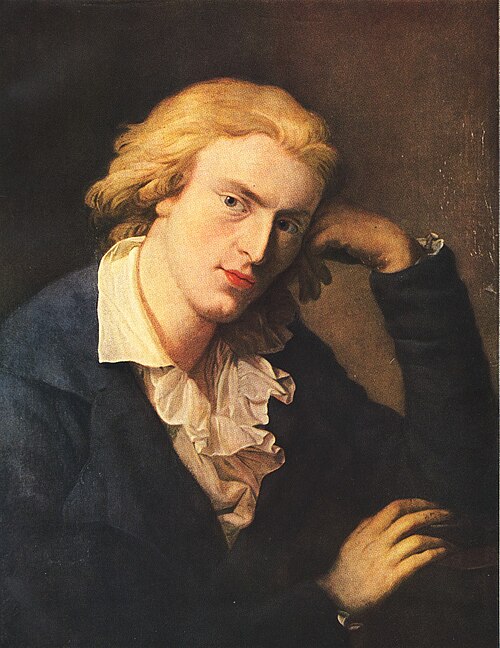
Image: Anton Graff’s portrait of Schiller, begun 1786 and completed 1791. Public-domain painting and faithful reproduction.

Anton Graff / Wikimedia Commons; Public domain. Image record, Public domain.
The round picture in the lists of the personalities is cropped from it.