




9 min read
Great Novelist
Fyodor Dostoevsky
author: High Priest Zevios Metathronos
The Difficult Work of Renewal
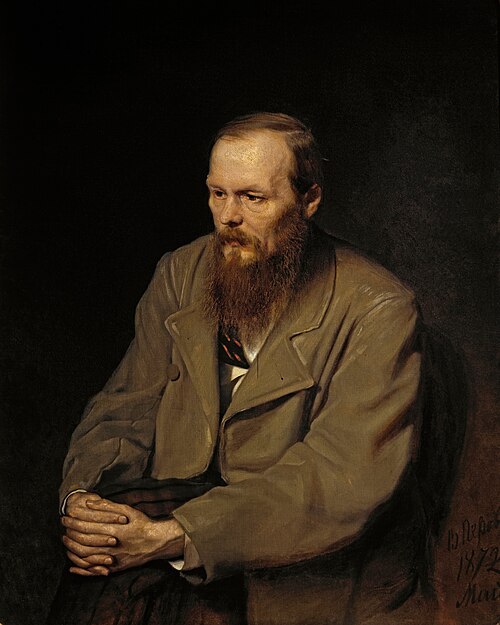
Dates: 11 November 1821–9 February 1881, Gregorian dates
Period: Imperial (1804–1900)
Fyodor Dostoevsky was a Russian novelist who stood on a scaffold at 28 waiting to be executed, spent 4 years in a Siberian prison camp and came back to write Crime and Punishment and The Brothers Karamazov.1
His greatest attainment is a kind of novel in which a theory is tested by what it does to the person who holds it. Britannica sums up the first of the great ones in a line: a poor former student whose “theory that humanitarian ends justify evil means leads him to murder.”2
Dostoevsky was a Christian believer, and his novels argue from that faith. Zevism reads them through its own doctrine of the Good, which demands right order and right act together, and through the figure of the Creator who builds where others only complain.
LIFE AND CONTEXT
He was born in Moscow on 30 October 1821 by the Russian calendar, the 2nd son of Mikhail Andreevich Dostoevsky, a staff doctor at the Mariinsky Hospital for the Poor, and Maria Fyodorovna, born Nechaeva. The birth took place on Novaya Bozhedomka street.3
Poor Folk made his name. It came out in the Petersburg Miscellany in January 1846, with “extraordinary success” in the museum's words, and both Nikolai Nekrasov and Vissarion Belinsky praised it.4
Then came the Petrashevsky circle. On 15 April 1849 its members read Belinsky's banned letter to Gogol, which passed from hand to hand in copies. On 23 April Dostoevsky and others of the circle were arrested and locked in the Alekseevsky ravelin of the Peter and Paul Fortress.5
He served his sentence at Omsk from 23 January 1850 to 23 January 1854. On 2 March 1854 he was enrolled as a private in the 7th Siberian Line Battalion at Semipalatinsk. On 6 February 1857 he married Maria Isaeva at Kuznetsk. His rights, including his nobility, came back by decree on 17 April 1857, and after his discharge for illness he reached St Petersburg in December 1859.6
The great books followed. Notes from the Underground appeared in 1864 and Crime and Punishment in 1866, the year he also dictated The Gambler. His final novel, The Brothers Karamazov, came out in 1879–80.7
In June 1880 he took part in the festival for Pushkin and on 6 June attended the unveiling of the poet's monument. He died in St Petersburg on 9 February 1881, at 8:36 in the evening, aged 59.8
ATTAINMENTS
- Poor Folk (1846) won him fame at 24 and the praise of Nekrasov and Belinsky.4
- He turned 4 years at Omsk into The House of the Dead. As its Everyman introducer put it: “Out of that terror, which turned youth grey, was distilled the terrible reality of The House of the Dead.”9
- In Notes from the Underground (1864) he wrote the monologue of a man who rejects calculation, against the idea that human beings are something like “a piano-key or the stop of an organ.”10
- Crime and Punishment (1866) follows Raskolnikov from his theory of the extraordinary man, questioned by the investigator Porfiry, to Sonia's reading of the raising of Lazarus and a new life begun in Siberia.11
- He dictated The Gambler (1866) to a stenographer and “finished just on time.”12
- The Brothers Karamazov (1879–80), the story of Fyodor Karamazov and his sons Alyosha, Dmitry and Ivan, sets Ivan's rejection of God against the elder Zosima's teaching of active love.13
KEY STORIES
The Scaffold on Semyonovsky Square
On 22 December 1849, by the Russian calendar, 21 members of the Petrashevsky circle were led out onto a scaffold on the Semyonovsky parade ground in St Petersburg. The sentence was read out to them, and it was death.14
Then they waited for it to be carried out. The museum's chronology records the waiting as its own event, between the sentence and what came next: the death penalty was replaced by 4 years of hard labour followed by service as a common soldier. Dostoevsky was 28.15
On 25 December, Christmas Day, he left the Peter and Paul Fortress in fetters for Omsk. At Tobolsk in January 1850 the prisoners met the wives of the Decembrists, and the women gave each of them a copy of the Gospels. On 23 January he entered the Omsk prison. It was the same book from which his Sonia would later read the raising of Lazarus to a murderer.16
A Man Who Won't Be a Piano Key
Notes from the Underground opens with a voice that won't be liked: “I am a sick man.... I am a spiteful man. I am an unattractive man.” A footnote warns that “the author of the diary and the diary itself are, of course, imaginary.”17
The narrator has shut himself away and argues against anyone who'd reduce life to reason. If his whole life could be calculated in advance, he says, a man would have to admit that he's “something of the nature of a piano-key or the stop of an organ.” He'd rather defy it. “I admit that twice two makes four is an excellent thing, but if we are to give everything its due, twice two makes five is sometimes a very charming thing too.”18
What he values above every calculated benefit is “one's own free unfettered choice, one's own caprice.” Britannica describes him as “profoundly alienated from life, entombed in his room.”19
The Rehearsal
Crime and Punishment opens on the street. “On an exceptionally hot evening early in July a young man came out of the garret in which he lodged in S. Place and walked slowly, as though in hesitation, towards K. bridge.” He'd counted the way to his destination: “exactly seven hundred and thirty” steps from the gate.20
The young man was Raskolnikov, a former student, and he tried to talk himself out of it as he walked. “Is that serious? It is not serious at all. It's simply a fantasy to amuse myself; a plaything!” Yet “he was positively going now for a 'rehearsal' of his project, and at every step his excitement grew more and more violent.”21
The door opened on “a diminutive, withered up old woman of sixty, with sharp malignant eyes and a sharp little nose.” He offered her a pledge and asked, “Give me four roubles for it, I shall redeem it, it was my father's.” Back in the street he cried out, “Oh, God, how loathsome it all is!” The rehearsal ended in murder, and the rest of the book follows what the deed does to the man who did it.22
The Stenographer
In the autumn of 1866 Dostoevsky had a novel to deliver by a fixed date. On 4 October he met Anna Grigoryevna Snitkina, a stenographer, and the same day they began work on The Gambler.23
He dictated; she took it down. The book drew on his own compulsive gambling and on his stormy relationship with Appolinariya Suslova, and Britannica says he “finished just on time.” On 8 November he asked Anna to marry him, and she said yes.24
They married on 15 February 1867, and on 14 April they left Russia and lived abroad for over 4 years. “She at last put his life and finances in order,” Britannica notes.25
THE ZEVIST READING
Raskolnikov's theory is a lesson in the doctrine of the Good. Zevism defines the Good as the conjunction of Ma'at, the right order of things, and Right, the right act from the right will. A good end pursued by murder fails the test at once, and so does the claim that an extraordinary person stands outside the order that binds everyone else. Egyptian religion set Ma'at, “truth, justice, and the cosmic order,” against isfet.26 The novel shows the Izfet a theory like that lets loose, first in a murder, then inside the man who committed it.
The underground man is the andrapod drawn from life. Zevism describes the andrapod as the one who lives among ruins and answers them with complaint, attack and nostalgia, and this narrator has made a home of his spite. Dostoevsky knew ruins better than most: a death sentence, 4 years in fetters, then years as a private at Semipalatinsk. He answered as a Creator, with book after book.
The doctrine of Light and Darkness fits the whole work. Unexplored darkness isn't evil; it's what one walks into with light, and Dostoevsky walked into the darkest rooms of the mind, murder, spite and despair, and wrote down what he saw there. Explored darkness becomes knowledge.
Zevism sets the end of the path in Plato's formula, ὁμοίωσις θεῷ κατὰ τὸ δυνατόν, becoming like the divine as far as possible.27 Dostoevsky's own hope was Christian. The epilogue of Crime and Punishment still states a law the Temple shares. Its narrator presents Raskolnikov's regeneration as a new process just beginning, one that will still need effort, and Zevism holds the same of every elevation of human nature.28
NOTES
1 Literary and Memorial Museum of F. M. Dostoevsky, Semey, “Биография писателя”; Britannica, “Fyodor Dostoyevsky”.
2 Britannica, “Crime and Punishment”.
3 Dostoevsky Museum, Semey, chronology for 1821.
6 Dostoevsky Museum, 1850–1859.
7 Britannica, “Notes from the Underground”; Britannica, “The Brothers Karamazov”.
8 Dostoevsky Museum, 1880–1881; Britannica, “Fyodor Dostoyevsky”.
9 Bramont, introduction to The House of the Dead.
10 Britannica; Notes from the Underground, Part 1, tr. Garnett.
11 Crime and Punishment, 3.5, 4.4, Epilogue 2, tr. Garnett.
13 Britannica; The Brothers Karamazov, 2.4, tr. Garnett.
14 Dostoevsky Museum, 22 December 1849.
16 Dostoevsky Museum, 1849–1850; Crime and Punishment, 4.4.
17 Notes from the Underground, Part 1, tr. Garnett.
18 Notes from the Underground, Part 1.
19 Britannica, “Notes from the Underground”.
20 Crime and Punishment, 1.1, tr. Garnett.
22 Crime and Punishment, 1.1; Britannica, “Crime and Punishment”.
24 Britannica, “The Gambler”; Dostoevsky Museum, 1866.
25 Dostoevsky Museum, 1867; Britannica, “The Gambler”.
28 Crime and Punishment, Epilogue 2.
BIBLIOGRAPHY
Literary and Memorial Museum of F. M. Dostoevsky, Semey, “Биография писателя”: chronology entries for 1821, 1846, 1849, 1850, 1854, 1857, 1859, 1866, 1867, 1880 and 1881.
Encyclopaedia Britannica, “Fyodor Dostoyevsky”: death in St Petersburg, 9 February 1881, aged 59.
Encyclopaedia Britannica, “Crime and Punishment”, “Notes from the Underground”, “The Brothers Karamazov” and “The Gambler”: dates of publication and summaries.
Fyodor Dostoevsky, Notes from the Underground, translated by Constance Garnett, Project Gutenberg; Part 1.
Fyodor Dostoevsky, Crime and Punishment, translated by Constance Garnett, Project Gutenberg; 1.1, 3.5, 4.4, Epilogue 2.
Fyodor Dostoevsky, The Brothers Karamazov, translated by Constance Garnett, Project Gutenberg; book 2, chapter 4, “A Lady of Little Faith.”
Julius Bramont, introduction to The House of the Dead, Everyman's Library, 1911, Project Gutenberg.
Encyclopaedia Britannica, “Maat”.
Plato, Theaetetus 176a–b, Greek text, Perseus Digital Library.
CREDIT
Picture: Fyodor Dostoevsky, painted by Vasily Perov in 1872. State Tretyakov Gallery, Moscow.
Vasily Perov (1834–1882); State Tretyakov Gallery / Google Art Project / Wikimedia Commons; Public domain. Image record, Public domain.

The round picture in the lists of the personalities is cropped from it.