




9 min read
Prince of Physicians
Galen
author: High Priest Zevios Metathronos
Healing, Reason, and the Discipline of the Soul
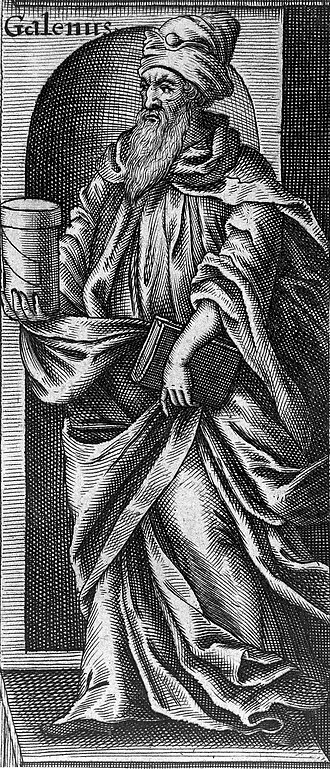
Dates: 129–c. 216 CE
Period: Roman period
Galen of Pergamum began his career as surgeon to the gladiators of his home city and ended it as physician to the emperor Marcus Aurelius and his son Commodus. No author of antiquity wrote more. His surviving Greek fills 22 large volumes, and his medicine remained the authoritative model up to the 17th century.1
His method set the knife beside the argument. When a rival account brought urine to the bladder without the work of the kidneys and ureters, Galen answered with anatomical demonstrations of the urinary pathway. He also held that the best doctor had to be a philosopher, trained in logic, in the study of nature and in ethics.2
Pergamum was famous for its statue of Asclepius, and “Throughout Galen's life, he avowed a devotion to Asclepius.” Zevism receives his medicine as service to Asclepius and Apollo, and as the restoration of Ma'at in the bodies he treated.3
LIFE AND CONTEXT
Galen was born in 129 at Pergamum in Mysia, a city whose library “almost rivaled Alexandria's in its size.” His father, Nicon, was a prosperous architect. The Byzantine lexicon Suda calls Nicon “a geometer and architect.”4
Nicon directed the boy's education himself. Galen studied mathematics, a particular favourite of his father's, along with grammar, logic and philosophy in all 4 schools of the day: Platonist, Peripatetic, Stoic and Epicurean. Around the age of 16 the plan changed. Galen told how dreams instructed his father to set him on medicine, and Aileen Das identifies the God of those dreams as Asclepius.5
He studied at Smyrna and Corinth under a Rationalist and an Empiricist teacher. After his father died he went on to Alexandria and stayed perhaps 5 years, from 152 to 157. Years later he told students to “look at the human skeleton with your own eyes,” adding, “This is very easy in Alexandria.” His own anatomy rested on the dissection of animals, monkeys among them.6
In 157 he came home to become surgeon to the gladiators. Civil unrest broke out in 162 and he left for Rome, where he found a medical community the Internet Encyclopedia of Philosophy calls “competitive and corrupt.” His success made powerful enemies, and in 166 he left the city in secret. Brock's older account dates the flight to 168 and says Galen went “hurriedly and secretly.”7
He didn't stay away long. Marcus Aurelius and Lucius Verus recalled him to serve the army in their war against the Germans, and when plague struck Rome he became personal physician to Marcus and to Commodus. In Brock's words, “the Emperor gave him permission to remain at home, entrusting to his care the young prince Commodus.”8
The date of his death is disputed. The Suda says he lived under Marcus, Commodus and Pertinax and “died aged 70.” Vivian Nutton, working from Byzantine and Arabic writers, puts his death around 216, in the reign of Caracalla, perhaps at 87.9
ATTAINMENTS
- He was antiquity's most voluminous author. His surviving Greek fills 22 large volumes, the Kühn edition runs to more than 20,000 pages, and further works survive only in Arabic translation.10
- He wrote 23 treatises on moral philosophy, a body of practical ethics composed by a working physician.11
- In On the Natural Faculties 1.13 he refuted an account that brought urine to the bladder without the kidneys and ureters, using demonstrations of the urinary pathway in place of eloquence.12
- He built his anatomy on dissection, working comparatively on monkeys, and sent students to see the human skeleton for themselves.3
- In That the Best Doctor Is Also a Philosopher he required of the physician logic, knowledge of nature and ethics, and set the patient's welfare above the gathering of wealth.13
- He held posts from surgeon to the gladiators at Pergamum in 157 to personal physician of Marcus Aurelius and Commodus.3
- He made Hippocrates the authority of his medicine. “Greatest,” he said, “is the Physis, and Hippocrates is its prophet.”14
KEY STORIES
A Quiet Name in a Loud House
Galen described his parents in a passage Brock translated in 1916. “I had the great good fortune,” he wrote, “to have as a father a highly amiable, just, good, and benevolent man.” His mother “possessed a very bad temper; she used sometimes to bite her serving-maids, and she was perpetually shouting at my father and quarrelling with him.” Her quarrels with Nicon were, he said, “worse than Xanthippe with Socrates.”15
The name Nicon gave his son reads like a wish for that house. The Suda notes that the adjective galenos “also means ‘peaceful’.”16
When Galen was about 16, Nicon turned him to medicine on the strength of his dreams.3 The father's lessons outlived him. Sophia Xenophontos traces to them Galen's rule that “one should not be distressed by any material loss provided that what remains is adequate for the care of one's body.” She adds that “his father's indifference to worldly pleasures set an example that led him to scorn fame, wealth and social standing.”17
Hermes Against Fortune
Galen's Exhortation to the Study of Medicine sets out its case with 2 pictures. “The ancients, Galen tells us, depicted Tychē as a woman with a rudder in her hands, a spherical support for her feet and with no eyes,” Xenophontos writes of its 2nd chapter. Fortune's followers, in her summary of chapter 4, are “a whole band of demagogues, courtesans, betrayers of friends, desecrators of graves and even murderers.”18
Against her Galen set Hermes. The God's company is made up of “geometers, mathematicians, philosophers, doctors and scholars alongside architects, grammarians,” and at its head “Socrates, Homer, Hippocrates and Plato.” Hermes weighs no one by “political reputation, nobility or wealth”; he asks whether a man leads a good life.19
Later chapters take on athletics. The best men, Galen argued, earn the praise of the Gods for their arts, and Apollo had praised Socrates, Lycurgus and Archilochus. Then he let a God close the case: “If you do not wish to listen to me, at least have some respect for the Pythian Apollo.”20 A physician of Pergamum gave the arts to Hermes and called Apollo as his witness, and that's a link Zevism recognises in its own chain.
The Fire of 192
In 192 a great fire swept the Palatine Hill in Rome. Most people stored their possessions in the Temple of Peace, and Galen had stored all his valuables in repositories to keep them safe. When he came to them, everything had been destroyed. Every library on the Palatine burned that day.17
Xenophontos lists the loss as Galen gives it: “many gold and silver plates, but also his drugs (both simple and compound) as well as his medical instruments; then, the editions of ancient authors he had prepared and his own compositions; finally and most importantly, a rare collection of antidotes.” Some of the books were “rare works of limited circulation that had also now disappeared for ever.” The grammarian Philides lost his books in the same fire and died of depression.21
A friend wrote, astonished at his calm, and asked how he'd kept it. Avoiding Distress is the answer: what remains is enough if it keeps one “from hunger, cold or thirst.” Galen left a harder account too. In the Therapeutic Method he admits he'd been distressed for a long time, so badly that he couldn't touch a book.17
THE ZEVIST READING
Galen's medicine belongs to the Gods of healing by his own profession. He avowed devotion to Asclepius all his life, in a city famous for the God's statue. The oath of his tradition opens: “I swear by Apollo the physician, and Asclepius, and Hygieia and Panacea and all the gods.”22 When he called Hippocrates the prophet of Physis, he named the power that forms and repairs the body. Zevism reads that power as part of the divine order a physician learns to follow.
The Exhortation puts Galen inside the chain Zevism traces from the first worship to today. He set the arts under Hermes, the God of speech and exchange, and ranged Fortune's rabble against them. He called Pythian Apollo to witness, and by his own telling his vocation began with dreams sent to his father. The Temple honours him as a keeper of the source as well: he prepared editions of ancient authors, and his own works reached later ages partly through Arabic translators.
Disease is Izfet, dissolution working inside a living body, and fire is Izfet in a city. Ma'at is the order that Zeus holds as Sovereign of the Cosmos, “the personification of truth, justice, and the cosmic order.”23 A demonstration of the ureters is a true record set against a clever false one, and so it's Ma'at in anatomy. The fire of 192 tested whether that order lived only in his storerooms.
His answer there belongs to the Ethics dimension of the path, Φρόνησις governing loss: measure what the body needs and let the surplus go. The 2nd account, the long time when he couldn't touch a book, keeps the record honest. That the Best Doctor Is Also a Philosopher asks for logic, nature and ethics in 1 person. In Zevist terms that's ὁμοίωσις θεῷ κατὰ τὸ δυνατόν, likeness to the divine as far as possible, practised at the bedside.24
NOTES
1 Xenophontos, Medicine and Practical Ethics in Galen, introduction; Boylan, “Galen,” Internet Encyclopedia of Philosophy.
2 Galen, On the Natural Faculties 1.13, tr. A. J. Brock; Das, introduction to Galen's Humanistic Medicine, pp. 3–4.
3 Boylan, IEP.
4 Nutton, “Galen,” Britannica; Boylan, IEP; Suda γ 32, tr. Malcolm Heath.
5 Boylan, IEP; Das, introduction, pp. 5–7.
6 Boylan, IEP, quoting Kühn 2.220, tr. L. Edelstein.
7 Boylan, IEP; Brock, introduction to On the Natural Faculties, p. xvii.
8 Boylan, IEP; Brock, p. xviii.
9 Suda γ 32; Boylan, IEP.
10 Xenophontos, introduction; Boylan, IEP.
12 Galen, On the Natural Faculties 1.13.
13 Das, introduction, pp. 3–4.
14 Brock, introduction, p. xxvi.
15 Brock, introduction, p. xvi.
16 Suda γ 32.
17 Xenophontos, “Avoiding Distress”.
18 Xenophontos, “Exhortation to the Study of Medicine”.
19 Xenophontos, on Protrepticus 5.
20 Protrepticus 9, quoted by Xenophontos.
21 Xenophontos, Avoiding Distress 1–3.
22 Boylan, IEP; NLM, Hippocratic Oath, tr. Michael North.
BIBLIOGRAPHY
Vivian Nutton, “Galen”, Encyclopaedia Britannica; birth in 129 at Pergamum, death c. 216.
Michael Boylan, “Galen”, Internet Encyclopedia of Philosophy; life section: Nicon, education, Smyrna, Corinth, Alexandria 152–157, gladiators 157, Rome 162–166, recall, Asclepius, Nutton's dating, Kühn edition.
Suda γ 32, “Galenos”, tr. Malcolm Heath, Suda On Line, 22 June 2000.
Aileen R. Das, “Introduction: The Best Doctor-Philosopher,” in Das, ed., Galen's Humanistic Medicine, SAPERE 43, Mohr Siebeck, 2023, pp. 3–7 of the publisher's preview.
Galen, On the Natural Faculties, book 1, chapter 13, tr. Arthur John Brock, 1916, Internet Classics Archive.
Arthur John Brock, introduction to Galen On the Natural Faculties, Loeb Classical Library, London, Heinemann, 1916, pp. xvi–xxvi, Internet Archive.
Sophia Xenophontos, Medicine and Practical Ethics in Galen, Cambridge University Press, 2023, open access: introduction; chapter 4, “Avoiding Distress”; chapter 5, “Exhortation to the Study of Medicine”.
US National Library of Medicine, “Greek Medicine,” including “The Hippocratic Oath”, tr. Michael North, 2002.
Encyclopaedia Britannica, “Maat”.
Plato, Theaetetus 176a–b, Greek text, Perseus Digital Library.
CREDIT
Picture: Galen holding a book and an ointment jar, anonymous seventeenth-century engraving. This is a later imagined likeness.
Wellcome Collection, L0012416; via Wikimedia Commons. Image record, CC BY 4.0.

The round picture in the lists of the personalities is cropped from it.