



10 min read
Starry Messenger
Galileo Galilei
author: High Priest Zevios Metathronos
Dates: 1564–1642
Period: Renaissance (1336–1650 CE)
Galileo Galilei was a mathematician from Pisa who took a Dutch novelty, the spyglass, and within a few months made it strong enough to find 4 moons circling Jupiter. He also timed a bronze ball rolling down a groove and proved that a falling body covers distances in proportion to the square of the time.1
His short book of March 1610 called itself the Sidereus Nuncius, the starry messenger, and within 3 months it had won him a post at the Medici court.2
Zevism reads his life as a walk into darkness with a lamp. The night sky he searched was unexplored, and what he brought back from it became light: knowledge any person with a lens and a clock could test again.
LIFE AND CONTEXT
Galileo was born in Pisa on 15 February 1564. His father Vincenzo, born in Florence in 1520, taught music and played the lute. In 1581 Vincenzo sent him to the University of Pisa to study medicine. By 1585 he'd given up the course and left without a degree; his mathematics teacher there had been Filippo Fantoni.3
He took Fantoni's chair of mathematics at Pisa in 1589. In 1592 the University of Padua, the university of the Venetian Republic, hired him at 3 times his Pisan salary, and he gave his inaugural lecture on 7 December 1592. He stayed 18 years. Around 1601 he found that a pendulum's period depends only on the length of its cord.4
The telescope changed his life in a single year. In June 1610 he resigned at Padua and moved to Florence as “Mathematician and Philosopher” to the Grand Duke of Tuscany, with no teaching duties. That same year he saw that Venus shows phases like the Moon, so it must circle the Sun. He wrote on sunspots in 1612 and more fully in the Letters on the Sunspots of 1613.5
Copernicus's moving Earth brought him into conflict with the Church. Galileo was a Catholic and argued from inside it: his Letter to the Grand Duchess Christina of 1615 held that Scripture and nature can't contradict each other. In 1616 Cardinal Bellarmine told him not to “defend or hold” the Copernican doctrine.6
His old supporter Maffeo Barberini became Pope Urban VIII in 1623. In February 1632 Galileo published the Dialogue Concerning the Two Chief World Systems, which favours Copernicus though it never says so outright, and puts the Aristotelian case in the mouth of a character called Simplicio. The Inquisition banned its sale soon after publication. He was summoned to Rome, tried in 1633 and confined for the rest of his life. He died at Arcetri, outside Florence, on 8 January 1642.7
ATTAINMENTS
- He turned the spyglass into a research instrument. His first one, made in June or July 1609, magnified 3 times; by October or November he'd pointed a 20-power telescope at the sky.8
- A surviving telescope of late 1609 or early 1610, 927 mm long, wood covered in tooled leather, magnifies 21 times with a field of 15 minutes of arc. It's in the Museo Galileo in Florence, inventory 2428.9
- The Sidereus Nuncius (Starry Messenger), off the press in Venice in mid-March 1610, reported a Moon “full of inequalities, uneven, full of hollows and protuberances, just like the surface of the Earth itself.”10
- The same book counted “more than five hundred new stars” within 1 or 2 degrees in Orion, and he drew 80 of them around the Belt and Sword.10
- He discovered the 4 large moons of Jupiter in January 1610 and the phases of Venus later that year.2
- He stated the law of free fall: “a body in free fall from rest traverses a distance proportional to the square of the time elapsed.” It appeared in Two New Sciences, printed by the Elzeviers at Leiden in 1638.11
- He held the Padua chair for 18 years, and in 1609 the Venetian Senate made it his for life at 1,000 florins a year.12
KEY STORIES
The Bell Tower of San Marco
In May 1609 Paolo Sarpi wrote to Galileo about a spyglass a Dutchman had shown in Venice.5 A letter from Jacques Badovere in Paris confirmed the report. Galileo didn't wait to see the thing. He made his own “through deep study of the theory of Refraction,” and he described the result: “I prepared a tube, at first of lead, in the ends of which I fitted two glass lenses, both plane on one side, but on the other side one spherically convex, and the other concave.”10
Objects in that first instrument looked “one-third of the distance off.” He learned to grind and polish his own lenses, and by August he had one of 8 powers.13 On 21 August 1609 he carried it up the bell tower of San Marco and showed it to the Doge and the notables of Venice.
The Senate confirmed him in the Padua chair for life at 1,000 florins a year. In return Galileo gave the Senate the sole right to manufacture telescopes.14 He kept grinding. “At length, by sparing neither labour nor expense,” he made an instrument that showed objects “more than thirty times nearer than if viewed by the natural powers of sight alone.”15
Four Lights Beside Jupiter
On 7 January 1610, “at the first hour of the night,” Galileo turned the telescope on Jupiter and saw “three little stars” beside it. He took them for fixed stars. “But when, on the eighth, I returned to the same observation, guided by I know not what fate, I found a very different arrangement.”16
On the 9th “the sky was every-where covered with clouds.” On the 10th, “Only two stars were near him, both to the east.” Fixed stars don't jump from side to side. By the 11th he had reached “the conclusion, entirely beyond doubt, that in the heavens there are three stars wandering around Jupiter like Venus and Mercury around the Sun.” On the 13th, “for the first time four little stars were seen by me.”17
He asked the Medici whether they'd rather have the moons called “Cosmic Stars” after Grand Duke Cosimo II or “Medicean Stars”; they chose the 2nd.18 Galileo gave Cosimo the objective lens of the telescope that made the discovery. It later cracked, and it still sits in Florence in an ivory and ebony frame made by Vittorio Crosten in 1677.19
The Ball in the Groove
The law of fall came out of a wooden plank. Two New Sciences describes it: “A piece of wooden moulding or scantling, about 12 cubits long, half a cubit wide and three finger-breadths thick, was taken; on its edge was cut a channel a little more than one finger in breadth.” The groove was lined with parchment, “and we rolled along it a hard, smooth, and very round bronze ball.”20
He timed the runs with water. A thin jet ran from a raised vessel into a glass during each descent, and the water “was weighed, after each descent, on a very accurate balance.” The runs agreed to within “one-tenth of a pulse-beat.”21
The result held “in such experiments, repeated a full hundred times”: “the spaces traversed were to each other as the squares of the times, and this was true for all inclinations of the plane.” A ball that rolls 1 unit in 1 beat rolls 4 in 2 beats and 9 in 3.22
Kneeling at the Minerva
On 22 June 1633, in the convent of the Minerva in Rome, Galileo knelt before the cardinals of the Inquisition. “I, Galileo, son of the late Vincenzo Galilei, Florentine, aged seventy years, arraigned personally before this tribunal,” he began. Then: “With sincere heart and unfeigned faith I abjure, curse, and detest the aforesaid errors and heresies.”23
The court had found him guilty of “vehement suspicion of heresy.” His prison sentence became house arrest, first in the residence of the Archbishop of Siena and, from December 1633, at his villa in Arcetri.24
He went back to the physics of his Padua years. The finished Two New Sciences was smuggled out of Italy and printed at Leiden in 1638.5 The Dialogue was banned, but the law of the rolling ball left the house at Arcetri and reached the printers.
THE ZEVIST READING
Zevism teaches that unexplored darkness isn't evil. It's the ground one enters carrying a light, and darkness explored becomes Light: knowledge, and in time wisdom. Galileo's winter nights of 1609 and 1610 are that teaching in its plainest form. The dark around Jupiter had held 4 moons since the beginning of the world. He went into it with a tube and 2 lenses and came back with a record that others could check the following night.
Plato gives the arts Galileo practised to an Egyptian God. Theuth, says Socrates, “invented numbers and arithmetic and geometry and astronomy, also draughts and dice, and, most important of all, letters.”25 Galileo joined all 4 of the first arts in 1 practice. He ground lenses to see farther and weighed water to count time, and then wrote the result in letters that anyone could read.
Measurement also restores Ma'at, the order of the cosmos held by Zeus as its Sovereign. A heaven declared perfect by assertion and a heaven measured night after night are different kinds of order, and only the 2nd can be corrected when it's wrong. Galileo's nightly sketches of the points beside Jupiter corrected the older picture within a week.
He lived and died a Catholic, and the Temple leaves his faith as he held it. Its reading concerns the work. The aim of the Zevist path is ὁμοίωσις θεῷ κατὰ τὸ δυνατόν, likeness to the divine “as far as possible.”26 An old man under house arrest who finished his book on motion and sent it abroad had used his capacity to its limit.
NOTES
2 Van Helden, “Satellites of Jupiter”; MacTutor.
3 MacTutor, “Galileo Galilei”.
5 MacTutor.
6 SEP, §§2, 5.
8 Van Helden, “The Telescope”.
9 Museo Galileo, “Galileo's telescope”.
10 Galileo, Sidereal Messenger, tr. Carlos.
11 SEP, §3.1.
12 Museo Galileo, “From the Workshop to the Stars”.
13 Van Helden, “The Telescope”; MacTutor.
14 Museo Galileo; MacTutor.
15 Sidereal Messenger, tr. Carlos.
16 Galileo, Starry Messenger, tr. Van Helden, pp. 64–65.
17 Starry Messenger, pp. 65–68.
18 Van Helden, “Satellites of Jupiter”.
19 Museo Galileo, “Galileo's objective lens,” inv. 2429.
20 Rice Galileo Project, “Inclined Plane”.
21 Galileo, Two New Sciences, tr. Crew and de Salvio, p. 179.
23 Recantation, tr. de Santillana, Famous Trials.
24 SEP, §5.
25 Plato, Phaedrus 274c–d, tr. Fowler.
BIBLIOGRAPHY
Galileo Galilei, Starry Messenger, translated by Albert Van Helden (University of Chicago Press, 1989), excerpt; pp. 64–68, observations of 7 to 13 January 1610.
Galileo Galilei, The Sidereal Messenger, translated by Edward Stafford Carlos (London: Rivingtons, 1880), Project Gutenberg; the making of the telescope, the Moon, Orion and the naming of the Medicean Stars.
Galileo Galilei, Dialogues Concerning Two New Sciences, translated by Henry Crew and Alfonso de Salvio (New York: Macmillan, 1914), Internet Archive; Third Day, pp. 178–179.
Rice University Galileo Project, “Inclined Plane”, 1995, quoting Galileo's apparatus description from Two New Sciences. The historical account, not the students' results, is used here.
Albert Van Helden, Galileo Project, Rice University, “The Telescope” and “Satellites of Jupiter”, 1995.
Museo Galileo, Florence, object records “Galileo's telescope,” inv. 2428 and “Galileo's objective lens,” inv. 2429; exhibition text “Galileo's Telescope: From the Workshop to the Stars”.
Galileo Galilei, recantation of 22 June 1633, translated in Giorgio de Santillana, The Crime of Galileo (University of Chicago Press, 1955), pp. 312–313; Douglas O. Linder, Famous Trials.
David Marshall Miller (originally Peter Machamer), “Galileo Galilei”, Stanford Encyclopedia of Philosophy, revision of 2025; §§2, 3.1, 3.2 and 5.
J. J. O'Connor and E. F. Robertson, “Galileo Galilei”, MacTutor History of Mathematics, University of St Andrews; chronology, appointments, salary, telescope and trial.
Plato, Phaedrus 274c–275b, translated by Harold N. Fowler, Perseus Digital Library.
Plato, Theaetetus 176a–b, Greek text, Perseus Digital Library.
CREDIT
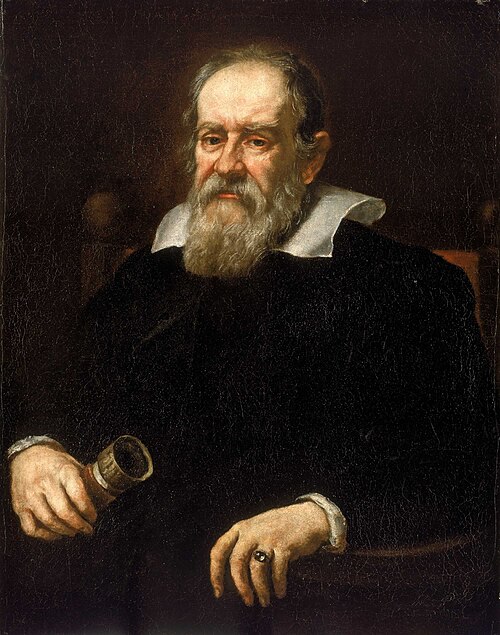
Image: Portrait of Galileo by Justus Sustermans, between 1636 and 1640, National Maritime Museum, BHC2700; public-domain artwork and faithful reproduction.

Justus Sustermans; Wikimedia Commons; Public domain; faithful reproduction of a public-domain artwork. Image record, Public domain; faithful reproduction of a public-domain artwork.
The round picture in the lists of the personalities is cropped from it.