





2 min read
Philosopher of Brahman
Gārgī Vācaknavī
author: High Priest Zevios Metathronos
The philosopher who questions the foundation of the world
Dates: early Upanishadic tradition, first millennium BCE
Period: Ancient (6000–500 BCE)
Region: Vedic India
Tradition: philosopher of Brahman
Religion or tradition: Vedic / early Upanishadic Brahmanical tradition; philosophical inquiry into Brahman and the imperishable.
Heresy status: No designation documented.
Gārgī Vācaknavī appears in the Bṛhadāraṇyaka Upaniṣad as a formidable participant in inquiry into ultimate reality. Her questions to Yājñavalkya are part of the text’s philosophical action. They display a mind that follows an explanation to its foundation and then asks what supports that foundation. Bṛhadāraṇyaka 3.6 and 3.8.
ADVANCING UNDERSTANDING THROUGH EXACT QUESTIONS
Gārgī’s questions make the Upanishadic discussion proceed towards its foundation. After receiving an explanation of what supports the world, she asks what supports that support. The second question requires the dialogue to move further, towards the account of the imperishable. Her subsequent assessment of the answer is also part of the philosophical encounter.1
Her positive contribution is therefore an act of intellectual work preserved within sacred literature. Human understanding advances because she asks precisely and follows the implications of a reply. Inquiry into divine reality gains depth through that insistence. For Zevist readers, she offers a strong model of trained attention and courageous participation: the student helps the whole discussion by identifying the question that still needs an answer.
QUESTIONS WITH THE FORCE OF ARROWS
In 3.8, Gārgī announces two questions with the image of a warrior taking up two arrows. She asks about the support of the world across past, present and future. After the first answer, she asks what supports the supporting medium itself. The exchange leads to Yājñavalkya’s account of the imperishable, akṣara.2
The text gives her a further act of judgment: she recognizes the strength of the answer and addresses the other learned participants about it. Her role includes both challenge and assessment. The philosophical encounter depends upon the quality of her questions.
The surviving evidence presents Gārgī through a literary and religious dialogue. It supports her standing as an exemplary ancient thinker within the tradition without supplying a complete independently dated life.
A ZEVIST INTERPRETATION
Gārgī exemplifies intellectual courage joined to concentration. A serious question has a definite object, and a further question follows when the answer leaves a deeper issue unresolved. Such inquiry requires preparation and the ability to hold a line of thought.
Her example fits a spiritual education in which study repeatedly returns at a higher level. The student learns enough to ask better questions, examines the answer and develops the understanding needed for the next inquiry.
For Zevist readers, her profile also demonstrates that reverence and demanding thought can share the same religious setting. Inquiry into the imperishable is itself a sacred undertaking. Gārgī’s contribution is the disciplined force with which she pursues it.
NOTES
2 3.8.1–11.
PRIMARY SOURCES
Bṛhadāraṇyaka Upaniṣad 3.6 and 3.8, trans. F. Max Müller, Sacred Books of the East 15 (1884).
CREDIT
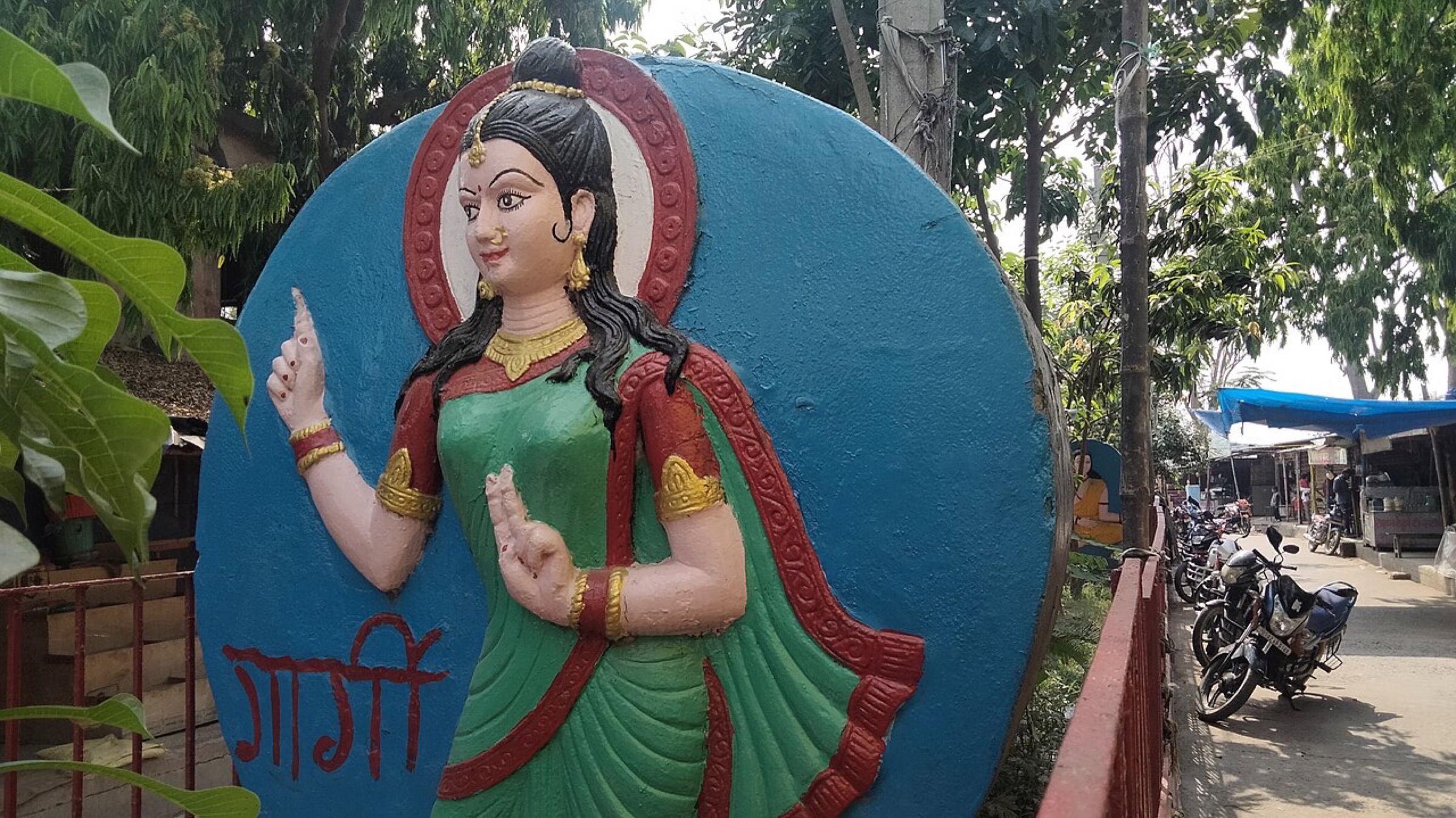
Picture: Commemorative statue. Statue identified as Gārgī in the Uchchaith Bhagawati Mandir complex, photographed by Sntshkumar750 in 2025. A modern commemorative representation, not an ancient likeness.
Credit: Sntshkumar750. Source record, CC BY-SA 4.0.

The round picture in the lists of the personalities is cropped from it.