





9 min read
Master of Simplicity
Ge Hong
author: High Priest Zevios Metathronos
Spiritual Aspiration and the Work of Character
Dates: 283–343 CE.
Period: Roman, the collection's chronological category for 30 BCE–800 CE.
Ge Hong was a Chinese scholar, soldier and Daoist adept of the 4th century CE, whom Britannica calls “perhaps the best-known alchemist” of Chinese Daoism. His Baopuzi, “He Who Holds to Simplicity,” runs to 20 Inner Chapters on the arts of immortality and 50 Outer Chapters on ethics and government.1
He also compiled a handbook of emergency remedies. In 1971 a single sentence from it, on soaking a handful of qinghao in water, showed Tu Youyou how to extract the antimalarial agent in the plant, the work she later presented in her Nobel Lecture on artemisinin.2
Ge Hong was a Daoist, and he sought the immortality his own tradition taught. Zevism reads him as a link in the chain of spirituality, a servant of Asclepius and Hygieia in his medicine and a seeker of the elevation of human nature toward the divine in his alchemy.
LIFE AND CONTEXT
Ge Hong was born in 283 “into a southern magnate family whose native place was the Jurong district in Danyang prefecture.” His grandfather and father had both “served as high ministers for the Wu state.”3 In his youth, Britannica says, “he received a Confucian education.”4
His father died in 296, when he was 13. The family fell into poverty and lost its large library in the fighting of those years, so the boy began to copy books by hand and read everything he could reach. Under Zheng Yin, “both a Confucian classicist and a Daoist adept,” he began to study the arts of immortality. The teaching came down a family line: Zheng Yin had been a disciple of Ge Hong's uncle Ge Xuan (164–244), an adept “reputed to have become an immortal.”3
The empire he grew up in was breaking apart. The Rebellion of the Eight Princes tore through the north and kept him from reaching the capital, Luoyang, in 305. He spent years in the far south at Guangzhou and on Mount Luofu, then went home to Jurong in 314.3
At Jurong he studied with another Daoist master, Bao Qing, a former governor of Nanhai, who “was so impressed that he gave Ge his eldest daughter in marriage.” For his earlier service in war he was given the title Marquis of the Region Within the Pass.3
He didn't fit his times, and he said so. He was “a southerner in an age where only northern émigrés were given posts of substance,” and he couldn't shine in the salons of “Pure Talk,” where men won prestige by abstract debate.3
He wrote widely. Besides the Baopuzi he compiled Biographies of Divine Transcendents and Biographies of Recluses, and he insisted on studying the writings of different schools. His last years were spent on Mount Luofu, where he died in 343.5
ATTAINMENTS
- He wrote the Baopuzi in 2 parts: “The 20 Inner Chapters” on alchemy, with “a recipe for an elixir called gold cinnabar,” and “The 50 Outer Chapters,” which show him “as a Confucian who stresses the importance of ethical principles.”4
- He ranked the elixir above every other method. Breathing exercises and herbs, he wrote, can extend a lifespan “but it will not save you from death,” while “ingesting divine cinnabar will make your lifespan inexhaustible.”6
- He tied immortality to conduct. Seekers “must regard loyalty, filiality, peacefulness, obedience, benevolence and trustworthiness as fundamental,” and needed 300 good deeds to become an earthbound immortal and 1,200 to become a celestial one.7
- He compiled the hagiographies Biographies of Divine Transcendents and Biographies of Recluses.3
- His Handbook of Prescriptions for Emergencies preserved the instruction “A handful of Qinghao immersed in two liters of water, wring out the juice and drink it all,” which guided the qinghao extraction that proved effective against malaria parasites in 1971.2
- He raised and led a militia at 20 that defeated a rebel army in 303, and by 305 held the rank of General Who Makes the Waves Submit.3
KEY STORIES
The Militia of 303
In 303 a rebel army threatened his home district. Ge Hong was 20. Keith Knapp writes that “he was called upon to organize and lead a militia in his native place against a rebel army, which he handily defeated.”3
Promotion followed. By 305 he held the rank of General Who Makes the Waves Submit, and he set off north for the capital, Luoyang. He never got there, and it wasn't for lack of trying. The Rebellion of the Eight Princes “was being fought throughout northern China,” and he turned back and wandered through the south instead.3
A friend then offered him a place. When that friend was named governor of Guangzhou, the port city of the far south, Ge Hong agreed to serve as his military councillor. The patron was killed on his way to take up the post. Ge Hong turned down every other military appointment and stayed 8 years near Guangzhou, living as a recluse on Mount Luofu.3
The Elixir and the Ledger
The Inner Chapters argue that there's a single sure road to deathlessness. “Even if one performs breathing exercises and calisthenics, as well as ingests herbal medicines,” Ge Hong wrote, in Knapp's translation, “this can only extend the years of your lifespan, but it will not save you from death.”6
Cinnabar was different. “Ingesting divine cinnabar will make your lifespan inexhaustible. You will last as long as heaven and earth, be able to travel on clouds and ride dragons, and ascend at will to the Heaven of Highest Clarity.”6
He didn't let anyone skip the moral work. Before the furnace came the ledger. Knapp sums up the rule: a candidate “had to continuously accumulate good deeds: 300 were needed to become an earthbound immortal and 1200 to become a celestial immortal. One mishap and the balance would be canceled.” Above the ledger sat the Director of Fates, who took 3 days from a life for each small wrong and 300 days for each major one.7
Detained at Guangzhou
By 332 Ge Hong was 50, which Knapp calls an “advanced age,” and he wanted ingredients for his elixirs. He “begged to be given a post in northern part of present-day Vietnam.”3
He got as far as Guangzhou. There the governor, Deng Yue, “detained him there indefinitely.” So Ge Hong went back up Mount Luofu, the mountain where he'd lived as a young recluse, and he stayed. He “engaged in immortality practices until his death in 343,” at 60 by the Western count. Britannica records the place of death as Danyang, his birthplace.8
He left behind the 2 halves of his answer to his age. In Knapp's summary, he “used the Daoist Inner Chapters to substantiate the reality of immortality and convey the methods for realizing it, while the Confucian Outer Chapters describe the problems afflicting the secular world and his proposed solutions.”3
A Handful of Qinghao
Tu Youyou's account begins with the National 523 Office, which the Chinese leadership set up in 1967 for malaria control. In 1969 its officials came to the Academy of Traditional Chinese Medicine. The search went badly. “Several thousand compounds were screened between 1967 and 1969 but no useful medicines were found,” she later wrote, and from May 1969 extracts of over 100 herbs gave “few promising results” until June 1971.2
She went back to the old books. “In Ge Hong's A Handbook of Prescriptions for Emergencies (肘后备急方), I noticed one sentence”: “A handful of Qinghao immersed in two liters of water, wring out the juice and drink it all.” The recipe used no heat. That, she wrote, “gave me the idea that heating during extraction might have destroyed the active components.”9
Her team extracted the plant at a lower temperature, with water, ethanol and ethyl ether. On 4 October 1971, sample number 191, an ethyl ether extract of qinghao, “showed 100% effectiveness in inhibiting malaria parasites in rodent malaria.” The line had waited more than 1,600 years. Tu gave her Nobel Lecture on 7 December 2015.10
THE ZEVIST READING
Tu Youyou's discovery is the doctrine of the source in a laboratory. Zevism holds that knowledge evolves in transmission while the source keeps priority, and that one must go back to it. Modern chemistry had screened thousands of compounds and failed. A sentence written by a 4th-century Daoist, read closely, told the chemist what her own method was destroying. Zevism honours Ge Hong as the one who wrote it down and the copyists who carried it as keepers of the source.
His medicine belongs to Asclepius and Hygieia. The Hippocratic Oath opens, “I swear by Apollo the physician, and Asclepius, and Hygieia and Panacea and all the gods.”11 A handbook for emergencies is Hygieia's work. Egyptian religion set Ma'at, “the personification of truth, justice, and the cosmic order,” against isfet.12 Malaria is Izfet in the blood, and the remedy restores Ma'at to the body.
Ethics, Φρόνησις and Justice, is one of the 4 dimensions of the Zevist path, and Ge Hong made it the gate to the others. Loyalty, benevolence and trustworthiness had to be counted deed by deed before any elixir could work. A right act from a corrupt will fails in Zevism, and in Ge Hong's ledger a single wrong cancelled the whole balance.
The aim he pursued was ascent, “to the Heaven of Highest Clarity.” Plato set the aim of human life as likeness to the divine “as far as possible,” ὁμοίωσις θεῷ κατὰ τὸ δυνατόν.13 Zevism reads that phrase as the literal elevation of human nature toward the divine, and Ge Hong's immortal is his tradition's name for the same goal.
NOTES
1 Britannica, “Ge Hong”; Knapp, “Ge Hong,” IEP.
2 Tu Youyou, Nobel biographical statement.
3 Knapp, §1.
4 Britannica.
6 Knapp, §2.
7 Knapp, §3.
8 Knapp, §1; Britannica.
10 Tu, biographical statement; Tu, Nobel Lecture.
11 Hippocratic Oath, tr. North, National Library of Medicine.
BIBLIOGRAPHY
Keith N. Knapp, “Ge Hong (283–343 C.E.)”, Internet Encyclopedia of Philosophy; §1 “The Life of Ge Hong,” §2 “Immortality,” §3 “Reconciliation of Daoism and Confucianism,” §5 “The Importance of Broad Knowledge.”
Encyclopaedia Britannica, “Ge Hong”; dates, the Baopuzi's 20 Inner and 50 Outer Chapters, gold cinnabar.
Tu Youyou, biographical statement, Nobel Prize in Physiology or Medicine 2015, NobelPrize.org; the National 523 Office, Ge Hong's handbook, low-temperature extraction and sample 191.
Tu Youyou, “Discovery of Artemisinin: A Gift from Traditional Chinese Medicine to the World”, Nobel Lecture, 7 December 2015, NobelPrize.org.
Hippocratic Oath, translated by Michael North, “Greek Medicine”, National Library of Medicine, 2002.
Encyclopaedia Britannica, “Maat”.
Plato, Theaetetus 176a–b, Greek text, Perseus Digital Library.
CREDIT
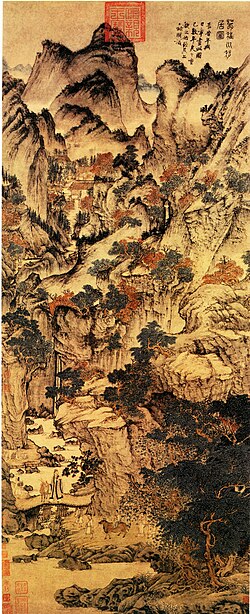
Picture: Wang Meng, Ge Zhichuan Relocating, fourteenth century, Palace Museum, Beijing. A later artistic depiction of Ge Hong, also known as Ge Zhichuan; it is not a contemporary likeness. Public-domain artwork and faithful reproduction.

Wang Meng, Ge Zhichuan Relocating, Palace Museum, Beijing; Wikimedia Commons; public domain. Image record, Public domain; PD-Art faithful reproduction.
The round picture in the lists of the personalities is cropped from it.