




9 min read
Godfather of AI
Geoffrey Hinton
author: High Priest Zevios Metathronos
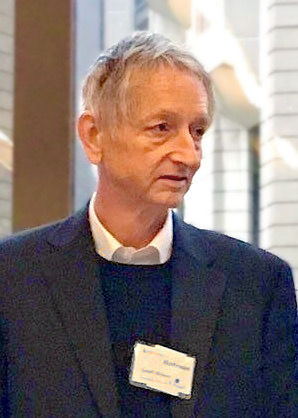
Dates: Born 1947
Period: Modern period
Geoffrey Hinton is a British-born computer scientist at the University of Toronto whose methods taught artificial neural networks to learn from examples. He shared the Nobel Prize in Physics for 2024 with John J. Hopfield, “for foundational discoveries and inventions that enable machine learning with artificial neural networks.”1
His name is on the Boltzmann machine paper of 1985, the Nature paper on back-propagation of 1986 and the ImageNet network of 2012. With Yoshua Bengio and Yann LeCun he received the ACM Turing Award for 2018.2
Zevism reads his work under the doctrine of Light and Darkness, since his methods teach hidden units to find what no one told them to look for. It also reads his later warnings under Prometheus, the Titan of forethought who gave mortals fire and every art.
LIFE AND CONTEXT
Geoffrey Everest Hinton was born in Wimbledon, London, on 6 December 1947. His father, Howard Everest Hinton, was an entomologist, and the family counted George Boole, “the Victorian logician whose work underpins the study of computer science and probability,” among its ancestors. His great-grandfather Charles Hinton coined the word “tesseract.”3
He took a bachelor's degree in experimental psychology at Cambridge in 1970 and a PhD in artificial intelligence at Edinburgh in 1978. In a telephone interview after the Nobel announcement he described himself as “someone who doesn't really know what field he's in but would like to understand how the brain works.”4
He worked at Sussex from 1976 to 1978, at the University of California, San Diego, from 1978 to 1980 and at Carnegie Mellon from 1982 to 1987. Then he left the United States, the ACM notes, “in part because of his opposition to the ‘Star Wars’ missile defense initiative.” He became a professor of computer science at Toronto in 1987 and worked at the Gatsby unit of University College London from 1998 to 2001.5
In those years he built, with David Ackley and Terrence Sejnowski, the network the Nobel committee would later single out. The Nobel press release says Hinton “used the Hopfield network as the foundation for a new network that uses a different method: the Boltzmann machine.” It adds that “the machine is trained by feeding it examples that are very likely to arise when the machine is run.” The paper of 1985 opens with the claim that the power of such networks “resides in the communication bandwidth provided by the hardware connections between elements.”6
After the ImageNet result of 2012, Google bought the company Hinton had founded with his 2 students, and he became a vice president and engineering fellow there. He left Google in 2023 after a decade, so that he could speak about the risks of artificial intelligence.7
The Nobel Prize in Physics for 2024 was announced on 8 October 2024. The prize of 11 million Swedish kronor was shared equally with Hopfield, and the award named his affiliation as the University of Toronto.8
ATTAINMENTS
- With David Ackley and Terrence Sejnowski he built the Boltzmann machine, published in Cognitive Science 9 (1985), 147–169. The network changes its connections “so as to construct an internal generative model that produces examples with the same probability distribution as the examples it is shown.”9
- The Nobel press release explains that for the Boltzmann machine Hinton “used tools from statistical physics, the science of systems built from many similar components,” with Hopfield's network as its foundation.10
- With David Rumelhart and Ronald Williams he published “Learning representations by back-propagating errors” in Nature 323 on 9 October 1986. It showed how “internal ‘hidden’ units which are not part of the input or output come to represent important features of the task domain.”11
- With Alex Krizhevsky and Ilya Sutskever he trained a network of 60 million parameters and 650,000 neurons that won the ILSVRC-2012 contest with a top-5 error of 15.3%, against 26.2% for the next entry.12
- He shared the ACM Turing Award for 2018 with Bengio and LeCun “for conceptual and engineering breakthroughs that have made deep neural networks a critical component of computing.”5
- He received half of the Nobel Prize in Physics for 2024.13
KEY STORIES
Errors Sent Backwards
Hinton moved to Carnegie Mellon in 1982, and with David Rumelhart and Ronald Williams he worked on a way to train networks that have layers between input and output. Their answer, in the ACM's words, “propagated measures of the errors produced by the network's guesses backwards through its neurons.”5
Nature printed the paper on 9 October 1986. It described a procedure that “repeatedly adjusts the weights of the connections in the network so as to minimize a measure of the difference between the actual output vector of the net and the desired output vector.” The hidden units then learned features on their own, and the authors claimed that “the ability to create useful new features distinguishes back-propagation from earlier, simpler methods such as the perceptron-convergence procedure.”14
The ACM is careful with the credit. The 3 authors “popularized” the algorithm, and “others had worked independently along similar lines, including Paul J. Werbos, without much impact.” A year after the paper Hinton left Carnegie Mellon for Toronto, partly because he opposed the Star Wars missile defence plan.5
The ImageNet Contest of 2012
The ImageNet challenge asked programs to sort images into 1,000 categories, with roughly 1.2 million training images to learn from. Hinton and his students Alex Krizhevsky and Ilya Sutskever built a network of 5 convolutional layers and 3 fully connected ones, with 60 million parameters.12
They trained it on graphics cards. “Our network takes between five and six days to train on two GTX 580 3GB GPUs,” the paper says, and its size was “limited mainly by the amount of memory available on current GPUs and by the amount of training time that we are willing to tolerate.” To keep it from overfitting the training images, they used a recently developed method called “dropout.”12
The entry won ILSVRC-2012 with a top-5 error of 15.3%, while the 2nd-best team managed 26.2%. The program “greatly outperformed all other entrants,” the ACM records, and the success “prompted Google to acquire a company” that Hinton and the 2 students had founded.15
Leaving Google
In the spring of 2023 Will Douglas Heaven of MIT Technology Review met Hinton at his house in north London, 4 days before the news broke that he was quitting Google after a decade. Leaving would let him speak freely. “I want to talk about AI safety issues without having to worry about how it interacts with Google's business,” he said.16
He'd changed his mind about the machines he helped create. “I have suddenly switched my views on whether these things are going to be more intelligent than us,” he told Heaven. “These things are totally different from us. Sometimes I think it's as if aliens had landed and people haven't realized because they speak very good English.” He summed up his state of mind in 2 short sentences: “I'm mildly depressed. Which is why I'm scared.”17
A Call to a Cheap Hotel
The prize was announced on 8 October 2024. When the Nobel Prize's Adam Smith reached him by telephone, Hinton said: “I'm in a cheap hotel in California, without an internet connection, and with a not very good phone line.” Then: “I was planning to get an MRI scan today, but I guess I'll have to cancel that.” He hadn't known he'd been nominated.18
He used the moment for his warning. “I think it's very important right now for people to be working on the issue of how will we keep control?”19
At the Nobel banquet on 10 December 2024 he listed harms already present: AI “has already created divisive echo-chambers,” and it “is already being used by authoritarian governments for massive surveillance and by cyber criminals for phishing attacks.” He also warned of “a longer term existential threat that will arise when we create digital beings that are more intelligent than ourselves,” and admitted, “We have no idea whether we can stay in control.” In Zevist terms the laureate spoke as Prometheus, the Titan of forethought.20
THE ZEVIST READING
Zevism teaches that unexplored darkness isn't evil: it's what one walks into with light, and explored darkness becomes knowledge. Hinton's methods do that inside a machine. The 1986 paper describes units “which are not part of the input or output,” hidden from both ends, that “come to represent important features of the task domain.”21 Those features aren't written in by anyone. The learning procedure carries light into the hidden layer until it holds a map of the world it was shown.
Prometheus was “the Titan god of forethought and crafty counsel.”22 In Aeschylus he says, “every art possessed by man comes from Prometheus,” and he names the price of his gifts. First, “I caused mortals to cease foreseeing their doom”; then, “I caused blind hopes to dwell within their breasts.”23 Hinton gave his field a new fire and then refused blind hope about it. The Temple reads his warnings as forethought returned to the maker's office.
The Good in Zevism joins Ma'at, right order, to Right, the right act from a right will. A learning machine has order without will; those who build and use it supply the will. Echo chambers, mass surveillance and fraud are Izfet worked through a sound method. The same method in right hands serves Ma'at, and the Temple holds the builders and users to that standard.
NOTES
1 Nobel Prize, “Geoffrey Hinton: Facts”.
4 ACM; Nobel Prize, telephone interview, October 2024.
5 ACM.
6 Nobel Prize, press release; Ackley, Hinton and Sejnowski, 1985.
7 ACM; Heaven, MIT Technology Review, 2 May 2023.
8 Nobel Prize, press release; Nobel Prize, Facts.
9 Ackley, Hinton and Sejnowski, 1985.
10 Nobel Prize, press release, 8 October 2024.
11 Rumelhart, Hinton and Williams, Nature 323, 533–536.
12 Krizhevsky, Sutskever and Hinton, 2012.
14 Rumelhart, Hinton and Williams, 1986.
15 Krizhevsky, Sutskever and Hinton, 2012; ACM.
16 Heaven, MIT Technology Review, 2 May 2023.
17 Heaven, 2023.
18 Nobel Prize, telephone interview.
21 Nature 323.
23 Aeschylus, Prometheus Bound 250–254, 507, tr. H. W. Smyth.
BIBLIOGRAPHY
Nobel Prize Outreach, “Geoffrey Hinton: Facts”, Nobel Prize in Physics 2024: birth, affiliation, motivation and prize share.
Royal Swedish Academy of Sciences, press release, Nobel Prize in Physics 2024, 8 October 2024.
Nobel Prize Outreach, telephone interview with Geoffrey Hinton, conducted by Adam Smith, October 2024; and Geoffrey Hinton, banquet speech, 10 December 2024.
Association for Computing Machinery, “Geoffrey E. Hinton,” A. M. Turing Award laureate page, 2018 award; biography.
David H. Ackley, Geoffrey E. Hinton, and Terrence J. Sejnowski, “A Learning Algorithm for Boltzmann Machines”, Cognitive Science 9 (1985), 147–169; abstract and introduction.
David E. Rumelhart, Geoffrey E. Hinton, and Ronald J. Williams, “Learning representations by back-propagating errors”, Nature 323 (9 October 1986), 533–536, DOI 10.1038/323533a0; abstract.
Alex Krizhevsky, Ilya Sutskever, and Geoffrey E. Hinton, “ImageNet Classification with Deep Convolutional Neural Networks”, Advances in Neural Information Processing Systems 25 (2012); abstract and §§2, 3 and 5.
Will Douglas Heaven, “Geoffrey Hinton tells us why he's now scared of the tech he helped build”, MIT Technology Review, 2 May 2023.
Theoi Greek Mythology, “Prometheus”; Aeschylus, Prometheus Bound 250–254 and 507, translated by Herbert Weir Smyth, Loeb Classical Library, 1926, Theoi Classical Texts Library.
CREDIT
Picture: Geoffrey Hinton, 27 October 2016; cropped event photograph
Steve Jurvetson, Deep Thinkers on Deep Learning, 2016; Commons crop and adjustments, CC BY 2.0. Image record, CC BY 2.0.
.jpg)
The round picture in the lists of the personalities is cropped from it.