



9 min read
Philosopher and Author
George A. Charalampidis
author: High Priest Zevios Metathronos
Bringing Ancient Thought into Conversation
Greek name: Γιώργος Α. Χαραλαμπίδης
Dates: 20 October 1969–20 October 2025
Period: Modern, 1900–present
George A. Charalampidis was a teacher, author and publisher from Thessaloniki who spent the last 15 years of his life putting ancient Greek philosophy into the hands of modern Greek readers. He wrote 16 books, most of them on Pythagoras, Socrates, Plato, Aristotle and Plutarch, taught seminars from 2010 and founded his own publishing house, Ανάμνηση (Remembrance), in 2020.1
His greatest attainment was a discipline of translation. His website calls it his own original method, “λέξη προς λέξη,” word for word, and he used it to bring the ancient texts into modern Greek.2
Zevism reads this work under its rule that one must return to the source. Knowledge changes as it passes from hand to hand, and the Temple honours those who carry the source itself across the gap of language. Charalampidis's method is that rule applied to a page of Greek.
LIFE AND CONTEXT
Charalampidis was born in Thessaloniki in 1969. His biography in Biblionet, the Greek books-in-print database, says that from childhood he “έδειξε ενεργά το ενδιαφέρον και την αγάπη του για την Αρχαία Ελλάδα,” showed an active interest in and love for ancient Greece. He studied Greek Culture at the School of Humanities of the Hellenic Open University.3
From 2010 he taught. Biblionet records that he gave seminars and lectures on philosophy “ανελλιπώς,” without a break, and wrote for printed and online journals. The course he taught was called “Φιλοσοφία Ανάμνησης,” the Philosophy of Recollection. He was a member of the Aristotelian Circle of Athens, and he worked with the research centre “Βιομιμητισμός Ελλάδος” as the person responsible for models of ancient civilizations, the Greek above all.4
His friend Panagiotis Liakos described the method plainly. Charalampidis “δεν έκανε ελεύθερη απόδοση του κειμένου.” He didn't paraphrase. “Το απέδιδε, όσο ήταν δυνατό και επιτρεπτό, κατά λέξη”: he rendered the text word for word, as far as that was possible and permitted.5
In 2020 he founded Ανάμνηση; its address was Stadiou 61, in central Athens. Liakos gives the reason in 1 sentence: he set it up “ώστε να βρει τόπο και τρόπο για να εκδίδει τα έργα του,” to find a place and a way to publish his works. He also recalls the care Charalampidis gave to the production and presentation of his books.6
He died on 20 October 2025, the day he turned 56. His website still speaks of him in the present tense. His last book, on the myth of Er, came out 7 months after his death.7
ATTAINMENTS
- He wrote 16 books. The biography on his website counts 13 in Greek, 2 in English and 1 in Spanish, and Liakos gives the same total of 16, with Plato, Pythagoras, Aristotle and Plutarch among their subjects.8
- Πυθαγόρας: Ο πρώτος Φιλόσοφος came out from Ανάμνηση in December 2020, a paperback of 278 pages, ISBN 978-618-85156-1-1.9
- Αριστοτέλης: Οι 12 Ηθικές Αρετές, Η Αρχή της Αντιφάσεως, Το Ακίνητον Κινούν followed in April 2021, 168 pages. It puts Aristotle's 12 ethical virtues, the principle of non-contradiction and the unmoved mover into 1 volume.10
- He rendered essays of Plutarch under their ancient titles, among them Περί του εμφαινομένου προσώπου τω κύκλω της σελήνης, on the face in the moon, and Εἰ καλῶς εἴρηται τὸ λάθε βιώσας. The moon essay also appeared in Spanish as Sobre la Cara Visible de la Luna.11
- He wrote for readers abroad: Aristotle, on memory and recollection and The Myth of Er in English, and L'autre Aristote, a commented text of Diogenes Laertius, in French.12
- He left dozens of recorded talks and lectures. His website files them under Plato, Aristotle, Sophocles, Hippocrates, Plutarch and Pythagoras.6
- Ο μύθος του Ηρός appeared posthumously from Dion in Thessaloniki in May 2026: 232 pages, the 7th volume of a series named Ανάμνηση, ISBN 978-618-5736-74-3.13
KEY STORIES
Er on the Pyre
His last book took up the final myth of Plato's Republic. The catalogue description calls it “τον επίλογο της Πολιτείας του Πλάτωνα,” the epilogue of the Republic, and the subtitle calls it the first recorded out-of-body experience.13
Plato's Socrates tells the tale. Er, “the son of Armenius, a Pamphylian by birth,” fell in battle. When the dead were gathered “ten days afterwards,” the other bodies had begun to rot, but “his body was found unaffected by decay.” They carried him home, and “on the twelfth day, as he was lying on the funeral pile, he returned to life and told them what he had seen in the other world.”14
He'd watched souls choose their next lives. Orpheus chose to be a swan, Ajax a lion, Agamemnon an eagle, and “the soul of the jester Thersites was putting on the form of a monkey.” Odysseus drew the last lot. He went looking “for the life of a private man who had no cares,” found it lying where everyone else had passed it by, and said he was “delighted to have it.”15
Then the souls marched to “the plain of Forgetfulness” and camped by “the river of Unmindfulness,” and “each one as he drank forgot all things.” Er “was hindered from drinking the water.” At dawn, “awaking suddenly, he found himself lying on the pyre.” Socrates ends: “the tale has been saved and has not perished.” A man who named his publishing house Remembrance chose for his last book the one witness who didn't drink.16
A House Called Remembrance
By 2020 Charalampidis had taught for 10 years and had books to publish. He built the means himself. Liakos says he founded Ανάμνηση “ώστε να βρει τόπο και τρόπο για να εκδίδει τα έργα του,” and the house shared its name with the course he'd been teaching since 2010, the “Φιλοσοφία Ανάμνησης.”6
In December 2020 Ανάμνηση issued Πυθαγόρας: Ο πρώτος Φιλόσοφος, 278 pages in a 16 by 23 cm paperback. In April 2021 came Αριστοτέλης, printed in Athens, on Aristotle's virtues, his principle of non-contradiction and his unmoved mover.17
His catalogue also holds 2 books on virtue itself. Ανδρεία, η Πρώτη Ηθική Αρετή treats courage as the first of the ethical virtues, and Εἰ διδακτὸν ἡ Ἀρετὴ asks whether virtue can be taught. The list grew to Plato, Socrates, Hippocrates' oath, Aristotle's Meteorologica and his short work on memory, Plutarch's essays and a book on Atlantis. Liakos remembered the maker as much as the author: a man who saw to the production and presentation of his books, and whom he called “ευγενικός, διακριτικός,” courteous and discreet.18
The Birthday of 20 October
He died on 20 October 2025, on his birthday. Liakos's notice ran in the culture pages of Dimokratia 4 days later. He gave the date in 1 sentence: he “ενώθηκε με την αιωνιότητα, 20 Οκτωβρίου, την ημέρα των γενεθλίων του, έχοντας συμπληρώσει 56 χρόνια,” joined eternity on 20 October, his birthday, having completed 56 years.19
Liakos also pointed readers to the work itself: “Στο YouTube υπάρχουν δεκάδες ομιλίες και διαλέξεις του,” there are dozens of his talks and lectures on YouTube, and he gave the address of the author's own website.19
The last book followed in May 2026. Dion, a publisher in Thessaloniki, the city where he was born, issued Ο μύθος του Ηρός in 232 pages as the 7th volume in a series that carried his house's name, Ανάμνηση. Its description calls the myth a text that “αναφέρεται στο θεμελιώδες φιλοσοφικό ερώτημα που απασχολεί διαχρονικά όλους τους ανθρώπους,” the fundamental philosophical question that has occupied all people in every age.13
THE ZEVIST READING
Zevism holds that one must return to the source. Knowledge grows as it's handed on, but the source keeps priority, and the Temple honours translators, copyists and editors as keepers of the source. Charalampidis's rule, κατά λέξη “όσο ήταν δυνατό και επιτρεπτό,” is the keeper's discipline. The ancient word leads; the modern word follows it and serves it. Zevism also reads spirituality as a chain running from its inception to today, and his catalogue walks that chain in order: Pythagoras, whom his title calls the first philosopher, then Socrates, Plato and Aristotle, and at last Plutarch under the Roman emperors.
Plato set the danger of transmission in a story. In the Phaedrus, Theuth brings his inventions to King Thamus of Egypt, letters among them, and offers them as an aid to memory. Thamus answers that they'll bring forgetfulness to learners who trust marks outside themselves and stop using their own memory.20 A book can be such a mark. Charalampidis named his house Remembrance, and a text rendered word for word keeps the ancient original in front of the reader who holds it.
The myth of Er gives the same lesson its mythic form. At the river of Unmindfulness, “those who were not saved by wisdom drank more than was necessary.”21 Zevism reads forgetting of the source as a form of Izfet, the dissolution of order, and the careful keeping of a text as a restoration of Ma'at in the record.
The myth also turns on a choice of life, and Odysseus chose well because he remembered his labours. Plato named the aim of such a choice elsewhere: ὁμοίωσις θεῷ κατὰ τὸ δυνατόν, becoming like the divine as far as possible.22 Zevism reads a life spent carrying Plato, Aristotle and Plutarch to new readers as service to that aim, the existential dimension of the path lived in 16 books and 15 years of teaching.
NOTES
1 Charalampidis, official biography; Liakos, “Η Ανάμνηση του Γιώργου Χαραλαμπίδη,” 24 October 2025.
3 Biblionet, “Χαραλαμπίδης, Γιώργος Α.”; Official biography.
4 Biblionet; Official biography.
7 Liakos; Biblionet, Ο μύθος του Ηρός.
11 Charalampidis, publisher's catalogue.
13 Biblionet, Ο μύθος του Ηρός.
14 Plato, Republic 10.614b, tr. Jowett.
17 Bookpoint, Πυθαγόρας; Bookpoint, Αριστοτέλης.
18 Publisher's catalogue; Liakos.
19 Liakos.
BIBLIOGRAPHY
George A. Charalampidis, official biography, undated; birth, Hellenic Open University studies, the “λέξη προς λέξη” method, book count by language, teaching from 2010, founding of Ανάμνηση in 2020, lecture categories.
Biblionet, “Χαραλαμπίδης, Γιώργος Α.”, author record; childhood interest, seminars from 2010, Aristotelian Circle of Athens, “Βιομιμητισμός Ελλάδος.”
Panagiotis Liakos, “Η Ανάμνηση του Γιώργου Χαραλαμπίδη”, Dimokratia, 24 October 2025; death on his birthday, 16 books, method, publishing and recorded lectures.
Ανάμνηση, publisher's catalogue, georgecharalampidis.gr; Greek and foreign-language titles.
Charalampidis, Πυθαγόρας: Ο πρώτος Φιλόσοφος, Ανάμνηση, December 2020, 278 pp., ISBN 978-618-85156-1-1; Bookpoint record.
Charalampidis, Αριστοτέλης: Οι 12 Ηθικές Αρετές, Η Αρχή της Αντιφάσεως, Το Ακίνητον Κινούν, Ανάμνηση, Athens, April 2021, 168 pp., ISBN 978-618-85156-5-9; Bookpoint record.
Charalampidis, Ο μύθος του Ηρός: Η πρώτη καταγεγραμμένη εξωσωματική εμπειρία και η άγνωστη πορεία της, Dion, Thessaloniki, May 2026, 232 pp., series Ανάμνηση 7, ISBN 978-618-5736-74-3; Biblionet record and description.
Plato, Republic, book 10, translated by Benjamin Jowett, Internet Classics Archive, MIT; 614b, 620a–d, 621a–c.
Plato, Phaedrus 274c–275b, translated by H. N. Fowler, Perseus Digital Library.
Plato, Theaetetus 176a–b, Greek text, Perseus Digital Library.
CREDIT
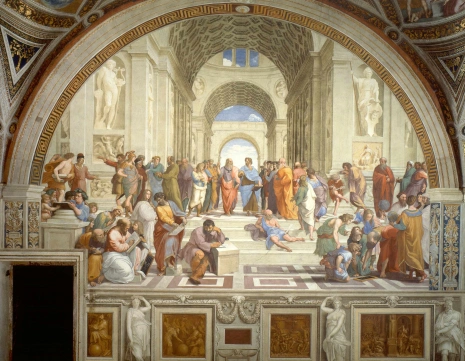
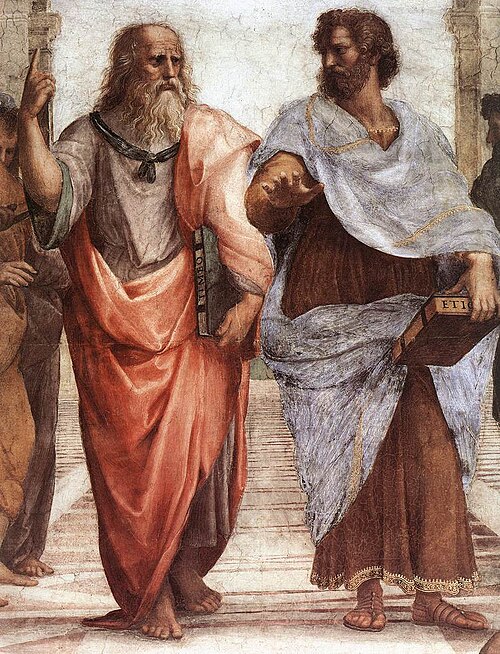
Image: Plato and Aristotle in a detail of Raphael's School of Athens. This Renaissance painting illustrates the philosophical inheritance discussed by Charalampidis and is not his portrait. Public domain. Verified image record.

Raphael; reproduction from Web Gallery of Art / Wikimedia Commons; Public domain. Image record, Public domain.
The round picture in the lists of the personalities is cropped from it.