





9 min read
Pioneer of Cytology
Georgios Papanikolaou
author: High Priest Zevios Metathronos
Attention That Gave Life More Time
Dates: 1883–1962
Period: Modern period
Georgios Papanikolaou, known in America as George Papanicolaou, was a Greek physician and zoologist who worked for 47 years at Cornell's medical school in New York. He showed that cancer of the cervix could be recognised in a few cells spread on a glass slide, the test the world now calls the Pap smear.1
In 1950 he received the Albert Lasker Clinical Medical Research Award “for outstanding contributions to the early diagnosis of cancer of the cervix through cytological methods.” The US National Cancer Institute now states that “regular Pap screening decreases cervix cancer incidence and mortality by at least 80%.”2
Zevism receives this work under Hygieia, who keeps the body whole before disease takes hold, and under the Light that discovery carries into the unseen. The Hippocratic physician was told to “foretell the future.” Papanikolaou gave medicine a way to do it from a little fluid on a slide.3
LIFE AND CONTEXT
He was born on 13 May 1883 in Kymi, on the island of Euboea.4 At the University of Athens he studied music and the humanities before he chose to “follow in his father's footsteps” and become a physician. As a young doctor he cared for leprosy patients on the outskirts of Kymi.5
He finished his medical studies at Athens in 1904 and took a doctorate in zoology at Munich in 1910. The Balkan War broke out in 1912, and in 1913 he and his wife Mary, also known as Andromachi, left for the United States.6
In New York he didn't find a laboratory at once. He sold rugs in a department store for a short time before he found posts at New York University and at Cornell.7 In 1914 he joined the Department of Anatomy at Cornell University Medical College, where he assisted Charles Stockard and studied the sex cycle of guinea pigs.8
In 1920 he turned the same smear technique on human cells. Mary “was his first and long term, human subject.” He announced his cancer findings in 1928, met little interest and spent the next 10 years on hormone studies with Ephraim Shorr.8 Aurel Babeș independently investigated the cytological detection of cervical cancer in the same year.9
The collaboration with Herbert Traut led to the paper and the book of 1943. Other scientists then tested the smear for themselves, and some hospitals began to use it to detect cervical cancer.8 After 47 years at Cornell he moved to Miami, and he died on 19 February 1962, aged 78.10
ATTAINMENTS
- In 1917, with Charles Stockard, he showed that the guinea pig has a typical oestrous cycle and that its stages can be read day by day in smears taken from the living animal.11
- In January 1928 he reported to a conference at Battle Creek, Michigan, that cancer of the cervix leaves typical cells in the vaginal smear, and that some cases “may be diagnosed by the presence of only one of these cells.”12
- With Herbert Traut he examined thousands of smears against clinical findings and biopsies, a series that included 193 uterine carcinomas, and reported it in 1943.13
- He and Traut published Diagnosis of Uterine Cancer by the Vaginal Smear in 1943, which the Cornell archives call their “classic book.”8
- In 1947 he taught the first course in cytology at Cornell, and in 1954 he published the Atlas of Exfoliative Cytology.8
- His test came to detect cancer of the vagina, the endometrium and the fallopian tubes as well as the cervix.8
- Case-control studies reviewed by the NCI find that the risk of invasive cervical cancer “is three to ten times higher in women who have not been screened.”14
- Screening built on it cut deaths on a national scale: “In Iceland, the mortality rate declined by 80% for more than 20 years, and in Finland and Sweden by 50% and 34%, respectively.”15
KEY STORIES
The Guinea Pigs and the Nasal Speculum
At Cornell, Stockard and Papanicolaou set out to prove that the guinea pig has “a typical oestrous cycle” and to trace the changes it brings. They couldn't study it without a way to watch the cycle in a living animal. Their paper of 1917 describes the tool: “a small nasal speculum which was introduced into the vagina and the arms opened apart by means of the thumb screw.”16
With it, “the vaginae of a number of virgin females have been examined daily and smears made from the substances that happened to be present in the lumen.” Every day brought a new slide to stain and read.17
The slides told a story. In the first stage of the cycle the fluid held “an abundant mass of cells” with small shrunken nuclei. Toward the end of that stage came “elongate, cornified cells without nuclei,” which stained “a decidedly red color, while the abundant first type cells are almost grey.” Each type of cell marked a stage, so the cycle could be read from a smear.17 In 1920 Papanikolaou began to use the same technique on women.8
Battle Creek, January 1928
The Third Race Betterment Conference met at Battle Creek, Michigan, on 2–6 January 1928, and Papanicolaou gave it a paper titled “New Cancer Diagnosis.” The work, he said, “was started about two and one-half years ago in the spring of 1925,” at the Cornell clinic and then at the Women's Hospital in New York. “First we selected a number of normal women, and we took vaginal smears every day. The technique was very simple.”18
To know what was normal he had to study the sick as well, so he collected smears from infections and tumours. In benign tumours “the cells look like the cells found in normal smears.” Cancer of the cervix wasn't like that. “The changes of the cells are mainly an abnormal growth and the development of the nucleus of the cell.” In a smear, he explained, those cells lay apart and were easy to see, while in a tissue section “the cells are crowded one against the other.”19
Then he made his claim: “certain cases of carcinoma of the cervix may be diagnosed by the presence of only one of these cells.” He described a 2nd sign as well, a flood of white cells that sometimes gathered in groups around half-digested cells, and closed by saying that the recognition of malignancy rested “not only on the presence of malignant cells but also on the reaction of the organism itself.” The New York World printed the article, but the pathologists showed “very little enthusiasm.”20
The Slides of the New York Hospital
The method came back when Herbert Traut, a gynecological pathologist, joined him, and later Anthony Marchetti of the obstetrics department. Women admitted to the gynecological service at New York Hospital were given routine vaginal smears.8
Their report of 1943 rested on thousands of smears, compared with the clinical evidence and with biopsies. The series held 193 uterine carcinomas. They insisted that finding malignant cells took careful scrutiny by a trained observer, and they treated the smear as an indicator that had to be confirmed.21
They could already see the next step, the same examination for large numbers of women, and they said plainly that it'd need time to train enough microscopists.22 In the mid-1940s he and his Cornell colleague Dr Hinsey set about training pathologists and cytologists, and in 1947 he gave Cornell's first course in cytology.8 Zevism counts this teaching as part of the discovery, because a way of seeing that stays in one man's eye saves nobody after he's gone.
THE ZEVIST READING
The Hippocratic Oath names the powers of healing: “I swear by Apollo the physician, and Asclepius, and Hygieia and Panacea and all the gods.”23 Asclepius cures the sick, and Hygieia keeps the healthy well. Papanikolaou's test works in Hygieia's hours, when a woman feels nothing and a few cells already carry the warning.
The Hippocratic writer of Epidemics asked the physician to “tell the antecedents, know the present, and foretell the future.”24 A Greek from Euboea gave that old demand a new instrument. In 1928 he told his audience that one could, “by the story of the vaginal smear, predict the condition of the ovary or of the uterus.”19
Zevism teaches that unexplored darkness isn't evil. It's the part of the world no one has yet entered with a light. The inside of the body is that darkness, and the microscope sends light through it quite literally, through a stained film of cells, grey and red. A slide read in time turns that darkness into knowledge while treatment can still work.
Ma'at, “the personification of truth, justice, and the cosmic order,” governs the reading too.25 Cancer is Izfet, the body's order dissolving from within. A diagnosis claimed too early or dismissed too quickly is disorder of another kind. Papanikolaou and Traut kept the measure: a trained eye, a smear treated as a sign, a biopsy to confirm it.
The work also rested on Mary, his first and long-term human subject. Zevism reads the aim of a human life as ὁμοίωσις θεῷ κατὰ τὸ δυνατόν, becoming like the divine as far as possible.26 For a physician that likeness is the healing Gods' own power to see harm coming and turn it aside, and the 2 of them at a microscope in New York put that power into a test any trained hand can perform.
NOTES
1 Roy C. Swan, Cornell memorial statement; Weill Cornell Medical Center Archives.
2 Lasker Foundation, 1950 award; NCI, “Cervical Cancer Screening”.
3 Epidemics 1, tr. Francis Adams.
5 Lasker Foundation, “The Inventor of the Pap Test”.
9 PAHO/WHO, Cervical Cancer Screening, p. 3.
10 Swan.
11 Stockard and Papanicolaou, American Journal of Anatomy 22 (1917).
12 Papanicolaou, “New Cancer Diagnosis,” 1928.
13 Traut and Papanicolaou, “Cancer of the Uterus,” pp. 121–122.
14 NCI.
15 NCI, “Cervical Cancer Screening”.
16 Stockard and Papanicolaou, American Journal of Anatomy 22.
18 Papanicolaou, “New Cancer Diagnosis,” pp. 528–534.
20 Papanicolaou, 1928; Weill Cornell Archives.
21 Traut and Papanicolaou, pp. 121–122.
23 NLM, “Greek Medicine,” Oath tr. Michael North.
24 Epidemics 1.
BIBLIOGRAPHY
Roy C. Swan, “George Nicholas Papanicolaou”, Cornell University faculty memorial statement, 1962, pp. 1–3; birth, education, emigration, career and death.
Weill Cornell Medical Center Archives, “George Papanicolaou: Development of the Pap Smear”, 29 June 2011; Stockard, Mary Papanikolaou, 1920 and 1928, Shorr, Traut and Marchetti, New York Hospital, the 1943 book, teaching and the 1954 atlas.
Charles R. Stockard and George N. Papanicolaou, “The existence of a typical oestrous cycle in the guinea-pig, with a study of its histological and physiological changes”, American Journal of Anatomy 22 (1917), 225–283, Internet Archive scan of vol. 22.
George N. Papanicolaou, “New Cancer Diagnosis”, in Third Race Betterment Conference, January 2–6, 1928, proceedings, pp. 528–534, Internet Archive scan from the Boston Medical Library.
Herbert F. Traut and George N. Papanicolaou, “Cancer of the Uterus: The Vaginal Smear in Its Diagnosis”, California and Western Medicine 59.2 (August 1943), pp. 121–122.
Lasker Foundation, “The Inventor of the Pap Test”, 4 December 2017; and “Pap smear for detecting cervical cancer”, 1950 Albert Lasker Clinical Medical Research Award.
PAHO/WHO, Cervical Cancer Screening: An Introduction for Health Workers in the Caribbean, p. 3; the independent work of Aurel Babeș.
National Cancer Institute, “Cervical Cancer Screening (PDQ), Health Professional Version”, section “The Pap Test,” consulted 27 September 2026.
Hippocratic Corpus, Epidemics, book 1, tr. Francis Adams, Internet Classics Archive.
US National Library of Medicine, “Greek Medicine”, Hippocratic Oath tr. Michael North, 2002; Encyclopaedia Britannica, “Maat”; Plato, Theaetetus 176a–b, Greek text, Perseus Digital Library.
CREDIT
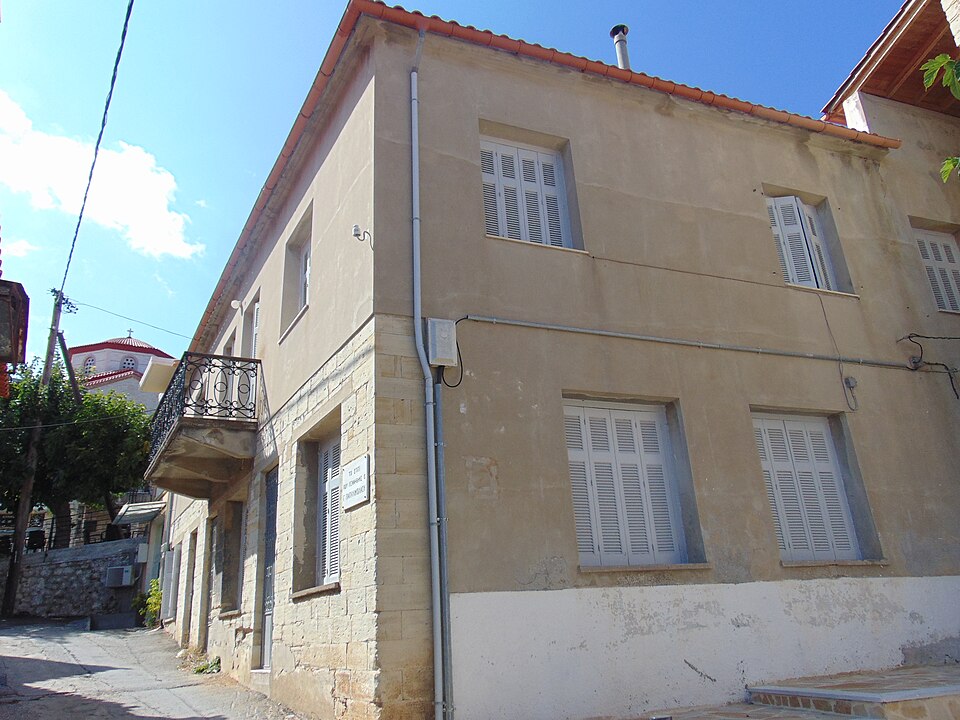
Picture: The house identified as Papanikolaou’s birthplace in Kymi, photographed on 14 September 2018.
Photograph by Lemur12, via Wikimedia Commons. Image record, CC BY-SA 3.0.

The round picture in the lists of the personalities is cropped from it.