






3 min read
Seeress of the Aśvins
Ghoṣā
author: High Priest Zevios Metathronos
The seer whose prayer seeks the renewal of life
Dates: Rigvedic textual tradition; individual lifetime undated
Period: Ancient (6000–500 BCE)
Region: Vedic India
Tradition: traditional woman seer
Religion or tradition: Vedic religion: the Ghoṣā hymn tradition, especially devotion to the Aśvins.
Heresy status: No designation documented.
Ghoṣā is traditionally associated with hymns 10.39 and 10.40 of the Ṛgveda, addressed to the Aśvins. The latter hymn names her in a direct appeal to the Divine twins. Her religious significance is therefore anchored in ancient hymnic material, while later accounts of her life must be assessed separately.1
GIVING PRAYER A CONSTRUCTIVE AND PERSONAL PURPOSE
The hymns associated with Ghoṣā remember the Aśvins’ rescues and renewals, then bring that divine history into a present request for help. The speaker seeks a fuller human life and prepares the appeal with the care of a maker shaping a valued work. The poem’s own comparison of hymn-making with skilled construction gives sacred speech a conscious craft.2
Her gift to later readers is a purposeful form of prayer: remember the Gods’ powers, state the need and address them with prepared attention. Her service to the Aśvins is carried by the preservation of their praised deeds. The human benefit lies in a religious voice that gives companionship, renewal and hope a serious place within sacred aspiration.
REMEMBERING THE GODS’ HELP
Hymn 10.39 recalls the Aśvins’ acts of rescue and renewal. Those remembered deeds form the basis of a present appeal. The speaker asks to be heard and aided, then ends by comparing the making of the hymn to skilled construction and careful adornment.3
Hymn 10.40 brings prayer into the concerns of companionship, household life and a fulfilled future. It presents a person addressing the Gods with definite needs. The sacred voice is active: it remembers, praises, asks and anticipates a changed condition.4
These passages establish a sounder foundation for the profile than a detailed diagnosis of an illness assigned to Ghoṣā by later retellings. The textual evidence supports the central religious themes directly.
A ZEVIST INTERPRETATION
Ghoṣā’s example gives prayer a purposeful structure. The worshipper learns the deeds attributed to the Gods, considers their relevance and addresses them with a clearly understood request. The act of remembering becomes part of the act of seeking help.
Her hymn also honours the craft of sacred speech. A prayer is prepared with care because the relationship it expresses matters. This provides a useful discipline for anyone studying hymns alongside ritual practice.
For a Zevist reader, her place in the collection concerns the will to recover a fuller life through an active relationship with the Divine. Her petitions show spiritual seriousness expressed through the real conditions of human existence and through confidence in the Gods’ capacity to hear.
NOTES
1 Ṛgveda 10.40.
2 Ṛgveda 10.39.14; 10.40.
4 10.40.
PRIMARY SOURCES
Ṛgveda 10.39 and 10.40, trans. R. T. H. Griffith. Read 10.40.5 for the named speaker and 10.39.14 for the image of the crafted hymn.
CREDIT
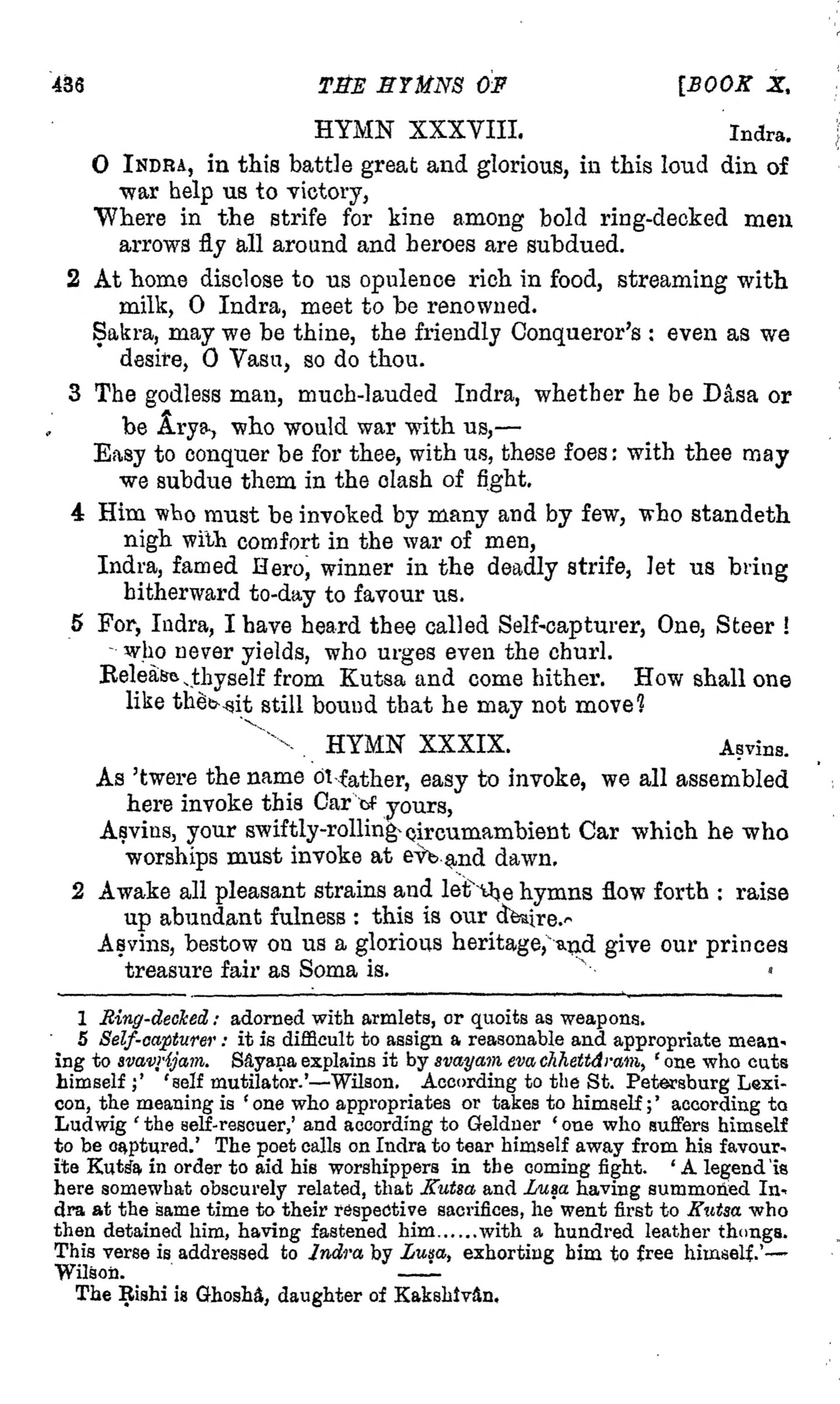
Picture: Facsimile naming the seer. The opening of Ṛgveda 10.39 appears in the lower part of this page, with a footnote naming Ghoṣā as its seer. Griffith, The Hymns of the Rigveda, volume II, 1897, page 436. A historical printed witness, not a portrait.
Credit: R. T. H. Griffith. Source record, Public domain.
The round picture in the lists of the personalities is cropped from it.