





3 min read
Seeker of Sacred Understanding
Giovanni Pico della Mirandola
author: High Priest Zevios Metathronos
The interrupted search for a wider sacred understanding
Dates: 1463–1494 CE
Period: Renaissance (1336–1650 CE)
Region: Italy and France
Tradition: Christian philosophy, magic and Cabala
Religion or tradition: Christianity: philosophical and theological synthesis incorporating magic and Cabala.
Heresy status: Christian Heretic: condemned propositions in 1487; papal pardon in 1493.
Giovanni Pico della Mirandola wanted to bring different traditions of wisdom into conversation. His proposed Roman disputation ranged across philosophy and theology and included magic and Cabala.1 He understood the undertaking as a Christian search for truth; its breadth also carried him into conflict with ecclesiastical authority.2
A PROJECT INTERRUPTED BY CONDEMNATION
In 1487, the papal commission examining his propositions condemned seven and found six others suspect. Pico’s defence provoked a wider condemnation of the collection. His planned debate never took place. After leaving Italy, he was detained in France at the pope’s request. Alexander VI eventually pardoned him in 1493. The designation Christian Heretic in this profile refers to those condemned propositions and the resulting proceedings, with the later pardon expressly included.3
THE VALUE OF A DEMANDING ENCOUNTER WITH OTHER TRADITIONS
Pico’s intellectual ambition required readers to consider material beyond the boundaries of a single school. His work brought questions about the soul, spiritual transformation and sacred knowledge into a common field of argument. His synthesis remained Christian in intention, including his use of magic and Cabala in support of Christian claims.4
For humanity, the constructive legacy is the example of learning that asks difficult traditions to be understood before being dismissed. The encounter itself can deepen a student’s powers of attention and judgment. Pico’s story also shows how quickly an invitation to debate could become a matter for detention and ecclesiastical judgment.
HONORARY REMEMBRANCE IN THE TEMPLE
Zevist devotional interpretation. The Temple remembers Pico as an unfortunate soul whose desire for spiritual advancement encountered religious and political restrictions. His engagement with ancient philosophy and sacred arts is read here as an inward attraction to the wisdom through which the Gods may be known. That is the Temple’s interpretation of his undertaking, not a claim that his surviving writings profess a concealed pagan allegiance.
His misfortune was to pursue an expansive intellectual vocation in circumstances where authorities could prevent its public examination and endanger its author. He could study and write, yet could not assume that the next step of the inquiry would be permitted. The pardon belongs to the story without erasing the earlier pressure.
For what he suffered while seeking a wider understanding of divine things, Pico receives honorary mention. The Temple honours that suffering, in its own devotional reading, as part of the difficult survival of knowledge belonging to the Gods and to humanity’s common inheritance.
May his next incarnation unfold without the fear of condemnation for sincere inquiry. May he encounter the Gods’ wisdom openly, apply it with discernment, and advance in freedom.
NOTES
1 Brown University’s edition of the theses.
2 Stanford Encyclopedia of Philosophy.
3 Stanford, life and early writings.
4 Stanford, the Conclusions and their interpretation.
BIBLIOGRAPHY
Brown University, Pico’s 900 Theses project, digital access to the primary Latin text and scholarly annotations.
Stanford Encyclopedia of Philosophy, “Giovanni Pico della Mirandola”, especially the biography, Conclusions and accounts of the ecclesiastical proceedings.
CREDIT
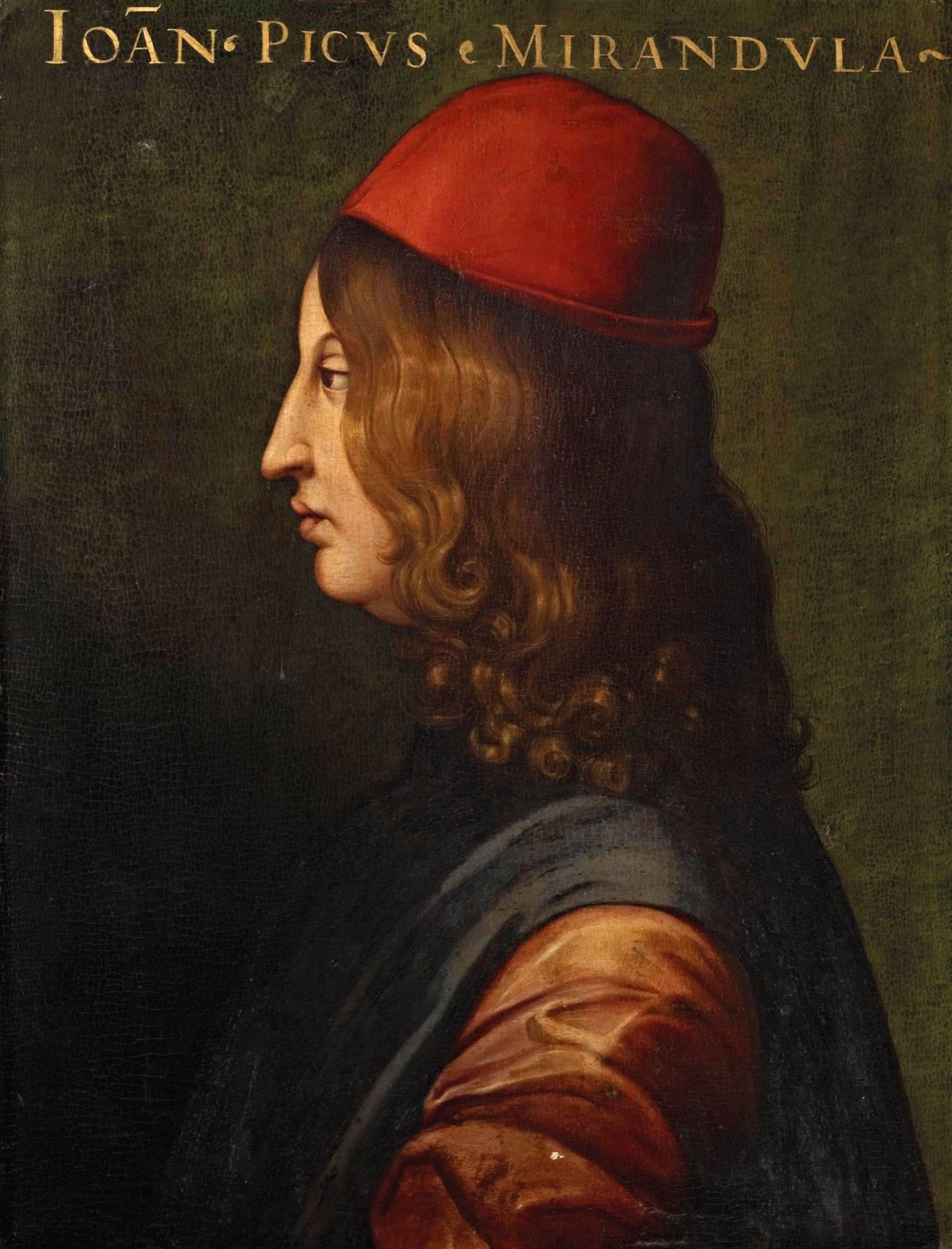
Picture: Posthumous historical portrait. Cristofano dell’Altissimo, portrait of Giovanni Pico della Mirandola, 1552–1568, in the Uffizi’s Gioviana series. The painting postdates Pico’s life. The date follows the Italian cultural-heritage catalogue.
Credit: Cristofano dell’Altissimo; Uffizi Gallery. Source record, Collection record, Public domain. Faithful enlargement; no new image content added.

The round picture in the lists of the personalities is cropped from it.