





10 min read
Poet of Weimar
Johann Wolfgang von Goethe
author: High Priest Zevios Metathronos
The Form of a Cultivated Life
Dates: 1749–1832
Period: Enlightenment, 1650–1804; his later work continued into the Imperial period
Johann Wolfgang von Goethe was a poet, dramatist, minister of state and student of nature who made Weimar his home for 56 years. He wrote The Sorrows of Young Werther, Iphigenie auf Tauris and the 2 parts of Faust, ran commissions for mines, roads and war for his duke, and wrote a theory of colour against Newton.1
His greatest labour was Faust, a drama “considered by some to be Germany's most significant contribution to world literature.” He published a fragment in 1790 and Part One in 1808, then finished Part Two in August 1831 and sealed it for publication after his death.2
Zevism reads his poetry under Apollo and the Muses, and his science of colour under the Temple's doctrine of Light and Darkness. He held that colour is born where light meets its absence, and that the eye sees light because something of the light lives in it.
LIFE AND CONTEXT
Goethe was born in Frankfurt am Main on 28 August 1749. “Die Jahre 1765–68 hat G. als Student der Rechte in Leipzig zugebracht,” his Neue Deutsche Biographie entry records, and he finished his law studies at Strasbourg “am 6. August 1771.” There he met Herder, and the 2 men saw each other daily from mid-September 1770 until Easter 1771.3
Fame came fast. The first draft of Götz von Berlichingen took him 6 weeks in the autumn of 1771. Werther was “written in two months early in the year” 1774 and “appeared that autumn”; it was translated into French almost at once and into English in 1779. On 7 November 1775 he arrived in Weimar at the invitation of the young Duke Karl August.4
The duke put him to work. “Six months after his arrival, Goethe was made a member of the ruling Privy Council.” In 1779 he took on the War Commission besides the commissions for mines and highways, and in 1782 he was ennobled as “von Goethe.” For over 20 years he struggled with the duchy's mines, only to be beaten by repeated flooding of the shafts. The duke also bought him a cottage and garden just outside the city walls.5
In 1782 he moved into the house on the Frauenplan, where he lived and worked “for almost 50 years.” In 1786 he fled to Italy and stayed until June 1788. Back in Weimar he took Christiane Vulpius, daughter of the duke's late archivist, into his life; she bore him a son, August, on 25 December 1789.6
He sealed Faust Part Two shortly before his 82nd birthday. The next spring he caught a cold and died of a heart attack in his armchair, in his small bedroom, on 22 March 1832 “at about 11:30 in the morning.” On 26 March he was laid in the ducal vault “next to Schiller.”7
ATTAINMENTS
- Die Leiden des jungen Werthers, written in 2 months, appeared in the autumn of 1774. It was translated into French almost at once and into English in 1779.4
- He governed as well as wrote: a seat on Weimar's Privy Council from 1776, and from 1779 the War, Mines and Highways commissions at once.5
- Iphigenie auf Tauris began in 1779 as a prose drama, and he recast it in blank verse during his Italian journey.8
- In 1790 he published Versuch, die Metamorphose der Pflanzen zu erklären, which traced all plant forms to “alternating expansion and contraction of a basic unit, the leaf.”9
- He built a theory of colour against Newton, first in the Beiträge zur Optik of 1791–92 and then in Zur Farbenlehre in 1810, which Charles Eastlake put into English in 1840.10
- Faust took him most of his life: Faust: Ein Fragment in 1790, Part One in 1808 after war delayed it, and Part Two sealed in August 1831.11
- He published the first 3 parts of his autobiography, Dichtung und Wahrheit, in 1811–13, and supervised his collected works, the Ausgabe letzter Hand, planned “initially in 40 volumes.”12
KEY STORIES
Three in the Morning at Karlsbad
On 3 September 1786 Goethe left the spa of Karlsbad before dawn. He opened his Italian journal with the escape: “Früh drei Uhr stahl ich mich aus Karlsbad, weil man mich sonst nicht fortgelassen hätte.” His friends had just celebrated his birthday, 28 August, and that, he wrote, gave them a right to hold him; “allein hier war nicht länger zu säumen.” There was no more waiting.13
He travelled light: “Ich warf mich ganz allein, nur einen Mantelsack und Dachsranzen aufpackend, in eine Postchaise.” Alone, with a portmanteau and a badger-skin knapsack, he threw himself into the post coach. Boyle writes that he'd made the decision “in a state near to despair.”14
At Verona on 16 September he stood inside the Roman arena and wrote: “Das Amphitheater ist also das erste bedeutende Monument der alten Zeit, das ich sehe.” On 29 October he reached Rome, “only to find its ruinous state a painful disappointment.” He stayed in Italy for almost 2 years, and his return to Weimar in June 1788, Boyle writes, “was extremely reluctant.”15
The Sketch at Malcesine
On 14 September 1786 he stopped at Malcesine on Lake Garda and sat down in the courtyard of the ruined castle to draw. “Ich saß nicht lange, so kamen verschiedene Menschen in den Hof herein.” A man pushed forward and asked what he was doing, and Goethe said that he was drawing “den alten Turm.” The man took the sheet “mit wahrer italienischer Gelassenheit,” tore it and left it lying on the board.16
The podestà came. Why was the stranger drawing their fortress? Goethe answered that he didn't recognise these walls as a fortress at all. The crowd had its own theory: Emperor Joseph was “ein unruhiger Herr,” and this might be his agent, sent “um die Grenzen auszuspähen,” to spy out the frontier.17
Goethe played his best card. “Ich bin nämlich von Frankfurt am Main gebürtig, einer Stadt, deren Name und Ruf gewiß bis zu euch gekommen ist.” A man of about 50 called Gregorio stepped up; he'd once been in service with the Bolongaro house in Frankfurt. After a few questions he turned to the magistrate: “Herr Podestà, ich bin überzeugt, daß dieses ein braver, kunstreicher Mann ist.” His advice settled it: “Wir wollen ihn freundlich entlassen, damit er bei seinen Landsleuten Gutes von uns rede.” Let him go in friendship, so he'll speak well of them at home.17
Iphigenia Tells the King
Goethe's Iphigenia takes place among the Taurians, where Iphigenia serves Diana as priestess. Arkas reminds her that until her coming no stranger landed there but “fell, according to an ancient rite, / A bloody victim at Diana's shrine.” Then her brother Orestes and his friend Pylades are captured, and the 3 plan a secret escape by sea.18
In Act 5 she won't deceive the king who has sheltered her. She tells Thoas everything: “A secret plot is laid,” and the eldest captive “is Orestes, / My brother, and the other Pylades.” Thoas tests her: “And dost thou think / The savage Scythian will attend the voice / Of truth and of humanity, unheard / By the Greek Atreus?” She answers: “'Tis heard by all, / Whate'er may be their clime, within whose breast / Flows pure and free the gushing stream of life.”19
Leave to sail isn't enough for her. “I cannot part / Without thy blessing, or in anger from thee,” she says, and asks him to “graciously extend to me thy hand, / In pledge of ancient friendship.” She promises a welcome in Greece to any of his people who come there. The play ends as Thoas, “extending his hand,” says “Fare thee well!”20
Jena, October 1806
On 14 October 1806 Napoleon routed the Prussian armies at Jena. Weimar, 12 miles from the battlefield, was occupied and sacked. Goethe's house was spared, Boyle writes, “thanks to Napoleon's admiration for the author of Werther.”21
Soldiers were billeted in the house, and it was Christiane Vulpius who kept them under control. She “showed great courage” in those days, and 5 days after the battle Goethe married her in the vestry of the court church.22
The emperor and the poet met face to face 2 years later. “In 1808 he met Napoleon during the Congress of Erfurt and was made a knight of the Legion of Honour.” The same year Faust Part One, held back by the war, finally went to print.21
THE ZEVIST READING
Goethe's colour theory puts the Temple's doctrine of Light and Darkness into the language of optics. “Light and darkness, brightness and obscurity, or if a more general expression is preferred, light and its absence, are necessary to the production of colour,” his introduction states, and the preface calls colours “acts of light; its active and passive modifications.”23 Boyle calls his first attempt, in the Beiträge zur Optik, to set these ideas up as new laws of physics unconvincing. Zevism takes the other lesson: darkness isn't evil, and the world's colour appears where light goes into it.
The same introduction quotes “an old mystic writer”: “If the eye were not sunny, how could we perceive light? If God's own strength lived not in us, how could we delight in Divine things?”24 Zevism reads these lines as the ground of the path. A human being can become like the divine only because something of the divine is already in him. Plato named that aim ὁμοίωσις θεῷ κατὰ τὸ δυνατόν, likeness to God as far as possible.25
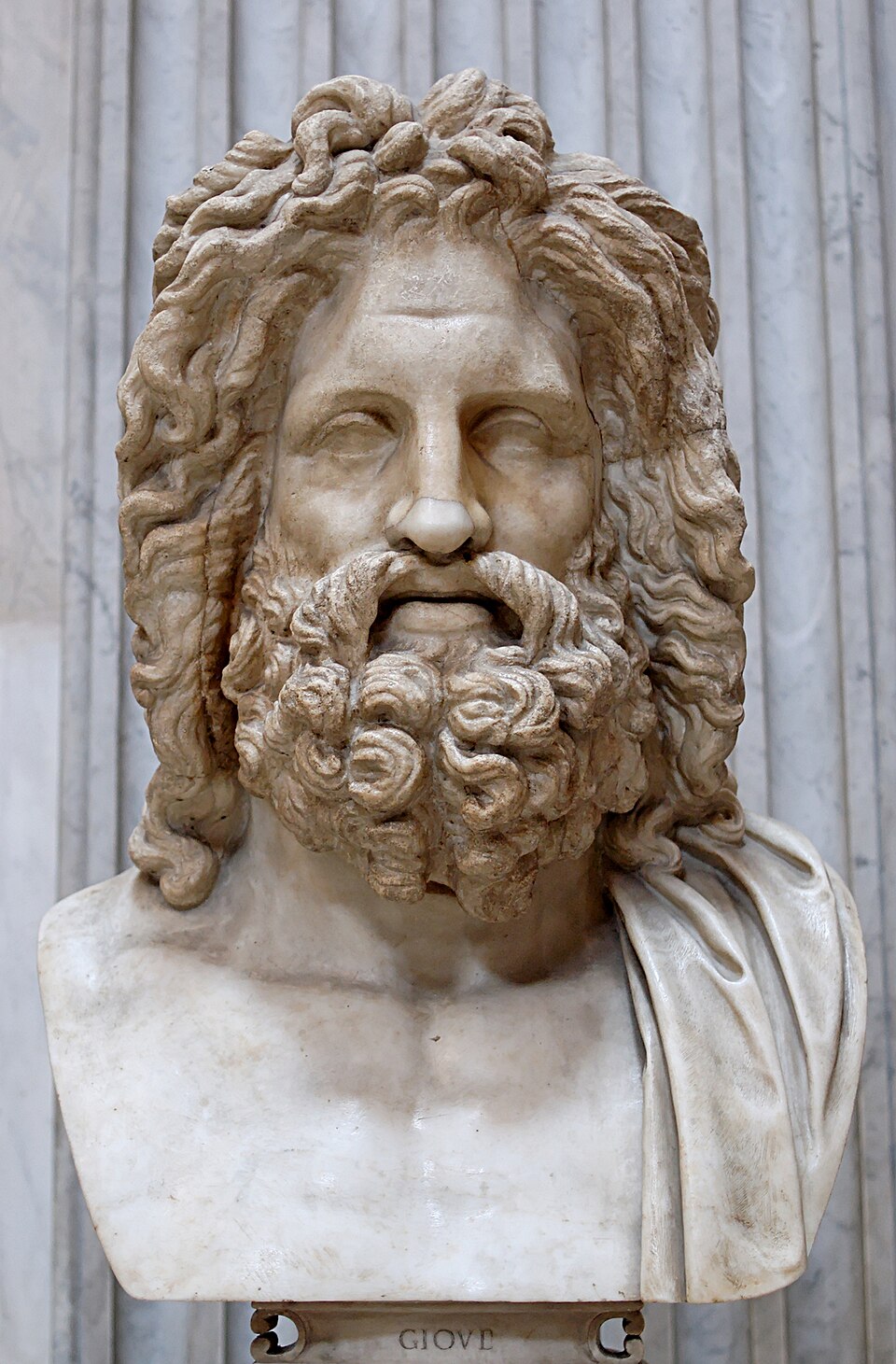
Iphigenia belongs to Zeus as God of strangers. In the Odyssey, Odysseus warns the Cyclops that Zeus “takes all respectable travellers under his protection, for he is the avenger of all suppliants and foreigners in distress.”26 The rite that killed every stranger on the shore was Izfet dressed as worship. Iphigenia ended it, then turned an escape into a pledge of friendship between 2 peoples, and that's Ma'at restored between host and guest.
Goethe met the same law in a real town. At Malcesine the crowd took the stranger for a spy, and Gregorio, who'd served in the stranger's own city, had him sent on his way in friendship. Zevism reads that release, like Thoas's outstretched hand, as the law of Zeus kept between host and guest.
NOTES
1 Boyle, “Johann Wolfgang von Goethe,” Britannica.
2 Klassik Stiftung Weimar, Faust-Fragment; Boyle, Britannica, “Last years”.
4 Boyle, Britannica, “Sturm und Drang”.
5 Boyle, Britannica, “First Weimar period”.
6 Klassik Stiftung Weimar, “The Goethe Residence”; Boyle, Britannica, “Return to Weimar”.
7 Boyle, Britannica, “Last years”; Klassik Stiftung Weimar, “Ducal Vault”.
8 Boyle, Britannica, “First Weimar period” and “Italian journey”.
9 Boyle, Britannica, “Return to Weimar”.
10 Boyle, Britannica; Goethe, Theory of Colours, tr. Eastlake.
11 Klassik Stiftung Weimar, Faust-Fragment; Boyle, Britannica, “Napoleonic period” and “Last years”.
12 Boyle, Britannica, “Napoleonic period” and “Last years”.
13 Goethe, Italienische Reise, Karlsbad, 3 September 1786.
14 Italienische Reise; Boyle, Britannica, “First Weimar period”.
15 Italienische Reise, Verona, 16 September; Boyle, Britannica, “Italian journey”.
16 Italienische Reise, Malcesine, 14 September 1786.
18 Goethe, Iphigenia in Tauris, Act 1, scene 2, tr. Swanwick.
19 Act 5, scene 3.
20 Act 5, scene 6.
21 Boyle, Britannica, “Napoleonic period”.
22 Boyle, Britannica, “Napoleonic period”; Boyle, Britannica, “Return to Weimar”.
23 Goethe, Theory of Colours, tr. Eastlake, preface and introduction.
24 Theory of Colours, introduction, p. xxxix.
26 Homer, Odyssey 9, tr. Butler.
BIBLIOGRAPHY
Nicholas Boyle, “Johann Wolfgang von Goethe”, Encyclopaedia Britannica, updated 3 September 2026; sections “Sturm und Drang (1770–76)”, “First Weimar period (1776–86)”, “Italian journey (1786–88)”, “Return to Weimar and the French Revolution (1788–94)”, “Napoleonic period (1805–16)” and “Last years (1817–32)”.
Wilhelm Flitner, “Goethe, Johann Wolfgang von”, Neue Deutsche Biographie 6, 1964, pp. 546–575; Leipzig, Strasbourg and Herder.
Johann Wolfgang von Goethe, Italienische Reise, vol. 1, Project Gutenberg; entries for Karlsbad, 3 September, Malcesine, 14 September, and Verona, 16 September 1786.
Goethe, Iphigenia in Tauris, translated by Anna Swanwick, Project Gutenberg; Act 1, scene 2, and Act 5, scenes 3 and 6.
Goethe, Theory of Colours, translated by Charles Lock Eastlake, 1840, Project Gutenberg; preface to the 1st edition and introduction, pp. xxxix and xlii.
Klassik Stiftung Weimar, “Johann Wolfgang von Goethe: Faust-Fragment. Leipzig 1790”, Herzogin Anna Amalia Bibliothek, F 675.
Klassik Stiftung Weimar, “The Goethe Residence”, Goethe National Museum.
Klassik Stiftung Weimar, “Ducal Vault”.
Klassik Stiftung Weimar, Johann Wolfgang von Goethe, person record, life dates 1749–1832.
Homer, Odyssey, book 9, translated by Samuel Butler, Internet Classics Archive, MIT; 9.269–271.
Plato, Theaetetus 176a–b, Greek text, Perseus Digital Library.
CREDIT
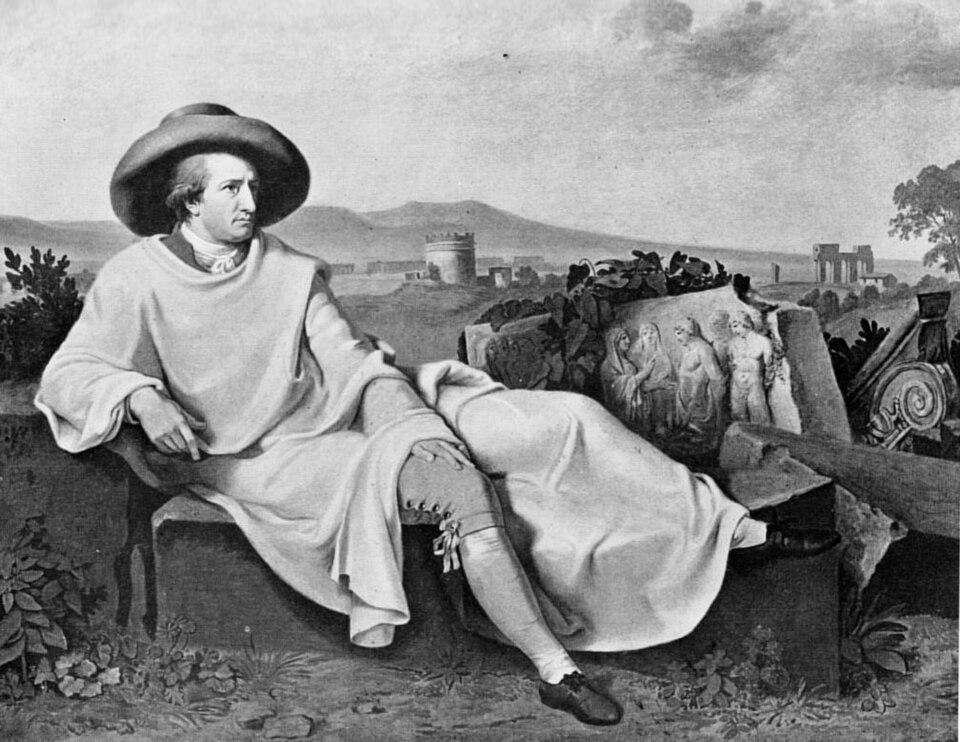
Image: Johann Heinrich Wilhelm Tischbein, Goethe in the Roman Campagna, 1787, Städel Museum. Public domain. Verified reproduction and rights statement.

Johann Heinrich Wilhelm Tischbein / Wikimedia Commons; Public domain. Image record, Public domain.
The round picture in the lists of the personalities is cropped from it.