





4 min read
Monk of Orbais
Gottschalk of Orbais
author: High Priest Zevios Metathronos
The imprisoned dissenter whose writings continued to travel
Dates: ninth century CE, died in the late 860s
Period: Darkness (800–1000 CE)
Region: Francia
Tradition: Christian dissent
Religion or tradition: Christianity: a monk and priest advocating an Augustinian doctrine of double predestination.
Heresy status: Christian Heretic: personally condemned for his predestination teaching.
Gottschalk of Orbais challenged ecclesiastical authority from within Christianity. A monk, priest and theologian, he defended a stringent account of predestination grounded in his reading of Augustine. His inclusion follows the collection’s category of resistance to coercive Church rule; it does not turn that doctrine into Zevist teaching.1
WHY HE IS IDENTIFIED AS A CHRISTIAN HERETIC
Gottschalk was personally condemned at Mainz in 848 and Quierzy in 849 for his teaching on predestination. He defended a stringent reading of Augustine concerning divine election and judgment, and continued to argue for it under confinement. His dispute with the bishops arose within Christian theology.2
Knowledge of the Gods: a Zevist interpretation. His own aim was to defend what he understood as Christian divine truth. The Temple’s point of connection is the conviction that sacred questions require study and argument, even when authorities demand submission. The freedom to pursue such questions is also necessary for those seeking the Gods. His contribution to this collection therefore concerns intellectual steadfastness under coercion. The surviving evidence does not connect his condemnation with pagan worship or the study of Platonic theurgy.
PRESERVING AN ARGUMENT UNDER CONFINEMENT
Gottschalk continued to write and seek readers when condemnation and imprisonment had curtailed his freedom. The circulation of his texts preserved a dissenting position that ecclesiastical authorities had tried to settle through punishment. His opponents still had to confront an argument with identifiable words, sources and claims.3
His positive legacy for humanity lies in this example of intellectual endurance and in the survival of evidence through which coercive authority can be examined. For a Zevist community, his courage has value as a defence of the person’s capacity to study and maintain a reasoned conviction under pressure. That is the point of connection with sacred freedom in this collection. It does not require attributing pagan worship to him or accepting his doctrine of predestination.
CONDEMNATION DID NOT END THE ARGUMENT
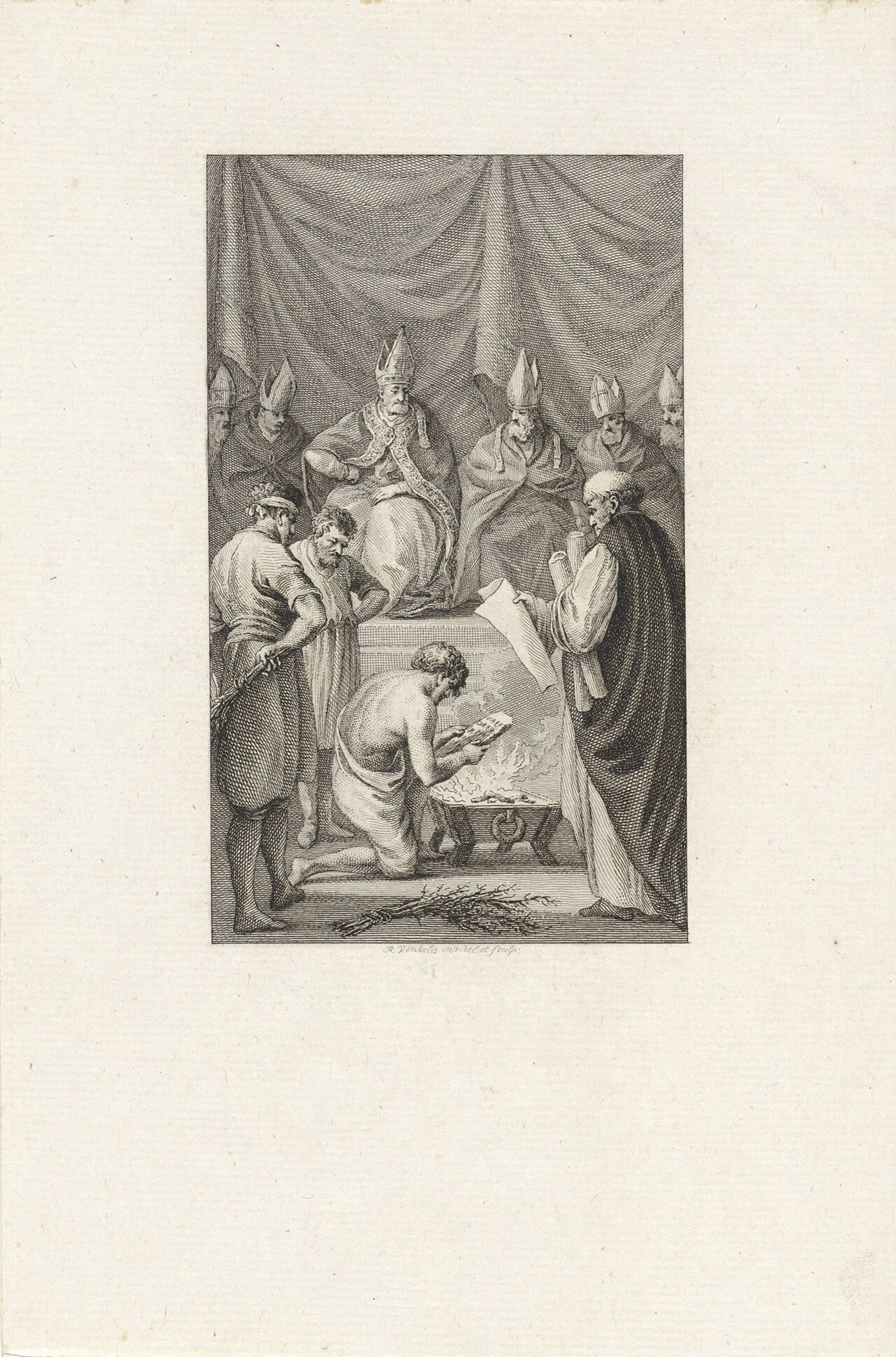
Councils at Mainz in 848 and Quierzy in 849 condemned him. He refused to recant despite punishment and was confined at Hautvillers. The dispute continued because his writings reached readers beyond the place of confinement. Gillis reconstructs this activity through surviving texts and the responses of his opponents, especially Archbishop Hincmar of Rheims.4
His persistence was intellectual as well as personal. The surviving portrait is of a man who argued, circulated texts and sought supporters when the hierarchy had declared his position unacceptable. Prison restricted his movement but did not completely control the movement of his words.5
A DISSENTER WITH HIS OWN DEMANDS
Gottschalk was not a modern advocate of universal religious pluralism. He believed his own interpretation to be true and pressed others to accept it. This matters because courage under coercion and openness towards rival doctrines are different qualities. The former can be recognized in his career without inventing the latter. Gillis’s account explicitly examines his uncompromising claims as well as the coercion exercised against him.6
A ZEVIST READING OF CONSCIENCE AND ARGUMENT
Gottschalk’s value in this section lies in his refusal to let punishment substitute for an answer. For a community committed to study, that distinction has lasting importance. A proposition is not established by silencing its opponent, and a condemned writer can still require a serious response.
His example also calls for precision in admiration. A Zevist reader need not adopt predestination in order to study his steadfastness, his use of texts and the mechanisms by which a hierarchy maintained conformity. The article honours a particular form of resistance while keeping his historical religion and intellectual commitments intact.
The surviving sources support a substantial account of the controversy; they do not supply every detail of a continuous life. Accordingly, exact birth dates and an overconfident chronology of his final years are avoided here.
NOTES
1 Matthew Bryan Gillis’s study.
2 Gillis, Heresy and Dissent in the Carolingian Empire; Stanford account of the predestination controversy.
3 Gillis’s reconstruction of his life and writings.
5 Gillis, book abstract and chapter outline.
BIBLIOGRAPHY
Matthew Bryan Gillis, Heresy and Dissent in the Carolingian Empire: The Case of Gottschalk of Orbais (Oxford University Press, 2017), publisher abstract and contents.
Matthew Bryan Gillis, “Heresy in the Flesh: Gottschalk of Orbais and the Predestination Controversy in the Archdiocese of Rheims,” in Rachel Stone and Charles West, editors, Hincmar of Rheims: Life and Work (Manchester University Press, 2015), pp. 247–267, chapter abstract.
The Medieval Review, 18.09.18, review of Gillis, for the limits of biographical reconstruction and the dating of Gottschalk’s death.
CREDIT
Picture: Later historical illustration. Reinier Vinkeles, Gottschalk undergoes his punishment and burns his books, 1807. Etching and engraving, Rijksmuseum RP-P-OB-64.715. A later depiction of the persecution, not an eyewitness image.
Credit: Reinier Vinkeles; Rijksmuseum. Source record, CC0.

The round picture in the lists of the personalities is cropped from it.