







3 min read
Herald of Indra's Power
Gṛtsamada
author: High Priest Zevios Metathronos
The seer who names Divine power through its deeds
Dates: Rigvedic period; individual lifetime undated
Period: Ancient (6000–500 BCE)
Region: Vedic India
Tradition: ṛṣi and hymn tradition
Religion or tradition: Vedic religion: the Gṛtsamada hymn tradition, including praise of Indra.
Heresy status: No designation documented.
Gṛtsamada is associated with the second book of the Ṛgveda. Hymn 2.12, traditionally assigned to Gṛtsamada Śaunaka, offers one of the most emphatic Vedic proclamations of Indra’s power. Each sequence of deeds leads the listeners back to the identity of the God.1
TEACHING THE RECOGNITION OF A GOD THROUGH HIS POWERS
Gṛtsamada’s Indra hymn gave its audience a forceful means of learning divine identity. The God is made known through the ordering of the world, the overcoming of obstruction and the release of waters. The repeated identification gathers the separate deeds into a coherent act of praise.2
His positive contribution is a sacred composition that teaches as it invokes. Humanity received a durable literary form for remembering what a divine name signifies, while Indra’s powers were honoured through an exact sequence of examples. In Zevist use, that inheritance encourages informed prayer: study the deeds and attributes, understand the purpose of the address, and let the words carry a considered knowledge of the God. The hymn makes religious memory active in the moment of recitation.
RECOGNITION THROUGH SACRED NARRATIVE
The hymn describes Indra supporting the world, overcoming the obstructing dragon and releasing the rivers. It also confronts the question of the God’s presence and calls the hearer to recognize him through the actions being recounted. Its repeated identification gives the composition a strong public and instructional character.2
Later commentary supplies stories explaining the circumstances of Gṛtsamada’s recitation. Those accounts belong to the hymn’s reception and should be distinguished from the text of the hymn itself. The present profile draws its central interpretation from the poem’s structure and stated Divine deeds.3
A ZEVIST INTERPRETATION
Gṛtsamada’s hymn offers a method for studying the powers of a God: attend to the actions, relationships and effects associated with the Divine name. A name becomes more meaningful as its religious content is understood.
This has a practical application in prayer. The worshipper can approach a hymn by asking what is being praised and why that praise is relevant to the purpose of the invocation. Understanding makes the recitation more deliberate.
The emphasis on released waters and established order can also be read as a sacred image of effective power. Strength has a task and produces a result. Within a Zevist interpretation, the corresponding human discipline is to develop ability together with judgment about its use.
Gṛtsamada’s enduring place rests on that forceful hymn tradition, rather than a reconstructed life unsupported by the surviving record.
NOTES
1 Traditional attribution and Sanskrit text, 2.12.1.
2 Ṛgveda 2.12.
3 Wilson’s translation with Sāyaṇa’s commentary, 2.12.1.
PRIMARY SOURCES
Ṛgveda 2.12, R. T. H. Griffith translation, full hymn.
Ṛgveda 2.12.1, H. H. Wilson translation and transmitted commentary, text and attribution.
Indira Gandhi National Centre for the Arts, Vedic Heritage Portal, “Rigveda,” maṇḍala and seer-family table, for traditional family-book attribution.
CREDIT
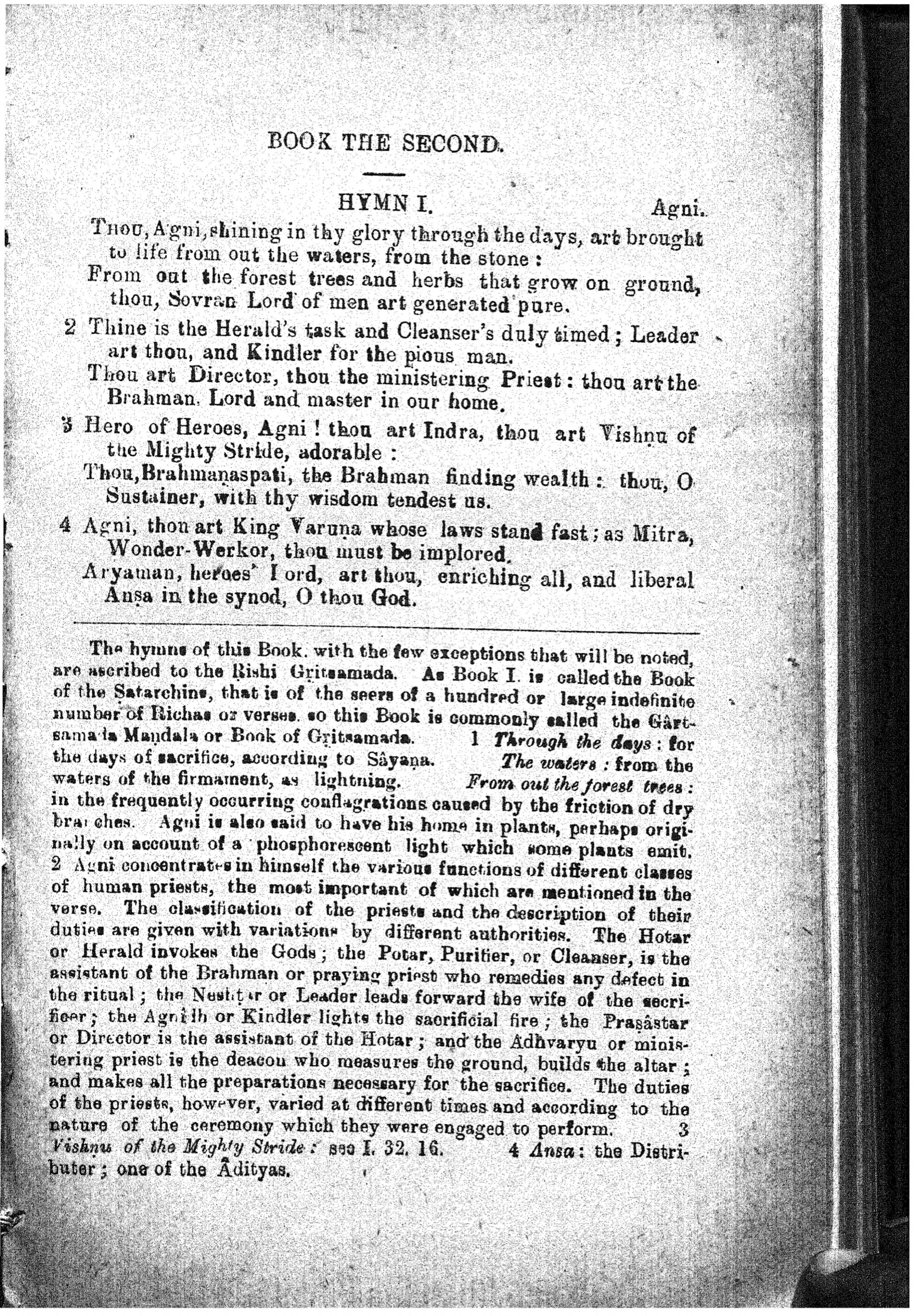
Picture: Facsimile of the associated hymn tradition. Opening of Ṛgveda Book II in Griffith’s The Hymns of the Rigveda, volume I, 1920 printing, page 259. The footnote names Gṛtsamada and the traditional attribution of the book; the page is a textual illustration, not a portrait.
Credit: R. T. H. Griffith; Arthur Probsthain. Source record, Public domain.
The round picture in the lists of the personalities is cropped from it.