




9 min read
Temple Builder
Gudea of Lagash
author: High Priest Zevios Metathronos
The Sacred Work of Building Well
Dates: Active in the 22nd century BCE; exact chronology varies.
Period: Ancient (6000–500 BCE).
Gudea ruled the Sumerian city-state of Lagash as ensi, governor, in the 22nd century BCE. The Cleveland Museum of Art counts “more than 2,400 inscriptions that describe his reign,” a reign of art patronage and “an extensive building program.”1
His great work was the Eninnu, the house of the warrior God Ningirsu at Girsu. Gudea rebuilt it with cedar rafted down from the Amanus and copper mined at Kimash, then had the whole undertaking set down as a hymn on 2 clay cylinders of 30 and 24 columns.2
Zevism reads Gudea as an early link in the chain of spirituality, a builder who served the divine order under the Sumerian names of his Gods. His rope, his pegs and his brick mould belong to Ma'at, the right order of the cosmos that Zeus holds as its Sovereign.
LIFE AND CONTEXT
Lagash lay in the far south of Mesopotamia, in modern Iraq, and its temple city was Girsu, today's Tello. The dates are disputed: Cleveland gives Gudea's reign as about 2144–2124 BCE, the Metropolitan Museum as about 2150–2125 BCE. The Met names his son Ur-Ningirsu as his successor.3
He didn't build only for Ningirsu. A seated statue in New York lists the work: after the Eninnu he raised the Sirara House for the Goddess Nanshe, “her Mountain rising out of the waters,” and the House of Girsu for his personal God Ningishzida. He also “built the individual houses of (other) great gods of Lagaš.”4
His reach ran far beyond the city. Statue B, the seated “Architect with Plan” in the Louvre, says Ningirsu “opened the roads for him from the Upper Sea to the Lower Sea,” and it names the sources: timber from the Amanus and from Ebla, stone slabs from the mountains of the Amorites, ebony and gold from Meluhha, bitumen from Madga. The same text records a war. Gudea “conquered the city of Anšan in Elam and brought its booty into the E-ninnu for Ninĝirsu.”5
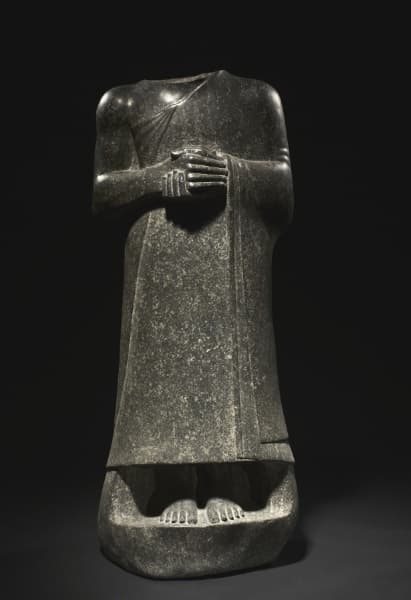
He also had himself carved in stone. The Cleveland curators explain that such statues “would have been placed in temples as stand-ins for Gudea himself.” Statue B names its material: “He imported diorite from the mountains of Magan, fashioned from it his statue.”6
The inscriptions don't say how Gudea died. His works came back to light 4 millennia later, when Ernest de Sarzec excavated Tello from 1877. The 2 building cylinders came out of the ground that first year and went to the Louvre, where Cylinder A stands 60 cm high and Cylinder B 56.5 cm.7
ATTAINMENTS
- He rebuilt the Eninnu, Ningirsu's temple at Girsu, and Statue B states his claim plainly: “No ruler but he has ever built a temple fashioned like this for him.”5
- He built at least 2 more sanctuaries, the Sirara House of Nanshe and the House of Girsu for Ningishzida, and houses for other Gods of Lagash.8
- He brought cedar timbers 60 and 50 kuš long and boxwood 25 kuš long down from the Amanus, and mined copper in the Kimash range for a mace that “no region can withstand.”5
- He had the building of the temple written as a single hymn on 2 terracotta cylinders, 30 columns on Cylinder A and 24 on Cylinder B, running to 1,363 lines in the Oxford translation.9
- He commissioned portrait statues in hard stone. Statue B, the “Architect with Plan,” 93 cm of diorite, holds a tablet with a building plan, a stylus and a graduated rule, and it's dedicated to Ningirsu.10
- At the temple's dedication he remitted debts and set aside the rank of master over slave for 7 days, a measure he reported on Statue B and in Cylinder B.11
KEY STORIES
The Dream at Nigin
Cylinder A opens in heaven. Enlil looked at Ningirsu “with approval,” and on that day “in a nocturnal vision Gudea saw his master, Lord Ninĝirsu,” who spoke to him of his house. Gudea couldn't grasp it. “The meaning of what the nocturnal vision brought to me I do not understand,” he said, and he resolved to take the dream to the Goddess Nanshe.12
He boarded his boat for Nigin. On the way he stopped to pray, and to the Goddess Gatumdug he said: “For me, who has no mother, you are my mother; for me, who has no father, you are my father.”13
At Nigin he laid out the vision. He had seen a man “as enormous as the heavens,” with wings like the Anzud bird and lions lying at his right and left. A woman held “a stylus of refined silver” over a tablet of stars. A warrior drew the plan of a house on lapis lazuli, a brick mould stood ready with the fated brick, and his master's donkey stallion pawed the ground.14
Nanshe read each figure. The giant was her brother Ningirsu, asking for the Eninnu. The woman was Nisaba, announcing “the holy stars auguring the building of the house.” The warrior was Nindub, drawing the plan. The stallion stood for Gudea himself, “who will paw the ground for the E-ninnu like a choice steed.”15
A City Cleansed and a Forest on the River
Gudea still wanted a sign. He slept in the temple, and Ningirsu “stepped up to the head of the sleeper” with a promise: “On that day I will touch your arm with fire and you will know my sign.” Gudea woke and shuddered: “it was a dream.” He checked the words by an omen taken from a white kid.16
Then he prepared the city. The poem says he “undid the tongue of the goad and the whip, replacing them with wool from lamb-bearing sheep. No mother shouted at her child.” He let “purifying fire loose over it” and expelled the unclean.17
Workers and timber came from every direction. “The Elamites came to him from Elam, the Susians came to him from Susa.” Ningirsu led Gudea into “the impenetrable mountain of cedars,” where he cut the trees “with great axes.” The rafts came down to the quay of Kan-sura, and “it was like a giant serpent floating on the water.” A copper mountain in Kimash “revealed itself to him,” and gold arrived “in dust form.”18
The First Brick
Gudea walked the site from the south and from the north. “He measured out with rope exactly one iku. He drove in pegs at its sides and personally verified them.” That night he prayed in the old temple, and at daybreak he bathed and dressed.19
Drums played while he poured clear water into the mould. He hoed “honey, ghee and precious oil” into the earth, then placed the clay and acted “exactly as prescribed.” He shook the brick out to dry and anointed it, and the sun God Utu “rejoiced over the brick.”20
When he lifted it from the mould, “it looked as a holy crown worn by An.” He carried it among his people and began to lay out the ground plan. The poet gives him a builder's nerves: “As if he were a young man building a house for the first time, sweet sleep never came into his eyes.”21
The 7 Days of Equality
Cylinder B brings the God home. “Warrior Ninĝirsu entered the house, the owner of the house had arrived,” and his consort Bau took possession of her own quarters. Gudea seated An at the place of honour at the banquet, with Enlil and Ninmah beside him.22
For 7 days the order of the city turned over. The slave woman was made “equal to her mistress and the slave was allowed to walk side by side with his master.” Gudea “provided protection for the orphan against the rich,” and “he had debts remitted and made all hands clear.”23
He made his statue carry the report to the God: “Statue, tell my lord: When I built the E-ninnu, his beloved temple for him, I remitted all debts, I pardoned everyone.” In Zevist terms the festival set Ma'at in the streets as firmly as in the brickwork.24
THE ZEVIST READING
Zevism holds that spirituality forms one chain from its inception to the present, and Gudea stands close to its Sumerian beginning. His Gods keep their own names in this reading: Enlil decides, Nisaba reads the stars, and when the work began “Enki put right the design of the house.”25 In the Temple's reading, that's the same craft intelligence the Hellenes later honoured in Athena and Hephaestus.
Egyptian religion called the right order Maat, “the personification of truth, justice, and the cosmic order,” and set it against isfet.26 Gudea's cylinders show Ma'at on 2 scales. A rope measured exactly and pegs checked by the ruler's own hand keep a building true. Remitted debts and an orphan protected against the rich keep a city true. Zevism counts both as the work of Zeus's order, and it counts the whip, the false measure and the crushing debt as Izfet.
Gudea didn't act on a dream he couldn't read. He took it to Nanshe, slept in the temple to receive a 2nd sign, and checked that sign by omen before he touched clay. Zevism calls this dimension of the path Theurgy: joining one's own intelligence to the intelligence of the Gods before acting.
Near its close, Statue B gives the stone a command: “O, statue, you turn your face towards Ninĝirsu!”27 The Temple reads that posture as the aim of the whole path, likeness to the divine “as far as possible,” ὁμοίωσις θεῷ κατὰ τὸ δυνατόν.28 The statue sits in Paris now, but the order cut into its diorite still turns it toward the God it was made to serve.
NOTES
1 Cleveland Museum of Art, Statue of Gudea, 1963.154.
2 Gudea Statue B v 21, ETCSRI; Louvre, Cylindre A de Gudea, MNB 1512; Louvre, Cylindre B de Gudea, MNB 1511.
3 Cleveland, 1963.154; Metropolitan Museum, Statue of Gudea, 59.2.
6 Cleveland, 1963.154; Statue B vii 10.
7 Louvre, MNB 1512; Louvre, Cylindre B de Gudea, MNB 1511.
8 Met, 59.2.
9 Louvre, MNB 1512; Louvre, MNB 1511; ETCSL 2.1.7, lines 1362–1363.
10 Louvre, AO 2.
11 Statue B vii 21; ETCSL 2.1.7, lines 1211–1223.
13 Lines 52–67.
14 Lines 101–123.
15 Lines 124–151.
16 Lines 226–322.
17 Lines 330–344.
18 Lines 386–451.
19 Lines 471–498.
20 Lines 499–522.
21 Lines 523–542.
23 Lines 1211–1223.
24 Statue B vii 21.
25 ETCSL 2.1.7, lines 463–481.
27 Statue B vii 49.
BIBLIOGRAPHY
University of Oxford, Electronic Text Corpus of Sumerian Literature, “The Building of Ningirsu's Temple (Gudea, cylinders A and B),” translation 2.1.7, ETCSL project, Faculty of Oriental Studies, 2003–2006; lines 1–32, 52–67, 101–151, 226–322, 330–344, 386–451, 463–542, 910–924, 1211–1223, 1258–1276 and 1362–1363.
Gudea Statue B (RIME 3/1.01.07, St B composite), Sumerian text and English translation, Electronic Text Corpus of Sumerian Royal Inscriptions, Oracc; columns v 21, vii 10, vii 21 and vii 49.
Musée du Louvre, “Gudea B dit ‘Architecte au plan’,” AO 2; description, dedication, material, dimensions and date.
Musée du Louvre, Cylindre A de Gudea, MNB 1512; dimensions, 30 columns, excavation at Tello in 1877, summary of contents.
Musée du Louvre, Cylindre B de Gudea, MNB 1511; dimensions, 24 columns, excavation by Ernest de Sarzec.
Cleveland Museum of Art, Statue of Gudea, 1963.154; reign dates, the title ensi, the count of inscriptions and the statues as stand-ins.
Metropolitan Museum of Art, Statue of Gudea, named “Gudea, the man who built the temple, may his life be long,” 59.2; reign dates, successor and translated inscription.
Encyclopaedia Britannica, “Maat”.
Plato, Theaetetus 176a–b, Greek text, Perseus Digital Library.
CREDIT
Picture: Headless statue of Gudea, twenty-second century BCE, dolerite; Cleveland Museum of Art 1963.154.
Cleveland Museum of Art, purchase from the J. H. Wade Fund, 1963.154; CC0. Image record, CC0.
The round picture in the lists of the personalities is cropped from it.