





9 min read
Lawgiver of Babylon
Hammurabi of Babylon
author: High Priest Zevios Metathronos
Judgment beneath a Sacred Standard
Dates: Reigned c. 1792–1750 BCE.
Period: Ancient.
Hammurabi was king of Babylon in the 1st dynasty of Babylon, and he reigned from about 1792 to 1750 BCE. He made Babylon the conqueror of Ur and Larsa. Near the end of his reign he had 282 legal judgments cut into a block of black basalt more than 2.25 m tall.1
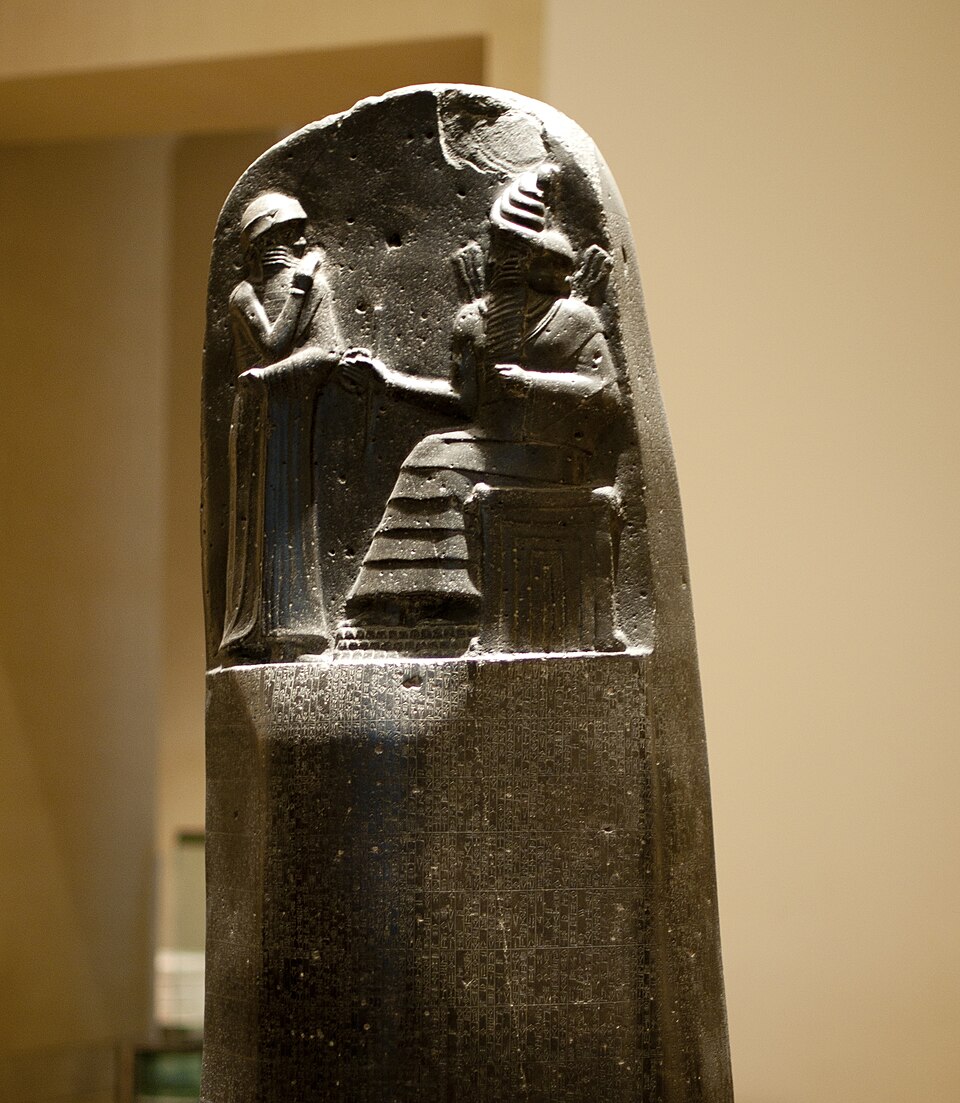
At the top of that stele he stands before Shamash, the sun God, who holds out to him the ring and the rod. The Louvre reads the scene as the meeting that legitimates the king's sovereignty and the judgments engraved below it.2
Zevism reads Hammurabi as a Babylonian link in the chain of spirituality, a lawgiver who served Shamash and Marduk under their own names. His stele set a written standard in public, and a written standard is the work of Ma'at, the order Zeus holds as Sovereign of the Cosmos.
LIFE AND CONTEXT
The king explained his mandate in the stele's prologue. Anu and Bel, it says, “called by name me, Hammurabi, the exalted prince, who feared God, to bring about the rule of righteousness in the land, to destroy the wicked and the evil-doers; so that the strong should not harm the weak.” He was to rule “like Shamash, and enlighten the land.”3
He built his kingdom by war. A Babylonian chronicle records the decisive campaign in the south: “Hammurabi captured Ur and Larsa and took their property to Babylon.” The prologue remembers him as “the warrior who guarded Larsa and renewed E-babbar,” and as the king “who spared the inhabitants of Mera and Tutul.”4
He governed by letter. L. W. King published 81 royal letters of the dynasty in 3 volumes, among them Hammurabi's orders to Sin-idinnam, who was, King judged, “a high official in Larsam and probably the governor of the city.” The letters went out on small oblong clay tablets sealed in clay envelopes.5
The stele came late in the reign. The Louvre dates the text to about 1750 BCE and warns that it “is not a ‛legal code' in the modern sense of the term; rather, it is a sweeping collection of jurisprudence.” The epilogue says why he had it made: “That the strong might not injure the weak, in order to protect the widows and orphans.”6
The same text weighs people by rank and uses hard penalties. “If a man put out the eye of another man, his eye shall be put out,” runs §196, yet §198 sets the price of a freed man's eye at 1 gold mina. A slave who denied his master lost his ear (§282), and a builder whose house fell and killed the owner's son lost his own son (§230).7
Britannica dates his death to about 1750 BCE. His stele didn't stay in Babylonia: the Elamite king Shutruk-Nahhunte, who reigned about 1185–1160 BCE, carried it to Susa “as a spoil of war.”8
ATTAINMENTS
- He captured Ur and Larsa, brought their property to Babylon and took the king of Larsa, Rim-Sin, to Babylon as a prisoner.9
- He restored the Gods' houses across the land: the prologue credits him with “enriching Nippur,” reestablishing Eridu and purifying “the worship of E-apsu,” enriching Ur and laying again “the foundations of Sippara.”10
- He had 282 judgments engraved around 1750 BCE on a basalt stele 225 cm high, 79 cm wide and 47 cm thick, now Louvre Sb 8.11
- He held judges to their verdicts: a judge whose written decision proved wrong through his own fault paid “twelve times the fine” and was “publicly removed from the judge's bench.”12
- He made builders answer for their work, requiring a builder whose walls seemed to be toppling to “make the walls solid from his own means.”13
- He corrected the calendar by royal order, inserting a 2nd month of Elul when the year fell short.14
- He ordered the landholders along the Damanum canal to clear its bed, and he sent a bribery case at Dur-gurgurri for investigation, with the guilty to be sent to Babylon.14
KEY STORIES
Rim-Sin Brought to Babylon
In the south Hammurabi's rival was Rim-Sin, ruler of Larsa, whom the chronicle calls king of Ur. The Chronicle of Early Kings, a later Babylonian compilation, tells the end of that rivalry in 5 short lines. “Hammurabi, king of Babylon, mustered his army and marched against Rim-Sin [I], king of Ur.”15
The campaign took both cities. “Hammurabi captured Ur and Larsa and took their property to Babylon.” The old king went with the spoils: “He brought Rim-Sin in a ki-is-kap to Babylon.” The chronicle doesn't explain the word, and the translators leave it untranslated.16
Hammurabi put a different face on the conquest in his prologue. There he's “the royal scion whom Sin made; who enriched Ur,” and “the warrior who guarded Larsa and renewed E-babbar, with Shamash as his helper.” The king who had taken both cities now claimed their temples as his own work.10
Orders to Larsa
Hammurabi ran the south from Babylon by clay tablet. King, who edited the letters, wrote that “no matter was too small to come under the royal cognizance,” and that the king who led campaigns could also notice “that his woodcutters in the forest were sending him dead or decayed wood instead of sound trunks.”17
One letter fixed time itself. The calendar had drifted, and Hammurabi wrote to Sin-idinnam: “Since the year (i.e. the calendar) hath a deficiency, let the month which is (now) beginning be registered as a second Elul.”18
Another fixed the water. He ordered Sin-idinnam to summon “the men who hold lands along the banks of the Damanum-canal” and make them clear out its bed.19
A 3rd went after corruption. “When a case of bribery was reported to have taken place in the city of Dur-gurgurri,” King summarises, the king “immediately forwarded the report to Sin-idinnam with instructions that he should investigate the affair and send the guilty parties to Babylon for punishment.”20
The Oppressed Man Before the Stone
The epilogue imagines a scene at the foot of the stele. “Let the oppressed, who has a case at law, come and stand before this my image as king of righteousness; let him read the inscription, and understand my precious words: the inscription will explain his case to him; he will find out what is just, and his heart will be glad.”21
The king then turned to his successors: “In future time, through all coming generations, let the king, who may be in the land, observe the words of righteousness which I have written on my monument.” Any king who annulled them was cursed in the name of the Judge: “May Shamash, the great Judge of heaven and earth, … shatter his dominion, annul his law, destroy his way.”22
The stone wasn't found in Babylonia. Nearly 6 centuries after Hammurabi, Shutruk-Nahhunte of Elam carried it to Susa, and the French mission of Jacques de Morgan dug it up there in 1902. The museum records the stone as broken. It went to the Louvre, where the king still stands before the seated Shamash. In Zevist terms the stele is a public measure of Ma'at that outlasted the kingdom that raised it.11
THE ZEVIST READING
Zevism holds that spirituality forms one chain from its inception to the present, and Hammurabi's Gods keep their names in it: Anu and Bel call him, Marduk sends him, Shamash hands him the ring and the rod. The king calls himself the one “on whom Shamash has conferred right.”22
The Temple reads that office through the Hellenic lens. Hesiod seats Justice, the daughter of Zeus, beside her father: when anyone hurts her, “she sits beside her father, Zeus the son of Cronos, and tells him of men's wicked heart,” until the people pay for princes who “pervert judgement and give sentence crookedly.”23 Hammurabi's 5th law strikes at that same crime in a Babylonian court. A judge whose written verdict proves wrong by his own fault pays 12 times the fine and never sits on the bench again.
Egyptian religion named the right order Maat, “the personification of truth, justice, and the cosmic order,” and set it against isfet.24 Hammurabi's best work restores Ma'at in plain ways. A calendar corrected, a canal cleared and a bribe investigated each bring a disordered thing back into measure. Writing the rules on stone in a public place, so that an oppressed man could read his case, set the order where anyone could check it.
The Good in Zevism is the conjunction of Ma'at and Right: right order together with a right act from a right will. Much of the stele meets both tests. Some of it doesn't. A builder's son put to death for his father's fault is order bought with an act against the innocent, and an eye priced by the rank of its owner measures persons unequally. The Temple keeps the standard and judges each clause by it.
Justice given a fixed written form can be read, argued over and appealed to by people who never met the king. In the Temple's reading that's what makes the stele a work of Zeus's order: the oppressed man of the epilogue could stand before it and find “what is just” without asking anyone's leave.
NOTES
1 Britannica, “Hammurabi”; Louvre, Sb 8; ABC 20, B obv. 10; Louvre, The Code of Hammurabi.
2 Louvre, Code de Hammurabi, Sb 8.
3 Code of Hammurabi, prologue, tr. L. W. King.
4 ABC 20, B obv. 8–12, Livius; Prologue.
5 King, Letters and Inscriptions of Hammurabi, vol. 3, introduction.
6 Louvre, The Code of Hammurabi; Epilogue.
7 Code of Hammurabi, §§196–198, 230, 282.
8 Britannica, “Hammurabi”; Louvre, The Code of Hammurabi.
10 Prologue.
11 Louvre, The Code of Hammurabi; Louvre, Sb 8.
14 King, vol. 3, introduction.
15 ABC 20, B obv. 8–9; King, vol. 3, introduction.
18 King, vol. 3, introduction; Letter 4.
19 King, vol. 3, introduction; Letter 5.
20 King, vol. 3, introduction and Letter 8.
22 Epilogue.
23 Hesiod, Works and Days 256–262.
BIBLIOGRAPHY
Musée du Louvre, The Code of Hammurabi, especially “A monument of ancient law” and “Hammurabi: a powerful ruler and upholder of justice.”
Musée du Louvre, Code de Hammurabi, Sb 8, Description, dimensions, excavation and Places and dates.
Yale Law School, Avalon Project, Code of Hammurabi, tr. L. W. King; prologue, §§5, 196–198, 230, 233, 282, and epilogue. Used for the identified passages without adopting outdated social terminology as current terminology.
Chronicle of Early Kings (ABC 20), B obv. 8–12, adapted from A. K. Grayson, Assyrian and Babylonian Chronicles (1975) and J.-J. Glassner, Mesopotamian Chronicles (2004), Livius.org.
L. W. King, ed. and tr., The Letters and Inscriptions of Hammurabi, King of Babylon, vol. 3, English Translations, London, Luzac, 1900, Cornell University Library copy, Internet Archive; preface, introduction and Letters 4, 5 and 8.
Johannes M. Renger, “Hammurabi”, Encyclopaedia Britannica; reign and death dates.
Hesiod, Works and Days 256–262, tr. H. G. Evelyn-White, Theoi Classical Texts Library.
Encyclopaedia Britannica, “Maat”.
CREDIT
Picture: Stele of Hammurabi, Louvre. Photograph by Urko Dorronsoro, 2011; CC BY-SA 2.0. The ancient relief shows Hammurabi before Shamash.

Photograph by Urko Dorronsoro, 2011, via Wikimedia Commons; CC BY-SA 2.0. Image record, CC BY-SA 2.0.
The round picture in the lists of the personalities is cropped from it.