




9 min read
Pharaoh of Egypt
Hatshepsut
author: High Priest Zevios Metathronos
The Ruler Who Offers Before the Gods
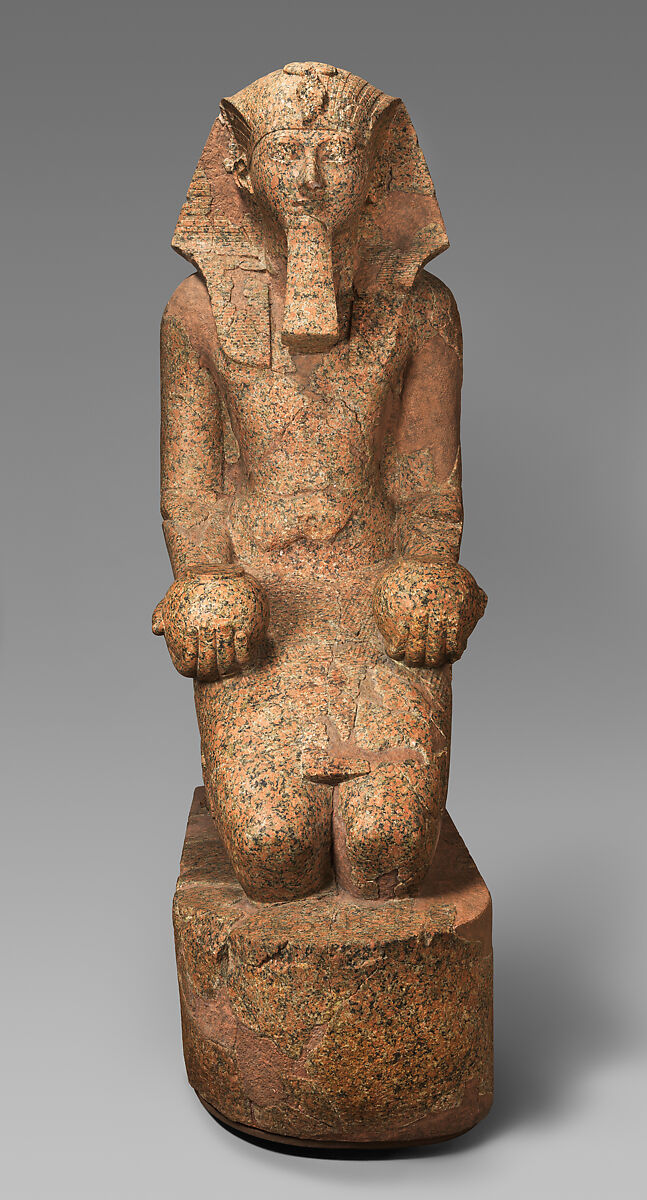
Dates: 15th century BCE; reign as king conventionally dated around 1473–1458 BCE.
Period: Ancient (6000–500 BCE).
Hatshepsut was a queen of Egypt's 18th Dynasty who made herself king. Sometime between years 2 and 7 of her young nephew Thutmose III, she took the full titulary of a pharaoh, and she ruled for about 20 years under the throne name Maatkare.1
Her great work is Djeser-djeseru, the terraced temple at Deir el-Bahri, with 26 colossal statues along its front. On its walls she had carved the fleet she sent to the land of Punt in her 9th year.2
Zevism reads her reign as a link in the chain that runs through Egypt: a ruler whose statues knelt to offer Maat, right order, to Amun-Re. That order is the one Zeus holds as Sovereign of the Cosmos.
LIFE AND CONTEXT
She was the daughter of Thutmose I and a wife of Thutmose II, “his son by another marriage.” The Met calls her the “principal queen” of this half-brother, the 4th king of the dynasty. When Thutmose II died young, the throne passed to his small son Thutmose III, and Hatshepsut “seems to have taken over the task of government.”3 The Met names her role at first: she “acted as regent for her young stepson/nephew.”4
Then she took the crown itself, with all 5 royal names. Her Horus name was Weseretkau, her throne name Maatkare, her birth name Hatshepsut. Thutmose III remained on the throne beside her, and the 2 ruled together.5
Her sculptors had to show a woman in an office shaped for men. They carved her as “the ideal Egyptian king,” with nemes headcloth, false beard and kilt, but each inscription kept “her personal name, Hatshepsut” or “a feminine pronoun or verb form.” The Met concludes that “the masculine garb and physique were not intended to trick people into thinking that she was a man.”6
Her court ran a prosperous state. She “renewed trade with western Asia to the east, the far-off land of Punt to the south, and the Aegean Islands to the north,” and she restored monuments wrecked in the Second Intermediate Period. Of her officials, “Senenmut was the best known and the most often represented.”4
Senenmut, her chief steward, is thought to have directed the work at Deir el-Bahri. The temple rose in terraces against the mountain cliffs of western Thebes and held large sanctuaries for Hathor, Amun-Re, Anubis and Re. Its builders dropped the old chamber for the king's own cult and set the royal image outside, in colossal statues along the front.7
Her tomb was cut into the rock of the Valley of the Kings, KV 20.8 Her memory didn't survive her intact. Her statues were broken and her name was cut from monuments, and the Met states plainly that the reasons “are still unclear.”4
ATTAINMENTS
- She built Djeser-djeseru at Deir el-Bahri, a temple of terraces joined by ramps, with “triple tiered pillared halls” and 26 colossal statues on its front; the chief steward Senenmut is thought to have run the project.7
- She held the kingship for about 20 years, from around 1473 to 1458 BCE, under a full royal titulary of 5 names, from the Horus name Weseretkau to the throne name Maatkare.9
- She sent an expedition by sea to Punt, at the southern end of the Red Sea, in her 9th regnal year, and recorded it in reliefs on the portico of the temple's 2nd terrace.10
- She reopened trade in 3 directions, to western Asia, Punt and the Aegean, and paid for sculpture and decorative art that the Met calls “remarkable innovations.”4
- She repaired monuments “destroyed during the disruptive Second Intermediate Period,” when a dynasty of Asian princes had held the north.4
- She raised an obelisk at Karnak, where fragments of a 2nd also survive, and cut inscriptions in the chapel of the Goddess Pakhet near Beni Hasan.11
- She lined the processional way with granite kings on their knees. The 2 in New York stand 261.5 cm and 295.9 cm high.12
KEY STORIES
The Fleet to Punt
In the 9th year of her reign, Hatshepsut's ships sailed down the Red Sea to Punt. The route wasn't new. Punt had traded with Egypt over at least 1,100 years, sending “incense, gold, leopard skins, and living baboons.”13 The voyage is carved on the Punt portico of Deir el-Bahri, and 2 of its blocks, painted limestone 49.3 cm high, are now in Cairo. There Parehu, king of Punt, stands with his wife Ati behind him, and men follow carrying “incense, myrrh, gold, and ivory.”10
Other scenes follow the fleet home, and live baboons ride among the cargo. The reliefs show “seven examples of Papio hamadryas depicted in the rigging of Egyptian ships returning to Egypt from Punt.”13
The fleet also brought trees. In the Oriental Institute's photographic record of the site, dated 26 January 1920, the captions note the “position of trees brought from Punt shown by holes” along the causeway, and the “stump of a tree brought from Punt.”14
In 2020 isotope tests on mummified baboons took up the old question of where Punt lay. The tests sourced 2 New Kingdom animals to “a region that encompasses much of present-day Ethiopia, Eritrea, and Djibouti.”15
Amun Crosses the River
Once a year, at the Beautiful Feast of the Valley, the image of Amun-Re left Karnak. The procession carried him in his sacred barque across the Nile to the west bank, then followed “a roadway lined with sphinxes” to Hatshepsut's temple, whose central sanctuary belonged to him.16
Along the temple's axis the God passed between colossal granite statues of the king on her knees. The inscription on one of them, now in New York, names her gift: “Hatshepsut is offering Amun Maat,” which the Met renders as “order, truth, or justice.”17
So the procession staged a meeting. The God came across the water, and the ruler met him on her knees, handing back the order she governed by. Her throne name, Maatkare, carried the same word. In Zevist terms the statues set Ma'at on the road where the God would see it.5
The Statues in the Quarry
Once 20 years had passed after her death, her nephew Thutmose III “had her statues smashed and her name and image erased from all monuments.”4 The broken stone didn't vanish. Much of it ended up in a quarry and along a causeway beside the temple, and there it lay for over 3 millennia. On the temple itself, “the most noticeable damage was the destruction of the Osirides,” the colossal statues of the king in the form of Osiris.18
The Metropolitan Museum had worked in western Thebes since 1911, and from 1922 its digging took in the forecourt and the lower and middle terraces of Hatshepsut's temple. In 1926 the expedition found “masses of broken Hatshepsut statuary at the Mentuhotep causeway and in the so-called Senenmut-quarry.”7 Seasons of digging followed. The fragments given to New York “were reconstructed in New York by attaching them to metal armatures and filling in the gaps with plaster.”17
One seated statue had a stranger history. Karl Richard Lepsius had carried its lower part to Berlin in 1845, and its head, left forearm and pieces of the throne came out of the Senenmut Quarry in the 1926–27 season. The statue is 197 cm of painted, indurated limestone, and the titles on its throne are feminine: “the Perfect Goddess, Lady of the Two Lands,” and “Bodily Daughter of Re.”19
THE ZEVIST READING
Egyptian religion named Maat “the personification of truth, justice, and the cosmic order” and set her against isfet, disorder.20 Hesiod gives the Hellenic form of the same truth: Dike, the daughter of Zeus, sits beside her father and tells him of human injustice.21 Herodotus drew the same line between the 2 lands when he wrote that “the Egyptians call Zeus Amun.”22 Zevism reads Maat and Dike as 1 order under 2 languages, held by Zeus as Sovereign of the Cosmos, and Hatshepsut's God as a name of the same sovereignty.
The kneeling statues turn that order into a gesture. The ruler holds Maat out to Amun, and the office bows to its source. Zevism sees in this the right shape of rule: power that knows where its order comes from and hands it back to the God who gave it.
Her reign also fits the Temple's figure of the Creator. The andrapod lives among ruins and answers them with complaint and nostalgia. Hatshepsut inherited a country with monuments broken in the Second Intermediate Period, and she repaired them, reopened the sea road to Punt and built a new temple against the cliffs. In the Temple's doctrine that's the Creator's answer to ruin: creation is open forward, and it requires work.
The erasure after her death belongs to Izfet. Whatever the motive, cutting a true name out of the record is a small collapse of order. The excavators who pieced the granite back together on its armatures, and set her feminine titles where visitors could read them again, restored a true record, and that's Ma'at's work.
NOTES
1 Metropolitan Museum, Seated Statue of Hatshepsut, 29.3.2; Met, Hatshepsut: From Queen to Pharaoh.
2 Dieter Arnold, “Model of the Temple of Hatshepsut,” Met, 2023; Egyptian Museum Cairo, Punt reliefs.
3 UCL, Digital Egypt, “Hatshepsut”.
6 Met, Large Kneeling Statue of Hatshepsut, 30.3.2.
7 Arnold, “Model of the Temple of Hatshepsut”.
8 UCL.
9 UCL, titulary; Met, exhibition overview.
10 Egyptian Museum Cairo, Punt reliefs.
12 Met, 29.3.1; Met, 30.3.2.
13 Dartmouth, 15 December 2020.
14 Oriental Institute, “Deir el-Bahri and the Temple of Hatshepsut”.
15 Dominy et al., eLife 9 (2020), e60860.
16 Met, Large Kneeling Statue of Hatshepsut, 29.3.1.
17 Met, 29.3.1.
18 Arnold.
19 Met, Seated Statue of Hatshepsut, 29.3.2.
21 Hesiod, Works and Days 256–262.
22 Herodotus 2.42, tr. G. C. Macaulay.
BIBLIOGRAPHY
University College London, Digital Egypt for Universities, “Hatshepsut”; family, regency, titulary, main buildings, Punt and tomb.
The Metropolitan Museum of Art, Hatshepsut: From Queen to Pharaoh, exhibition held 28 March–9 July 2006; overview of reign, trade, restoration, Senenmut and later destruction.
The Metropolitan Museum of Art, Large Kneeling Statue of Hatshepsut, 29.3.1; Amun-Re, the Beautiful Feast of the Valley, the offering of Maat, Senenmut Quarry excavations of 1927–28 and modern reconstruction.
The Metropolitan Museum of Art, Large Kneeling Statue of Hatshepsut, 30.3.2; royal iconography, feminine inscriptions, dimensions and date.
The Metropolitan Museum of Art, Seated Statue of Hatshepsut, 29.3.2; accession between years 2 and 7 of Thutmose III, feminized titles, Lepsius and the 1926–27 season.
Dieter Arnold, “Model of the Temple of Hatshepsut at Deir el-Bahri”, The Metropolitan Museum of Art, 21 December 2023; Djeser-djeseru, Senenmut, the 26 colossi, destruction and the 1926 finds.
Egyptian Museum Cairo, “Wall reliefs with scenes of an expedition to Punt”; Punt portico, 9th regnal year, Parehu and Ati.
Oriental Institute, University of Chicago, “Deir el-Bahri and the Temple of Hatshepsut”, photographs and captions of 26 January 1920, N. 4240 and N. 4247.
Nathaniel J. Dominy, Salima Ikram, Gillian L. Moritz et al., “Mummified baboons reveal the far reach of early Egyptian mariners”, eLife 9 (2020), e60860, doi:10.7554/eLife.60860; with Dartmouth College, “Mummified Baboons Shine New Light on the Lost Land of Punt”, 15 December 2020.
Encyclopaedia Britannica, “Maat”.
Herodotus, Histories 2.42, tr. G. C. Macaulay, Internet Sacred Text Archive.
Hesiod, Works and Days 256–262, H. G. Evelyn-White translation, Theoi Classical Texts Library.
CREDIT
Picture: Large Kneeling Statue of Hatshepsut, c. 1473–1458 BCE, granite with modern restoration; The Metropolitan Museum of Art, 29.3.1.
The Metropolitan Museum of Art, Rogers Fund, 1929, 29.3.1; public domain. Image record, Public domain (Met Open Access).
The round picture in the lists of the personalities is cropped from it.