






3 min read
Master Shrine Builder
Heinouchi Yoshimasa
author: High Priest Zevios Metathronos
The master carpenter who preserved the knowledge of shrines
Dates: documented activity 1608–1610 CE
Period: Renaissance (1336–1650 CE)
Region: Japan
Tradition: shrine and temple architecture
Religion or tradition: Documented service to Shinto shrines and Buddhist temples; personal religious affiliation not securely established.
Heresy status: No designation documented.
Heinouchi Yoshimasa is remembered through the architectural knowledge preserved in the Shōmei. The distinction between father and son matters: Yoshimasa supplied the accumulated instruction, while his son Masanobu wrote the work in 1608. Yoshimasa added an instruction in 1610 concerning the preservation of the family’s knowledge. His exact birth and death dates are not securely supplied by the architectural reference used here.1
RELIGIOUS SETTING AND SERVICE TO SACRED PLACES
Yoshimasa’s documented work belongs to the architectural world of Shinto shrines and Buddhist temples. The Shōmei preserves instruction concerning both. This establishes the religious settings his craft served, while leaving his exclusive personal affiliation unconfirmed. No Christian heresy designation is documented.1
Service to the Gods: a Zevist interpretation. Knowledge becomes service when a builder makes a sanctuary fit for worship and teaches others to continue that work. Yoshimasa’s relevance to the Gods rests on this concrete contribution to sacred places, including shrines of the kami. The Buddhist commissions retain their own religious identity within the same architectural record.
HELPING SUCCESSORS INHERIT A DEMANDING CRAFT
The architectural instruction associated with Yoshimasa joined proportion with drawing, carving and work in timber. Its organization in the Shōmei, written down by Masanobu, made the accumulated knowledge of a building family available for continued transmission. Yoshimasa’s later instruction concerning its preservation shows that the survival of this knowledge was itself a responsibility.2
The benefit reaches both sacred and ordinary building. Gates, shrines, pagodas, temples and residences appear within the work’s scope. For religious communities, competent construction provides places capable of sheltering repeated worship; for later craftsmen, recorded standards make disciplined learning possible. Yoshimasa’s service can therefore be understood through the successors his teaching equipped and the sacred places that such a craft could continue to build and maintain.
THE RESPONSIBILITIES OF A BUILDING MASTER
The Shōmei arranges its material in five scrolls dealing with gates, shrines, pagodas, temples and residences. Its instruction joins proportional calculation with drawing, carving and the practical handling of timber. The Heinouchi family served as official carpenters; the reference also connects its work with Wakaura Tenmangū and Izumo Taisha. The text survives in later copies rather than an extant original manuscript.3
This evidence makes Yoshimasa an architectural personality of particular value. The work preserves decisions that otherwise remain hidden behind a finished building: how its parts relate, how a design becomes repeatable, and how a successor learns to judge whether the result is sound. The sacred commission depends upon this ordinary precision.
A ZEVIST INTERPRETATION
Yoshimasa’s contribution is service to the places where religious life continues. His inclusion rests on the architectural tradition he transmitted, without assigning him an undocumented private theology. Shinto shrines and Buddhist temples retain their distinct identities in that record.
For the Zevist reader, he exemplifies mastery sustained across generations. Personal skill has limited reach if it disappears with its possessor. Recording it makes another person’s excellence possible. The master’s responsibility therefore includes teaching, correction and the preservation of standards.
His example is especially useful beside those of poets and philosophers. Sacred culture also needs builders who understand materials, measures and long use. A shrine’s capacity to shelter worship is part of its achievement. The religious value of skilled construction can be studied in that concrete service.
NOTES
2 JAANUS account of the Shōmei.
3 JAANUS.
BIBLIOGRAPHY
Japanese Architecture and Art Net Users System (JAANUS), “Shōmei 匠明,” specialist architectural reference, full entry.
CREDIT
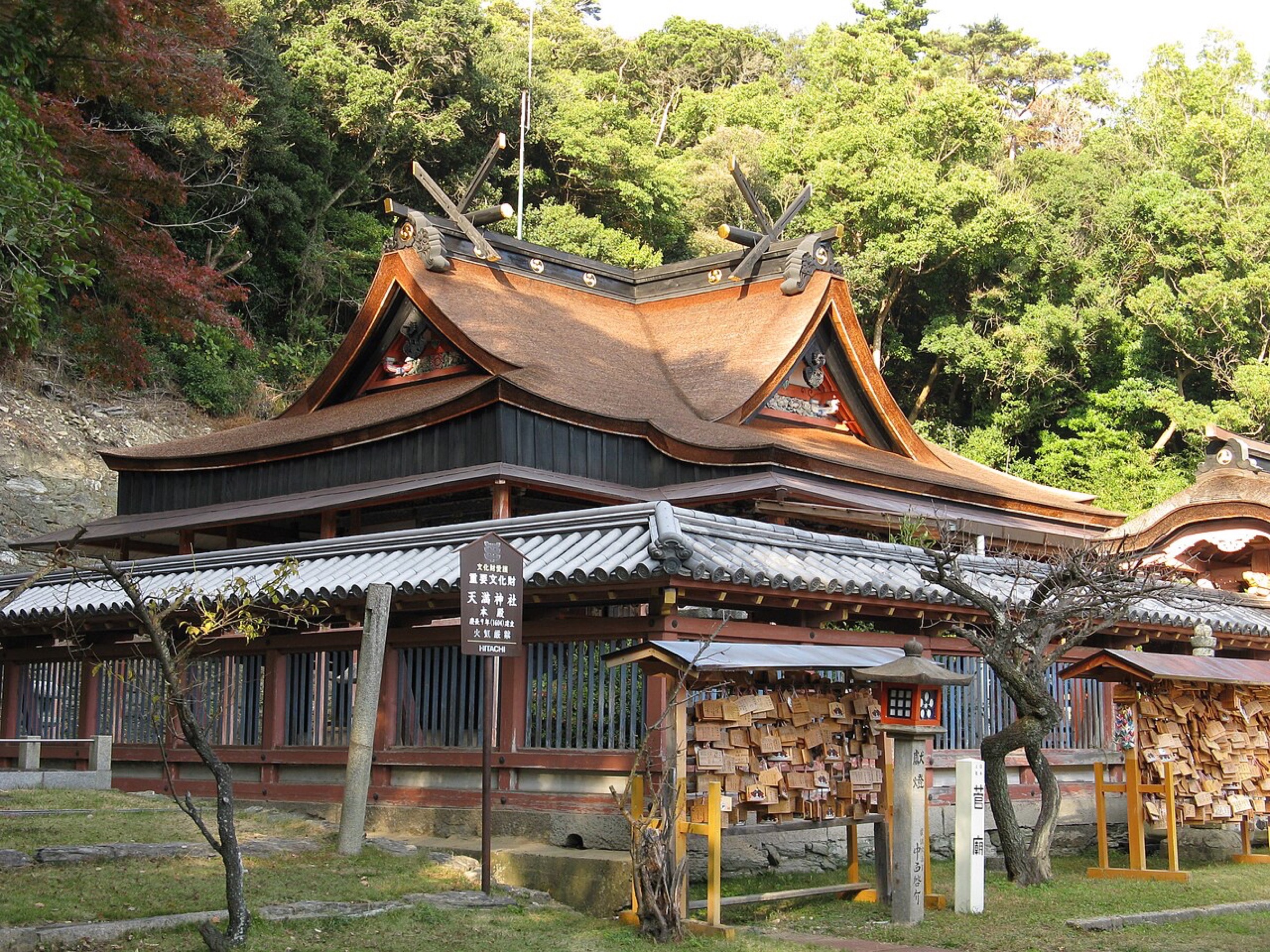
Picture: Associated shrine architecture. The worship hall and main sanctuary of Wakaura Tenmangū, photographed by KENPEI in 2008. JAANUS connects the Heinouchi family’s building work with this shrine; the photograph illustrates that architectural setting.
Credit: KENPEI. Source record, CC BY-SA 3.0.

The round picture in the lists of the personalities is cropped from it.