




9 min read
Great Engineer
Hero of Alexandria
author: High Priest Zevios Metathronos
Intelligence in the Work of the Hand
Dates: Active in the 1st century CE; conventionally c. 10–c. 75 CE
Period: Roman (30 BCE–800 CE)
Hero of Alexandria described over 100 machines, among them “a fire engine, a wind organ, a coin-operated machine, and a steam-powered engine called an aeolipile.” He also wrote down the rule that finds the area of a triangle from its 3 sides alone.1
He taught in Alexandria in the 1st century CE, and a lunar eclipse he mentioned as recent fixes his date: 13 March 62. His books carried the mathematics and engineering of Babylon, Egypt and the Greek cities into one written body.2
Zevism reads his work under Hephaestus and Athena, who taught men their crafts, and under Prometheus, whose stolen fire became “a teacher to mortals in every art.”3 Hero made fire turn a ball and open a temple's doors, and he wrote the method down for others to build.
LIFE AND CONTEXT
Nothing survives of Hero's life outside his books. For a long time scholars couldn't agree on his century. One school put him around 150 BCE, partly because he quotes no author later than Archimedes, and another put him around 250 CE.4
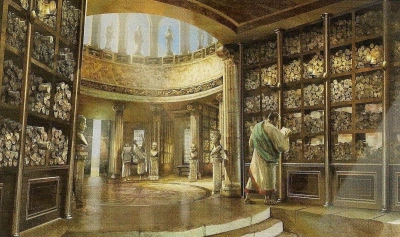
Alexandria had bred a pioneer of air and water machines well before him. Vitruvius, who wrote in the 1st century BCE, says Ctesibius, “a barber's son” of that city, “was the first who found out the properties of the wind, and of pneumatic power.” He hung a mirror in his father's shop on a lead weight that ran in a tube, heard the trapped air sound as the weight fell, and went on to build “hydraulic machines,” automata and water clocks.5
Hero's writings suggest he taught at the Museum of Alexandria. MacTutor describes them as looking “like lecture notes from courses he must have given there on mathematics, physics, pneumatics, and mechanics.” They're practical in tone: how to measure a field, lift a stone, survey a line or build an instrument.4
He built on older work. His Mechanica follows ideas of Archimedes closely, the 3rd book of the Metrica takes up a problem Euclid had studied, and his method for square roots was “known to the Babylonians 2000 years before.” Britannica sums up the result: his writings “preserved for posterity a knowledge of the mathematics and engineering of Babylonia, ancient Egypt, and the Greco-Roman world.”6
The surviving titles cover surveying in On the Dioptra, air and water machines in the 2 books of the Pneumatica, a puppet stage in The Automaton Theatre, war engines in the Belopoeica, heavy lifting in the 3 books of the Mechanica, and mirrors in the Catoptrica. The Cheirobalistra, on catapults, carries his name but “was almost certainly not written by Heron.”4
His books had to be found again. The Metrica, his main geometrical work, “was lost until 1896.” The Pneumatics reached English readers in 1851, translated by Joseph George Greenwood and edited by Bennet Woodcroft in London.7
ATTAINMENTS
- He gave the rule for a triangle's area from its sides: if s is half the perimeter, the area squared equals s(s − a)(s − b)(s − c). For sides 13, 14 and 15, s is 21, the product is 7,056 and the area is 84.4
- The Metrica, in 3 books, measured areas of triangles, quadrilaterals and regular polygons of 3 to 12 sides, then volumes of spheres, cones, prisms and pyramids, and finally divided areas and volumes “according to a given ratio.”4
- He worked the square root of 720 to 26 5/6, whose square is 720 1/36, and showed how to repeat the step for a closer value.4
- The Pneumatica, in 2 books, studied “mechanical devices worked by air, steam or water pressure,” from the aeolipile to a fire engine and a wind organ.4
- The Mechanica, written in 3 books for architects, treated lifting “heavy objects with a lever, a pulley, a wedge, or a screw,” centres of gravity, sledges, cranes and wine presses.4
- On the Dioptra explained a sighting instrument for surveying and added a method for finding the distance from Alexandria to Rome by timing an eclipse of the Moon in both cities.4
- The Catoptrica treated mirrors and the paths of light. MacTutor summarises his view: vision “results from light rays emitted by the eyes,” and the rays “travel with infinite velocity.”4
- The Automaton Theatre described “a puppet theatre worked by strings, drums and weights.”4
KEY STORIES
The Eclipse of 13 March 62
The dioptra was a sighting instrument for surveyors, and MacTutor groups the book with “theodolites and surveying.” In it Hero set a problem that no one could solve by walking: how far is Rome from Alexandria? His answer used the sky. An eclipse of the Moon happens at the same instant for everyone who sees it. Observers in the 2 cities would note the local hour. Rome lies to the west, so its clocks would read earlier, and the difference between the 2 hours would give the difference in longitude, and from it the distance.4
He illustrated the method with a recent eclipse, and that example dated him. In 1938 Otto Neugebauer, an Austrian mathematician who studied ancient astronomy, worked through Hero's data and matched it to an eclipse at Alexandria “at 23.00 hours on 13 March 62.” The long argument between 150 BCE and 250 CE ended there, since Hero had called the eclipse recent. A man remembered for temple wonders was dated by the sky he'd used as a surveying instrument.8
Fire on the Altar and Steam in the Ball
Section 37 of the Pneumatics describes a small temple with an altar in front. When a fire was lit on the altar, the temple doors swung open by themselves; when the fire died down, they closed again.9
Hero showed the hidden works. The fire heated air in a closed space, and the expanding air drove liquid into a hanging vessel. As that vessel filled and grew heavier, it sank and pulled on chains wound round the door pivots, and the doors turned. When the fire went out, the vessel lightened again, and a counterweight pulled the doors shut. It's a design on the page, and the text doesn't show that any temple installed it.10
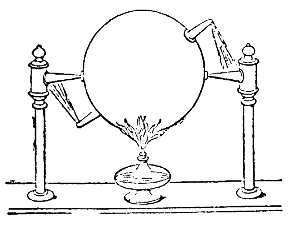
Section 50 puts the same fire to another use. A vessel of water sat over the flames, and its steam passed into a hollow ball held on a pivot. The ball carried 2 bent pipes, turned in opposite directions, and when steam rushed out of both, the ball spun on its axis. Hero specified the pivot and the opposed bends, the details that make it work.11
The aeolipile, as it was later called, wasn't an industrial engine. Its description still records heat turned into rotation, exactly enough for a reader to rebuild the device.
The Side of 720
The Metrica keeps a lesson in Hero's own voice. “Since 720 has not its side [rational], we can obtain its side within a very small difference as follows.” The nearest square above it, he went on, is 729, “which has 27 for its side.”4
Then came the steps: “divide 720 by 27. This gives 26 2/3. Add 27 to this, making 53 2/3, and take half this or 26 5/6.” He checked the result by squaring it and got 720 1/36, off by 1/36. For a closer answer he told the reader to run the same steps again from 26 5/6.4
The method was old when Hero used it. It had been “known to the Babylonians 2000 years before,” and he passed it on in Greek to the surveyors and engineers who read him.4
THE ZEVIST READING
The Homeric Hymn to Hephaestus praises the God “famed for inventions,” who “with bright-eyed Athene” taught men crafts after ages spent in caves “like wild beasts.”12 Hero's fire engine, wind organ, cranes and screws belong to that gift. Zevism reads a workshop as a place of the Gods' work when it follows the order of materials honestly, and Hero never hid the order: he wrote out every chain and weight.
Aeschylus gives Prometheus the claim that “every art possessed by man comes from Prometheus,” and has him hide fire in a fennel stalk as “a teacher to mortals in every art.”13 The aeolipile and the temple doors take that fire a step further. Heat becomes motion, and motion becomes a working machine that others can copy. Hero didn't keep his fire secret. He published it, which in Zevist terms completes the Promethean gift.
The temple doors show how Zevism reads wonder. The altar fire, the builder's hidden vessel and the opening doors form one act of worship, and knowing the mechanism takes nothing from it, since the craft that serves the altar is itself a gift of the Gods.
Plato's Theuth invented “numbers and arithmetic and geometry and astronomy.”14 Hero's books use all 4: the root of 720, the areas of the Metrica, the sightlines of the dioptra and the eclipse that measured the road to Rome. Zevism reads that range as the Logos applied to ground, water and sky.
Hero also stands in the long chain that Zevism traces through every tradition. A Babylonian root method, Egyptian mathematics, Archimedes' levers and Euclid's divisions passed through his hands into a single Greek corpus. The Metrica divides areas and volumes in exact ratios, the arithmetic of fair shares and true boundaries, and Zevism counts such work as the restoring of Ma'at against the disorder of disputed land.15 The Temple honours him as a keeper of the source who added his own measure to it.
NOTES
1 O'Connor and Robertson, “Heron of Alexandria”.
2 O'Connor and Robertson; Britannica, “Heron of Alexandria”.
3 Homeric Hymn to Hephaestus 1–4; Aeschylus, Prometheus Bound 107–111.
5 Vitruvius, On Architecture 9.8.2–4; O'Connor and Robertson.
6 O'Connor and Robertson; Britannica.
7 Britannica; Library of Congress catalogue record.
8 O'Connor and Robertson; O'Connor and Robertson, “Otto Neugebauer”.
10 Pneumatics §37.
12 Homeric Hymn to Hephaestus 1–4.
13 Aeschylus, Prometheus Bound 107–111, 505–507.
BIBLIOGRAPHY
J. J. O'Connor and E. F. Robertson, University of St Andrews, “Heron of Alexandria”, MacTutor History of Mathematics; chronology, Neugebauer's eclipse, the Museum, list of works, Metrica, square root of 720, Pneumatica and Mechanica.
Encyclopaedia Britannica, “Heron of Alexandria”; floruit c. 62 CE, transmission of Babylonian, Egyptian and Greco-Roman knowledge, Metrica lost until 1896.
Hero of Alexandria, The Pneumatics of Hero of Alexandria, translated by Joseph George Greenwood, edited by Bennet Woodcroft (London: Taylor, Walton and Maberly, 1851), §§37 and 50, pp. 57–58 and 72. Library of Congress digitized volume.
Homeric Hymn 20 to Hephaestus 1–4, H. G. Evelyn-White translation, Theoi Classical Texts Library.
Aeschylus, Prometheus Bound 107–111 and 505–507, translated by Herbert Weir Smyth, Theoi Classical Texts Library.
Encyclopaedia Britannica, “Maat”.
Plato, Phaedrus 274c–d, translated by H. N. Fowler, Perseus Digital Library.
Vitruvius, On Architecture, book 9, chapter 8, translated by Joseph Gwilt (1826), LacusCurtius; 9.8.2–4 on Ctesibius.
J. J. O'Connor and E. F. Robertson, “Otto Neugebauer”, MacTutor History of Mathematics.
CREDIT
Picture: Diagram of Hero’s aeolipile in Nordisk familjebok (1907), a later illustration of the described device.
Unidentified illustrator, Nordisk familjebok, volume7 (1907); Wikimedia Commons; Public domain; anonymous historical illustration (Commons PD-anon-70 and PD-Ugglan). Image record, Public domain; anonymous historical illustration (Commons PD-anon-70 and PD-Ugglan).

The round picture in the lists of the personalities is cropped from it.