



9 min read
Poet of the Theogony
Hesiod
author: High Priest Zevios Metathronos
Justice, Honest Work and the Gift of a Well-Governed Voice
Dates: Active around 700 BCE; exact life dates are unknown.
Period: Ancient (6000–500 BCE).
Hesiod was a poet from Ascra, below Mount Helicon in Boeotia, who became, with Homer, the poet of the Greek Gods. Britannica dates him to about 700 BCE. Herodotus put both poets 400 years before his own time and said they “made a theogony for the Hellenes and gave the titles to the gods and distributed to them honours and arts.”1
His Theogony tells how the Gods were born and how Zeus came to rule them. His Works and Days turns to men, and it sets Justice beside Zeus: “virgin Justice, the daughter of Zeus,” who “sits beside her father” and “tells him of men's wicked heart.”2
Zevism reads Hesiod as the Hellenic poet of Zeus's sovereignty and of Dike, the Greek name for the order Egypt called Ma'at. He also taught that the road to excellence is paved with work, and the Temple holds that creation requires exactly that.
LIFE AND CONTEXT
His father came by sea from Aeolian Cyme. He fled, Hesiod says, “not from riches and substance, but from wretched poverty which Zeus lays upon men,” and settled “near Helicon in a miserable hamlet, Ascra, which is bad in winter, sultry in summer, and good at no time.”3
Hesiod kept sheep there. By his own account the Muses found him “tending flocks of sheep in a valley of Helikon” and made him a poet.4
The family land brought trouble. The brothers divided the inheritance, and Hesiod accuses Perses: “you seized the greater share and carried it off,” to the profit of “our bribe-swallowing lords who love to judge such a cause as this.” The Works and Days is addressed to that brother.5
He wasn't a traveller. “For never yet have I sailed by ship over the wide sea,” he says, “but only to Euboea from Aulis.”6
Even in antiquity nobody agreed on what he'd written. Pausanias found that the Boeotians around Helicon held “that Hesiod wrote nothing but the Works,” and they rejected even its prelude to the Muses. Others credited him with the Theogony, a poem on women and the Great Eoeae.7
Read without its prelude, as the Helicon tradition read it, the Works begins “with the account of the Strifes.” Hesiod's first lesson is that there are 2 of them: “There was not one kind of Strife alone, but all over the earth there are two.” One “fosters evil war and battle, being cruel.” The other “stirs up even the shiftless to toil,” because a man “grows eager to work when he considers his neighbour, a rich man who hastens to plough and plant.”8
ATTAINMENTS
- He composed the Theogony, the Greek account of the Gods' descent, in which the Gods, after their war with the Titans, press “far-seeing Olympian Zeus to reign and to rule over them,” and Zeus divides “their dignities amongst them.”9
- He composed the Works and Days, a poem of farming and of justice addressed to his brother, with rules for the neighbour, the field and the court.10
- With Homer he gave the Hellenes their theogony, the titles, honours and arts of the Gods, in Herodotus' judgment.11
- He named the powers of order as the children of Zeus. Zeus married Themis, “who bare the Horae (Hours), and Eunomia (Order), Dike (Justice), and blooming Eirene (Peace).”12
- He won a singing contest at the games of Amphidamas at Chalcis and took home a tripod, which he dedicated to the Muses on Helicon.13
- He set the ethic of labour in single lines, among them “Work is no disgrace: it is idleness which is a disgrace.”14
- His Works was still kept at Helicon centuries later, where Pausanias saw it engraved on “a tablet of lead where the spring is, mostly defaced by time.”15
KEY STORIES
The Muses Under Helicon
Hesiod was out with the sheep below Helicon when the Muses came to him. They didn't flatter him. “Shepherds camping in the fields, base objects of reproach, mere bellies!” they called out. Then they warned him what their gift could do. They knew how to say “many deceptive things” that looked genuine, “but we also know how, whenever we wish it, to proclaim things that are true.”16
They plucked a branch of flourishing laurel and gave it to him as a sceptre. Then, he says, they “breathed into me a voice,” and it was “a godlike one,” so that he could make glory “for things that will be and things that have been.”17
They gave him his subject in the same breath: how the blessed Gods were born, “the ones that are forever,” and the Muses themselves “first and last.” The poem he made from that command is the Theogony.18
A Fable for Princes
The quarrel with Perses runs through the Works and Days, and at its centre Hesiod tells a fable “for princes who themselves understand.” A hawk had caught a nightingale and carried her “high up among the clouds, gripped fast in his talons,” while she, “pierced by his crooked talons, cried pitifully.”19
The hawk answered her with the law of force: “Miserable thing, why do you cry out? One far stronger than you now holds you fast, and you must go wherever I take you, songstress as you are. And if I please I will make my meal of you, or let you go.”20
Hesiod turned straight to his brother. “But you, Perses, listen to right and do not foster violence; for violence is bad for a poor man.” The hawk's law, he explains, is the law of animals: Zeus ordained that “fishes and beasts and winged fowls should devour one another, for right is not in them; but to mankind he gave right which proves far the best.”21
The Tripod from Chalcis
Hesiod's one voyage was short. He sailed from Aulis, where the Achaeans had once gathered their host for Troy, over to Euboea, and went on “to Chalcis, to the games of wise Amphidamas where the sons of the great-hearted hero proclaimed and appointed prizes.”22
He sang there and won. “And there I boast that I gained the victory with a song and carried off an handled tripod which I dedicated to the Muses of Helicon, in the place where they first set me in the way of clear song.”13
Centuries later the tripod was still part of the mountain's memory. Pausanias found many tripods dedicated on Helicon, “of which the oldest is the one which it is said Hesiod received for winning the prize for song at Chalcis on the Euripus.”23
The Crow at Naupactus
Hesiod was murdered. Pausanias reports that the traditions disagreed about the cause, but “all agree that Ctimenus and Antiphus, the sons of Ganyctor, fled from Naupactus to Molycria because of the murder of Hesiod.”24
His bones didn't stay in the land of Naupactus. When “a pestilence fell on men and beasts” at Orchomenus, the city sent envoys to Delphi, and the Pythian priestess told them that to bring “the bones of Hesiod from the land of Naupactus to the land of Orchomenus was their one and only remedy.” Asked where to look, she answered “that a crow would indicate to them the place.”25
The envoys landed and saw “a rock not far from the road, with the bird upon the rock.” They found the bones “in a cleft of the rock.” His tomb at Orchomenus carried an epigram: “Ascra rich in corn was his native land, but when Hesiod died, / The land of the horse-striking Minyans holds his bones.”26
THE ZEVIST READING
Hesiod is the poet of Zeus's sovereignty. In the Theogony, once the struggle with the Titans was settled, the Gods “pressed far-seeing Olympian Zeus to reign and to rule over them,” and he divided their honours among them. Zevism reads that scene as the founding charter of cosmic order, held by Zeus as Sovereign.27
Dike sits beside him. Egypt gave the same power the name Maat, “the personification of truth, justice, and the cosmic order,” and set her against isfet.28 The hawk's speech is Izfet in plain words, strength that owns no measure. The bribe-swallowing lords are Izfet in office. Hesiod's answer is a just judgment and a neighbour paid back “fairly with the same measure, or better,” and that's Ma'at restored.29
The Muses' warning teaches the discipline of the voice. They could say “many deceptive things,” and they could proclaim the truth. A poet who receives that gift has to choose, and Hesiod chose to sing the Gods and to tell his brother the truth about his own case.30
The same Muses, he says, “pour sweet dew” on the tongue of the king they favour, and such a king, “speaking surely, would soon make wise end even of a great quarrel.”31 Zevism reads such speech as Theurgy in the voice: human intelligence joined to the intelligence of the Gods and put to work for order.
The path he describes is the Temple's path. “Between us and Goodness the gods have placed the sweat of our brows: long and steep is the path that leads to her, and it is rough at the first.”32 Zevism holds that creation is open forward and requires work, and Hesiod put the same truth into hexameters about 27 centuries ago.
NOTES
1 Britannica, “Hesiod”; Herodotus 2.53, tr. G. C. Macaulay.
2 Hesiod, Works and Days 256–262.
4 Theogony 22–34, tr. Gregory Nagy.
7 Pausanias 9.31.4–5, tr. W. H. S. Jones.
9 Theogony 881–885, tr. H. G. Evelyn-White.
10 Works and Days 27–39, 213–218, 349–351.
11 Herodotus 2.53.
12 Theogony 901–903.
15 Pausanias 9.31.4.
21 Works and Days 213–218, 274–281.
23 Pausanias 9.31.3.
24 Pausanias 9.31.6.
25 Pausanias 9.38.3.
27 Theogony 881–885.
31 Theogony 81–87, tr. Evelyn-White.
BIBLIOGRAPHY
Hesiod, Theogony 22–34; Gregory Nagy's translation of lines 1–115, hosted by the Kosmos Society, Center for Hellenic Studies.
Hesiod, Theogony, 81–87, 881–885 and 901–903; H. G. Evelyn-White translation, Theoi Classical Texts Library.
Hesiod, Works and Days, 11–24, 27–39, 202–218, 256–262, 274–311, 349–351, 633–640 and 646–659; H. G. Evelyn-White translation, Theoi Classical Texts Library.
Pausanias, Description of Greece 9.31.3–6 and 9.38.3–4, tr. W. H. S. Jones, Theoi Classical Texts Library.
Herodotus, Histories 2.53, tr. G. C. Macaulay, Internet Sacred Text Archive.
Friedrich Solmsen, “Hesiod”, Encyclopaedia Britannica; floruit about 700 BCE.
Encyclopaedia Britannica, “Maat”.
CREDIT
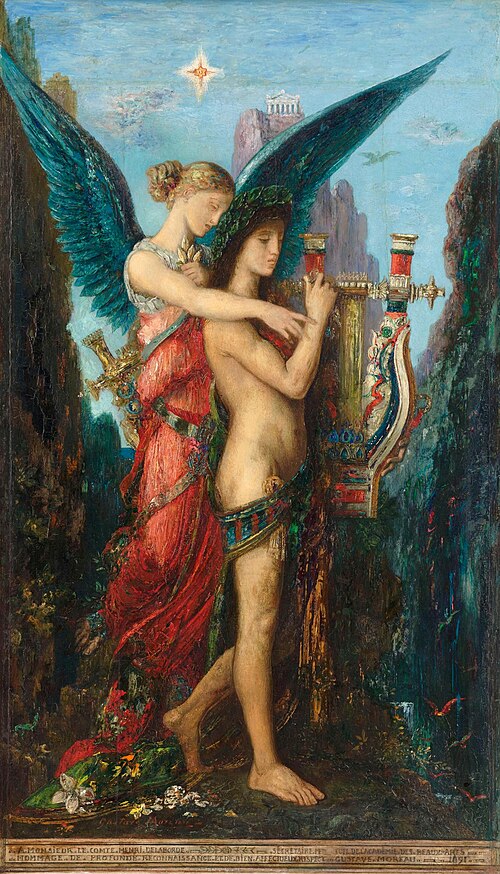
Picture: Gustave Moreau, Hesiod and the Muse, 1891, oil on panel, Musée d’Orsay. Later artistic interpretation, not a historical likeness.
Gustave Moreau (1826–1898); Public domain (PD-Art / PD-old-100-expired); Wikimedia Commons. Image record, Public domain (PD-Art / PD-old-100-expired).

The round picture in the lists of the personalities is cropped from it.