



9 min read
Father of Medicine
Hippocrates of Kos
author: High Priest Zevios Metathronos
Dates: c. 460–c. 370 BCE
Period: Classical (500–334 BCE)
Hippocrates of Kos was the physician whose name the Greeks gave to a library of about 60 medical works, the Hippocratic Corpus, and to the most famous oath in medicine. In his own lifetime Plato used him as the standard example of a paid teacher of the art: “Hippocrates of Cos, the Asclepiad.”1
The writings under his name turned medicine into a written record of observation. Their case notes follow sick men and women day by day, including the ones who died, and the treatise On the Sacred Disease traced epilepsy to the brain.2
The Oath opens with the Gods of healing, “Apollo the physician, and Asclepius, and Hygieia and Panacea.”3 Zevism receives this medicine as service to those powers and to Ma'at, the order that healing restores when disease has broken it.
LIFE AND CONTEXT
Hippocrates was born about 460 BCE on the island of Kos. Plato calls him “the Asclepiad,” a name that set him in the line of Asclepius, the healing God.4
Very little of his life is securely known. The Corpus that carries his name “contains about sixty works on a variety of medical topics,” written by several authors over several centuries, and they don't always agree. Neither the whole collection nor the Oath can be assigned with confidence to 1 man's pen.5
His fame, though, was plain within decades. Plato's Socrates asks a young Athenian what he'd be paying for “if, for example, you had thought of going to Hippocrates of Cos, the Asclepiad, and were about to give him your money.” The answer comes at once: “as a physician.”6
Aristotle used him the same way a generation later. Discussing what makes a city great, he wrote that “Hippocrates might be called greater, not as a man, but as a physician, than some one else who was taller.”7
Kos itself had a famous sanctuary of Asclepius, and centuries later Strabo still named Hippocrates as “one of the famous men from Cos.”8
The date and place of his death are reported differently. Britannica places it at Larissa in Thessaly about 375 BCE; the US National Library of Medicine gives c. 460–c. 370 BCE for his life.9
ATTAINMENTS
- The Hippocratic writers defined medicine as a relation of 3 parties: “The art consists in three things”: the disease, the patient and the physician. They set its aim as “to do good or to do no harm.”10
- They made the physician a forecaster: he “must be able to tell the antecedents, know the present, and foretell the future.”11
- Epidemics 1 records 14 case histories day by day, with the weather, the season and the patient's habits, sleep and speech, and it keeps the deaths in the record.12
- On the Sacred Disease argued that epilepsy is “nowise more divine nor more sacred than other diseases” and that “the brain is the cause of this affection.”13
- The same treatise located the whole inner life in the brain: “from nothing else but the brain come joys, delights, laughter and sports, and sorrows, griefs, despondency, and lamentations.”13
- The Oath bound the physician to regimens for the patient's benefit, to “no harm or injustice,” to refuse a lethal drug, to seduce no one, free or slave, in the homes he entered, and to keep secret what he saw and heard there.14
- The Aphorisms open with the physician's creed in 1 sentence: “Life is short, and Art long; the crisis fleeting; experience perilous, and decision difficult.”15
KEY STORIES
The Tablets in the Temple of Asclepius
Strabo describes the suburb of the city of Kos. “In the suburb is the Asclepïeium, a temple exceedingly famous and full of numerous votive offerings, among which is the Antigonus of Apelles.” The painter's Aphrodite Anadyomene had hung there too, until Augustus carried it to Rome and dedicated it to the deified Caesar.16
Among the offerings were tablets that recorded cures. Strabo passes on what was said of them in his day: “It is said that the dietetics practised by Hippocrates were derived mostly from the cures recorded on the votive tablets there.”16
The tradition puts the start of Greek clinical medicine inside a God's house. The sick came to Asclepius, their cures were written up on tablets in his temple, and, as Strabo heard it, a physician of the Asclepiads learned his regimens from them. Zevism reads that as the right order of things: the art learned at the altar of the healing God and carried out into the houses of the sick.
The Last Days of Philiscus
The 1st case in Epidemics 1 is “Philiscus, who lived by the Wall.” He “took to bed on the first day of acute fever; he sweated.” “On the second day all the symptoms were exacerbated.” Late in the evening he “had a proper stool from a small clyster; the night quiet.”17
The 3rd morning looked like recovery. “On the third day, early in the morning and until noon, he appeared to be free from fever.” By evening the fever was back, “with sweating, thirst, tongue parched; passed black urine.” That night he didn't sleep, and “he was delirious on all subjects.”17
On the 4th day all the symptoms worsened. On the 5th he “had a slight trickling of pure blood from the nose.” The 6th brought “loss of speech, cold sweats; extremities livid,” and “about the middle of the sixth day he died.” The writer then added what he'd watched throughout: breathing “like that of a person recollecting himself,” rare and large, and a spleen swollen in a round tumour. There's no excuse in the record and no claim of a cure.17
The Disease Called Sacred
The author of On the Sacred Disease opened with a charge. The men who first called epilepsy sacred “appear to me to have been just such persons as the conjurors, purificators, mountebanks, and charlatans now are.” They forbade baths and a list of foods, among them the flesh of the goat, the stag, the sow and the dog.13
His objection was religious as well as medical. “Neither truly do I count it a worthy opinion to hold that the body of man is polluted by god, the most impure by the most holy.” He went on: “we mark out the boundaries of the temples and the groves of the gods, so that no one may pass them unless he be pure.”13
Then he named the cause and the cure. The brain was the seat of the disorder, and a physician who could “render a man humid and dry, hot and cold by regimen, could also cure this disease,” without “purifications, spells, and all other illiberal practices.”13
The Answer to the Great King
Plutarch tells the story through Cato the Elder. “It was not only Greek philosophers that he hated, but he was also suspicious of Greeks who practised medicine at Rome.” Cato “had heard, it would seem, of Hippocrates' reply when the Great King of Persia consulted him, with the promise of a fee of many talents.” The physician answered that “he would never put his skill at the service of Barbarians who were enemies of Greece.”18
Cato drew his own lesson. “He said all Greek physicians had taken a similar oath, and urged his son to beware of them all.” He kept his own “book of recipes,” fed his sick on “greens, on bits of duck, pigeon, or hare,” and never made them fast. Such a diet, he said, was light and good for the sick, “except that it often causes dreams.” Plutarch saw a judgment in what followed: “Such presumption on his part seems not to have gone unpunished, for he lost his wife and his son.”19
THE ZEVIST READING
The Oath opens with an invocation: “I swear by Apollo the physician, and Asclepius, and Hygieia and Panacea and all the gods and goddesses as my witnesses.”3 Apollo holds healing among his powers, Asclepius practises it, Hygieia keeps the body whole and Panacea brings the remedy. A physician who swears by them places the art under their order.
Disease is a form of Izfet: dissolution working inside a living body. Healing restores Ma'at, the structured order that Zeus holds as Sovereign of the Cosmos, and a fever broken or a regimen that brings back sleep is a small restoration of that order. So is a true record. The notes on Philiscus, kept to the hour of his death, are Ma'at in writing, because they refuse the false story that would flatter the physician.
On the Sacred Disease shows the same order from another side. Its author held the Gods too holy to pollute a human body and refused to let their names cover ignorance. Zevism agrees with both halves: the Gods are honoured in their precincts, and the body is healed by knowing the causes of its disorder.
The Oath also meets the Temple's doctrine of the Good, which is Ma'at joined to Right, the right act done from a right will. Competence without fidelity fails it, and so does fidelity without competence. The Hippocratic physician swore to both: regimens “which will benefit my patients according to my greatest ability and judgement,” and “no harm or injustice to them.”20 That's ὁμοίωσις θεῷ practised in a sickroom, a human being made a little more like the healing Gods by knowledge joined to justice.21
NOTES
1 US National Library of Medicine, “Greek Medicine”; Plato, Protagoras 311b–c, tr. Benjamin Jowett.
2 Epidemics 1; On the Sacred Disease.
3 NLM, Oath, tr. Michael North.
4 Wesley D. Smith, “Hippocrates,” Encyclopaedia Britannica; Plato, Protagoras 311b.
5 NLM, “Greek Medicine”; NLM, Emotions and Disease.
7 Aristotle, Politics 7.4, tr. Benjamin Jowett.
8 Strabo 14.2.19, tr. H. L. Jones.
9 Smith, Britannica; NLM, Emotions and Disease.
10 Epidemics 1, tr. Francis Adams.
11 Epidemics 1.
12 Epidemics 1, section 3.1 and cases.
14 NLM, Oath, tr. Michael North, 2002.
15 Aphorisms 1.1, tr. Francis Adams.
16 Strabo 14.2.19.
18 Plutarch, Cato the Elder 23, tr. Bernadotte Perrin.
19 Plutarch, Cato the Elder 23.
20 NLM, Oath.
BIBLIOGRAPHY
US National Library of Medicine, “Greek Medicine,” including “The Hippocratic Oath”, Oath translated by Michael North, 2002; historical introduction on the Corpus.
US National Library of Medicine, Emotions and Disease, ancient Greek medicine and Hippocrates' traditional dates.
Wesley D. Smith, “Hippocrates”, Encyclopaedia Britannica; birth on Cos, death at Larissa.
Hippocratic Corpus, Epidemics, book 1, section 3.1, the 14 cases and case 1; tr. Francis Adams, Internet Classics Archive.
Hippocratic Corpus, On the Sacred Disease, opening, account of the brain and conclusion; tr. Francis Adams, Internet Classics Archive.
Hippocratic Corpus, Aphorisms 1.1, tr. Francis Adams, Internet Classics Archive.
Plato, Protagoras 311b–c, tr. Benjamin Jowett, Internet Classics Archive.
Aristotle, Politics 7.4, tr. Benjamin Jowett, Internet Classics Archive; 1326a15–16.
Strabo, Geography 14.2.19, tr. H. L. Jones, Loeb Classical Library, LacusCurtius.
Plutarch, Cato the Elder 23, tr. Bernadotte Perrin, Loeb Classical Library, 1914, LacusCurtius.
Plato, Theaetetus 176a–b, Greek text, Perseus Digital Library.
CREDIT
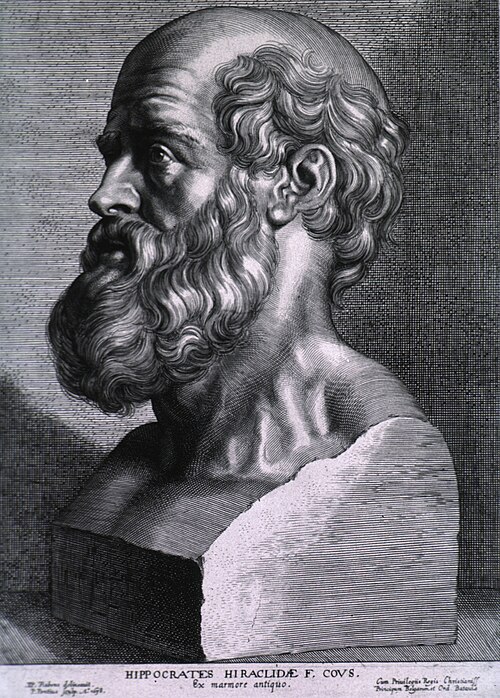
Picture: Hippocrates, a later imagined likeness: engraving by Paulus Pontius after Peter Paul Rubens, 1638
Paulus Pontius after Peter Paul Rubens; Wikimedia Commons; public domain. Image record, Public domain; PD-old-100 and PD-Art.

The round picture in the lists of the personalities is cropped from it.