





9 min read
Shinto Theologian
Hirata Atsutane
author: High Priest Zevios Metathronos
The Soul Within a Sacred Cosmos
Dates: 1776–1843 CE
Period: Imperial
Hirata Atsutane was the Japanese scholar whom Britannica calls the systematizer and leader of the Restoration Shintō school, Fukko Shintō. He left his home domain in 1795, worked in Edo for 46 years and had 553 students in his lifetime. After his death more than 1,330 people declared themselves his disciples.1
His central work answered a single question: where does the spirit go at death? In Tama no mihashira, drafted in 1812, he drew 10 charts of the making of heaven, earth and Yomi, then argued that the dead go to the hidden world, yūmei, ruled by the kami Ōkuninushi.2
Hirata served the kami under their own names, and his faith was Shinto. Zevism reads him as a link in the chain of spirituality: a scholar who went back to the oldest records of his people to recover their source, and who carried a lamp into the country of the dead, the domain that Greek religion gave to Hermes as messenger to Hades.
LIFE AND CONTEXT
He was born on the 24th day of the 8th month of 1776, the 4th son of Ōwada Yoshitane, a retainer of the Akita domain in northern Japan. He studied Neo-Confucianism first and then turned to Shintō. In 1795, in his 20th year by Japanese reckoning, he left the domain and went to Edo.3
In 1800 Hirata Tōbei Atsuyasu, a retainer of the Matsuyama domain in Bitchū, adopted him as his heir. Around 1803 the young man read the books of Motoori Norinaga, who had recently died, and in 1805 he entered the academy of Motoori Haruniwa.4
His reading ran wide. The Encyclopedia of Shinto lists ancient classics, calendrical calculation, Ijing divination, military science and Daoism, along with studies of Indian and Chinese tradition in Indo zōshi and Morokoshi taikoden. Britannica adds that he took in Western science through Chinese translations and borrowed “some aspects of theological works written by Jesuit missionaries in China.”5
His method set him apart from his teachers. Mori Mizue writes that he “did not investigate works such as Kojiki and Nihonshoki according to an existing historiographical tradition.” He laid the differing accounts side by side, fused them into one restored history, and “even actively used Chinese or Indian literature as reference materials for the restoration of ancient history.”6
He wrote under several names, among them Daigaku and Ibukinoya, and his school outlived him. Sakamoto Koremaru writes that his thought “greatly influenced the rise of Shintō at the end of the Edo period and the beginning of the Meiji period.” The Hirata faction spread across the country and became “a great force in political movements such as the sonnō jōi or shinbutsu bunri movements,” the royalist cause and the separation of kami from buddhas. Its political life ended soon after the Meiji Restoration.7
ATTAINMENTS
- He wrote Tama no mihashira, drafted in 1812 and published in 1813 in 2 volumes. Building on Hattori Nakatsune's Sandaikō, it explained the formation of heaven, earth and Yomi in 10 charts with notes.8
- He gave Shintō a doctrine of the afterlife. Sakamoto credits him with asserting “that after death humans go to the ‘hidden world’ of kakuriyo, where they are judged by the presiding kami Ōkuninushi.”9
- He rebuilt the ancient history of Japan as a single text in Koshi seibun (Treatise on Ancient History) and went on to write the commentary Koshiden.10
- He investigated the unseen at first hand. Senkyō ibun, completed in 1822, records his interviews with a boy who said he'd lived among immortals, and Katsugorō saisei kibun is his chronicle of the claimed rebirth of Katsugorō.11
- He wrote for ordinary readers as well as scholars. Kodō taii (True Meaning of the Ancient Way) and Zoku Shintō taii put his teaching into plain language.12
- He trained 553 students in his lifetime, and his declared posthumous disciples came to exceed 1,330.12
KEY STORIES
The Disciple of a Dead Master
Around 1803, in Edo, Hirata opened the books of Motoori Norinaga and was deeply moved by them. It came too late for lessons: Norinaga had died. Noguchi Takehiko reports what Hirata did next. He said that Norinaga had appeared to him in a dream and accepted him there as a disciple after death.13
In 1805 he enrolled in the academy of Motoori Haruniwa, the living head of the school. He never let the dream go. The Encyclopedia of Shinto records that he entered Haruniwa's academy “although he declared himself a posthumous disciple of Motoori Norinaga.”12
The claim set a pattern that outlived him. Hirata taught 553 students while he lived. By the count of the Encyclopedia of Shinto, “the number of his declared posthumous disciples exceeded one thousand three-hundred and thirty,” well over twice as many, and each of them claimed the same bond with a dead teacher that he'd once claimed with Norinaga.12
A Pillar for the Soul
In 1812 Hirata sat down to write a book about the dead. The Encyclopedia of Shinto states its purpose: it was written “to make clear where the spirit (or soul, reikon) goes after death, and to strengthen the Japanese spirit (yamatogokoro).”2
He began with the universe. Taking Hattori Nakatsune's Sandaikō as his model, he drew the formation of heaven, earth and Yomi in 10 charts and wrote notes to explain them. His readers got a map of the cosmos before they reached the argument.14
Then came the argument. Yomi, the world of the dead, wasn't where the spirit went, Hirata wrote. It went to yūmei, a hidden world ruled by the kami Ōkuninushi, and there the dead are judged.15
The book was printed the following year, 1813, in 2 volumes.14
Letters to the Hidden World
In 1820 a boy named Torakichi came to Hirata's attention. Torakichi said that he had been spirited away, kamikakushi, and that while he was missing he'd lived in the land of the immortals. Hirata met him and questioned him, and he wrote down the answers.16
The record grew into a book, finished in 1822. Hirata titled it Senkyō ibun, “Strange Tales of the Land of Immortals,” and it's also known as Torakichi monogatari, the story of Torakichi. Noguchi Takehiko notes one detail that shows how seriously Hirata took his witness: he went so far as to entrust the boy with a letter to be carried into the hidden world. Noguchi reads the book as a window on Hirata's mystical thought, since it shows him bringing belief in the unseen world into his theology and holding that kakuriyo, the hidden world, really existed.17
Greek religion placed that errand in the hands of a God. The Homeric Hymn has Zeus ordain that Hermes “only should be the appointed messenger to Hades.”18 Hirata, with no Hermes in his pantheon, looked for a messenger among the living and wrote his letter.
Sent Home to Akita
In 1841 Hirata wrote Tenchō mukyūreki, the “Chronicle of the Perpetual Rule of the Emperor.” The book angered the Tokugawa government. The shogunate ordered him out of Edo and forbade him to write, and he was sentenced to confinement in the Akita domain.19
He went back to the province he had left 46 years before. Britannica says he “was confined to his birthplace for the rest of his life.” He died there on the 11th day of the intercalary 9th month of 1843, and Noguchi writes that he died in disappointment.20
The ban didn't reach his students. Sakamoto records that he “attracted many disciples around the country, both before and after his death,” and in the last years of the Edo period the Hirata faction spread across the whole country.21
THE ZEVIST READING
Hirata's school is called Restoration Shintō, and Zevism recognises its principle: one must return to the source. Knowledge changes as it passes from hand to hand, while the source keeps its priority. Hirata read the Kojiki and Nihonshoki outside the inherited tradition of historians and then searched the records of China and India for traces of the same first history. His Japan-centred cosmology is his own. The Temple takes from him the discipline of the return.
The doctrine of Light and Darkness fits his work closely. Unexplored darkness isn't evil; it's what one walks into with light, and explored darkness becomes knowledge. Death was the dark region on his tradition's map, and Hirata didn't leave it blank. He mapped it in charts, argued it from texts and questioned a living witness. What he brought back was an ordered teaching: the dead remain under a ruling God and are judged.
Greek religion gave the same passage a guide and a law. Zeus made Hermes the one “appointed messenger to Hades,” so the road of souls had its officer.18 Zevism reads Ōkuninushi's hidden world and the Greek underworld as 2 forms of the same claim: the cosmos has a Sovereign, and death falls inside his order.
The movements that took Hirata's name into politics after his death are part of the record. Zevism judges them by its doctrine of the Good, which requires right order and right act together, and doesn't credit any campaign with its founder's intentions.
Plato set the aim of the path as likeness to the divine “as far as possible,” ὁμοίωσις θεῷ κατὰ τὸ δυνατόν.22 That aim needs a soul that outlasts the body and can still rise. Hirata spent more than 30 years building a doctrine in which the soul has a place to go and a God to answer to, and Zevism reads that doctrine as ground on which the ascent can be built.
NOTES
1 Britannica, “Hirata Atsutane”; Matsu'ura, “Hirata Atsutane”.
2 Matsuura, “Tamanomihashira”.
3 Matsu'ura, EOS; Britannica; Noguchi, Sekai Daihyakka Jiten.
4 Tahara, Nipponica; Noguchi, Sekai Daihyakka Jiten; Britannica; Matsu'ura, EOS.
6 Mori, “Kokugaku,” section B.
7 Sakamoto, “Shinto in the Early Modern Period (2)”; Mori, “Kokugaku”.
8 Matsuura, “Tamanomihashira”; Tahara, “Tama no mihashira,” Nipponica.
10 Matsu'ura, EOS; Tahara, Nipponica.
11 Noguchi, “Senkyō ibun”; Matsu'ura, EOS.
12 Matsu'ura, EOS.
13 Noguchi, Sekai Daihyakka Jiten.
14 Matsuura, EOS.
15 Tahara, Nipponica; Sakamoto, EOS.
17 Noguchi, Sekai Daihyakka Jiten; Matsu'ura, EOS.
18 Homeric Hymn to Hermes 568–573.
19 Matsu'ura, EOS; Noguchi, Sekai Daihyakka Jiten.
20 Britannica; Matsu'ura, EOS; Noguchi, Sekai Daihyakka Jiten.
21 Sakamoto, EOS; Mori, “Kokugaku”.
BIBLIOGRAPHY
Matsu'ura Mitsunobu, “Hirata Atsutane”, Encyclopedia of Shinto, Kokugakuin University; birth, adoption, 1805 enrolment, works, 1841 sentence, death and numbers of disciples.
Matsuura Mitsunobu, “Tamanomihashira”, Encyclopedia of Shinto, Kokugakuin University; composition, 10 charts, purpose and teaching on yūmei.
Mori Mizue, “Kokugaku”, Encyclopedia of Shinto, Kokugakuin University; section B, Hirata's method and the later Hirata faction.
Sakamoto Koremaru, “Shinto in the Early Modern Period (2)”, Encyclopedia of Shinto, Kokugakuin University; kakuriyo, judgment by Ōkuninushi, and disciples before and after his death.
Encyclopaedia Britannica, “Hirata Atsutane”; dates, Restoration Shintō, Western science and Jesuit works, confinement.
Noguchi Takehiko, “Hirata Atsutane,” Kaitei shinban Sekai Daihyakka Jiten (Heibonsha), and Tahara Tsuguo, “Hirata Atsutane,” Nihon Daihyakka Zensho (Nipponica) (Shogakukan), both at Kotobank, “平田篤胤”; departure in 1795, adoption in 1800, the dream of Norinaga, Koshiden, the order of 1841 and his death. Translations from the Japanese are the author's.
Noguchi Takehiko, “Senkyō ibun,” Kaitei shinban Sekai Daihyakka Jiten (Heibonsha), at Kotobank, “仙境異聞”; the meeting with Torakichi in 1820, completion in 1822 and the letter to the hidden world.
Tahara Tsuguo, “Tama no mihashira,” Nihon Daihyakka Zensho (Nipponica) (Shogakukan), at Kotobank, “霊の真柱”; 2 volumes, 1813, 10 charts, the Sandaikō and yūmei.
Homeric Hymn 4 to Hermes 568–573, H. G. Evelyn-White translation, Theoi Classical Texts Library.
Plato, Theaetetus 176a–b, Greek text, Perseus Digital Library.
CREDIT
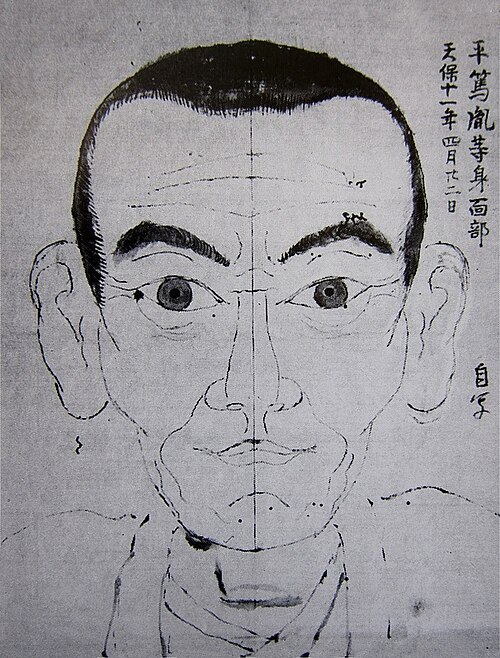
Picture: Self-portrait of Hirata Atsutane, ink on paper, from his later years.
Hirata Atsutane; Public domain (PD-Art, author died 1843); Wikimedia Commons. Image record, Public domain (PD-Art, author died 1843).

The round picture in the lists of the personalities is cropped from it.