



9 min read
Great Epic Poet
Homer
author: High Priest Zevios Metathronos
The Stranger, the Suppliant and the Heart That Learns
Dates: Traditionally placed in the 8th century BCE; personal biography and the formation of the epics remain uncertain.
Period: Ancient (6000–500 BCE).
Homer is the name under which the Greeks received the Iliad and the Odyssey. Herodotus, writing in the 5th century BCE, put him and Hesiod “four hundred years before my time and not more,” and he credited the 2 poets with the religion of the Hellenes: they “made a theogony for the Hellenes and gave the titles to the gods and distributed to them honours and arts, and set forth their forms.”1
His great attainment is those 2 epics, the wrath of Achilles and the homecoming of Odysseus. Inside them runs a law that Homer states twice in the same words: “from Zeus are all strangers and beggars.”2
Ancient Hellenism is the primary lens of Zevism, and Homer is where that lens was ground. His poems gave the Gods the forms by which Greeks knew them, and they set hospitality, supplication and mercy under the eye of Zeus.
LIFE AND CONTEXT
Nothing certain survives of Homer's life. The Hymn to Delian Apollo, which came down among the Homeric Hymns, ends with its singer's own portrait. When a traveller asks the girls of Delos who the sweetest singer is, they're to answer: “He is a blind man, and dwells in rocky Chios: his lays are evermore supreme.”3
The poems grew out of a long oral tradition. The Homer Multitext project at Harvard's Center for Hellenic Studies describes a poetry “composed in performance” and “through formulaic language,” in which “details may be changed and episodes may be expanded or compressed.” Its editors, Casey Dué and Mary Ebbott, build on “the comparative work of Milman Parry and Albert Lord.”4
Parry tested that idea in the field. In the early 1930s the Harvard classicist went to Yugoslavia to observe a living tradition of oral poetry, and his recordings on phonograph discs and in notebooks became the Milman Parry Collection of Oral Literature. He set out, in his own words, to put “lore against literature.”5
The poems became Greece's schoolbooks. In Plato's Republic, Socrates speaks of “the eulogists of Homer declaring that he has been the educator of Hellas.” Socrates grants the praise and still bars the epics from his ideal city, which would admit only “hymns to the gods and praises of famous men.”6
ATTAINMENTS
- He gave the Greeks the Iliad, the story of Achilles' wrath at Troy, which closes with Achilles giving Hector's body back to his father for burial.7
- He gave them the Odyssey, the long homecoming of Odysseus, with its landfalls among the Phaeacians and in a swineherd's hut on Ithaca.8
- By Herodotus' account, Homer and Hesiod fixed the Greek picture of the Gods, their names, honours, arts and “forms.”9
- He wrote hospitality into law under Zeus. Nausicaa and Eumaeus both say it in the same line, and Odysseus tells the Cyclops that “Zeus is the avenger of suppliants and strangers.”10
- His poems became the core texts of Greek education; by Plato's day his admirers called him “the educator of Hellas.”11
- The Homeric Hymns came down under his name, among them the Hymn to Delian Apollo with its portrait of the blind singer of Chios.3
- The formulaic, performed verse of his epics became the test case for the modern study of oral poetry, from Parry and Lord to the Homer Multitext.12
KEY STORIES
Nausicaa on the Shore
Odysseus came ashore on Scheria, the land of the Phaeacians, and fell asleep in hiding near the river. Princess Nausicaa and her maidens were playing ball close by. A throw missed and the ball dropped into a deep eddy, the girls cried out, and he woke. He came out “like a mountain-nurtured lion trusting in his might,” and to the girls he looked terrible, “all befouled with brine.” They ran along the beach. “Alone the daughter of Alcinous kept her place, for in her heart Athena put courage, and took fear from her limbs.”13
He weighed whether to clasp her knees and chose instead “to stand apart and beseech her with gentle words.” He praised her as a young palm shoot he'd once seen at Delos, “springing up beside the altar of Apollo.”14
Nausicaa didn't ask who he was before she acted. “Stand, my maidens,” she called. “Whither do ye flee at the sight of a man?” Then she gave the rule behind her orders: “From Zeus are all strangers and beggars, and a gift, though small, is welcome. Come, then, my maidens, give to the stranger food and drink, and bathe him in the river in a spot where there is shelter from the wind.”15
The Swineherd's Goatskin
Years later Odysseus reached Ithaca disguised as a beggar and walked up to the hut of Eumaeus, his own swineherd. The dogs saw him first and “rushed upon him with loud barking,” and Eumaeus drove them off with stones. “It is for a godlike master that I mourn and grieve,” he told the stranger, never guessing who stood in front of him.16
He led the stranger inside and made him a seat, “strowing beneath thick brushwood, and thereon spreading the skin of a shaggy wild goat, large and hairy, on which he was himself wont to sleep.” Then he gave the reason, in the same words Nausicaa had used: “it were not right for me, even though one meaner than thou were to come, to slight a stranger: for from Zeus are all strangers and beggars.”17
He didn't stop at words. He took 2 pigs from the pens, slaughtered and roasted them, and set the meat before his guest “hot upon the spits.” The master he mourned was eating at his table. Zevism reads that goatskin seat as the order of Zeus kept by a poor man in a hut.18
The Cyclops Who Scorned Zeus
The Odyssey also shows what happens when the law is refused. Trapped in the cave of Polyphemus, Odysseus asked for a guest's due and named its guarantor: “Zeus is the avenger of suppliants and strangers.”19
The Cyclops laughed at him. “For the Cyclopes reck not of Zeus, who bears the aegis, nor of the blessed gods, since verily we are better far than they.” He seized Odysseus' men 2 at a time and ate them. Odysseus answered with a stake of olive wood, “sharp at the point,” and his men “thrust it into his eye” while he whirled it from above.20
The escape cost Odysseus dearly. The blinded giant “prayed to the lord Poseidon, stretching out both his hands to the starry heaven,” and asked that his enemy come home late, “in evil case, after losing all his comrades.” Odysseus did come home late and alone, as the giant had asked.21
Priam in the Tent of Achilles
Achilles had killed Hector, and day after day he dragged the body “thrice about the barrow” of Patroclus.22 Old Priam crossed the Greek camp by night, and Hermes opened the door of Achilles' hut for him. He “clasped in his hands his knees, and kissed his hands, the terrible, man-slaying hands that had slain his many sons.”23
“Remember thy father, O Achilles like to the gods,” he began, and he ended with what he'd done: he had endured “what no other mortal on the face of earth hath yet endured, to reach forth my hand to the face of him that hath slain my sons.” Then both men wept, “the one for man-slaying Hector,” while “Achilles wept for his own father, and now again for Patroclus.”24
Achilles “raised the old man by his hand, pitying his hoary head and hoary beard,” and spoke of Zeus: “two urns are set upon the floor of Zeus of gifts that he giveth, the one of ills, the other of blessings.” He had the handmaids wash and anoint Hector apart, so that Priam wouldn't see the body and rage, and he promised to hold back the battle for the funeral.25
THE ZEVIST READING
Zevism holds that one must return to the source, and for Hellenic religion Homer is close to the source itself. Herodotus says it outright: the Greek picture of the Gods, their titles, honours and forms, comes from Homer and Hesiod.9 The Temple reads the epics as scripture of the Gods.
Homer's law of the guest is Ma'at in human form. Order at the scale of a hut or a beach means that the stranger is fed, washed and seated before anyone asks his name. The Cyclops is Izfet: a strength that owns no law, says it's “better far” than the Gods, and eats its guests. Zeus stands behind the first and against the second.
Priam's night with Achilles shows the Good as Zevism defines it, right order joined to right act from right will. Achilles had done wrong to the dead for days. When he returned the body, washed and anointed, he did the right act, and the tears he shed for his own father show the will turning with it.
Priam's greeting names the aim. He calls Achilles “like to the gods,” and in that tent the hero comes nearest to earning it. Plato later set the goal of human life as likeness to the divine “as far as possible,” ὁμοίωσις θεῷ κατὰ τὸ δυνατόν.26 Zevism reads Homer's scene as that likeness reached in a single act of mercy.
NOTES
1 Herodotus 2.53, tr. G. C. Macaulay.
2 Odyssey 6.207–208; Odyssey 14.57–58.
3 Homeric Hymn to Delian Apollo 165–173.
4 Center for Hellenic Studies, “A Multitextual Approach to Homer”.
5 Harvard Library, Milman Parry Collection; Milman Parry Collection, “About”.
6 Plato, Republic 10, 606e–607a, tr. Benjamin Jowett.
8 Odyssey 6; Odyssey 14.
10 Odyssey 6.207–208, 9.266–271, 14.57–58.
16 Odyssey 14.29–44.
17 Odyssey 14.48–59.
18 Odyssey 14.72–77.
20 Odyssey 9.272–293, 375–394.
22 Iliad 24.14–18.
23 Iliad 24.440–479.
24 Iliad 24.485–512.
25 Iliad 24.515–533, 582–590, 656–670.
BIBLIOGRAPHY
Homer, Odyssey 6, 1–10 and 110–210; A. T. Murray translation, Theoi Classical Texts Library.
Homer, Odyssey 9, 266–293 and 375–394; A. T. Murray translation, Theoi Classical Texts Library.
Homer, Odyssey 14, 29–77; A. T. Murray translation.
Homer, Iliad 24, 14–18, 468–515, 525–533, 582–590 and 656–670; A. T. Murray translation.
Homeric Hymn to Delian Apollo 165–173, H. G. Evelyn-White translation, Theoi Classical Texts Library.
Herodotus, Histories 2.53, tr. G. C. Macaulay, Internet Sacred Text Archive.
Plato, Republic 10, 606e–607a, tr. Benjamin Jowett, Internet Classics Archive, MIT.
Center for Hellenic Studies, Harvard University, Homer Multitext project introduction, “A Multitextual Approach to Homer,” ed. Casey Dué and Mary Ebbott; oral composition and textual transmission.
Harvard Library, Milman Parry Collection of Oral Literature; Milman Parry Collection, “About”.
Plato, Theaetetus 176a–b, Greek text, Perseus Digital Library.
CREDIT
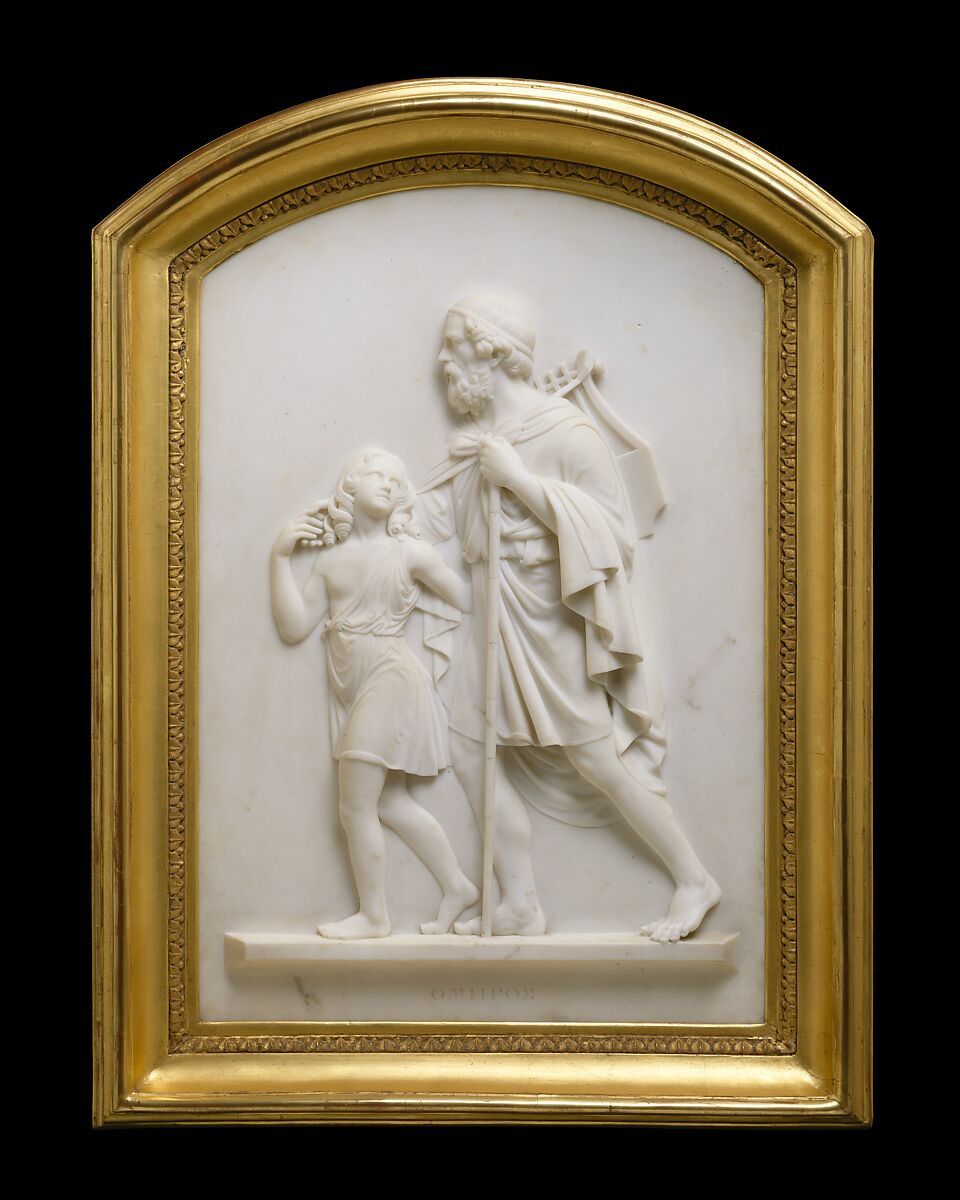
Picture: Edward Sheffield Bartholomew, Blind Homer Led by the Genius of Poetry, 1851, marble; Met 1996.74. Later artistic interpretation, not a historical likeness.
The Metropolitan Museum of Art, Purchase, Morris K. Jesup Fund, and Gift of William Nelson, by exchange, 1996, 1996.74; public domain. Image record, Public domain (Met Open Access).
The round picture in the lists of the personalities is cropped from it.