



9 min read
Father of Optics
Ibn al-Haytham
author: High Priest Zevios Metathronos
Justice in the Act of Seeing
Dates: c. 965–c. 1040 CE; often given as c. 965–c. 1039
Period: Ignorance (1000–1336 CE)
Al-Hasan ibn al-Haytham, known in Latin as Alhazen, was born in Basra about 965 and died in Cairo about 1040. His Kitab al-Manazir, the Book of Optics in 7 books, explained sight as light and colour radiating from every point of a visible object and entering the eye. He tested that account in darkened rooms, with sighting tubes and with measuring instruments.1
In the Optics, experiment, iʿtibār, becomes an explicit tool: the investigator builds a device and manipulates it to see what the light does. Latin translators rendered the word as experimentum, and its derivatives experimentare and experimentator.2
Zevism reads him under the doctrine of Light and Darkness. He set candles before a small opening into a dark chamber, and what the light showed on its wall became knowledge for everyone after him. He also asked the investigator for justice in judging evidence, the virtue Hesiod seats beside Zeus.
LIFE AND CONTEXT
He came from Basra in southern Iraq and worked within the intellectual world of medieval Islam.3 His autobiographical note records that, “reflecting in his youth on the conflicting but firmly held beliefs of the various religious sects,” he “was led to put them all in doubt and became convinced that truth was one.” One report makes him a minister at Basra and its environs.2
He wrote that note at the end of 1027, when he was 63 lunar years old, which is how his birth is dated to about 965. After his doubts he “decided to turn his back on the common people and devote himself to seeking knowledge of the truth as the worthiest possession.” He found that truth in “doctrines whose matter was sensible and whose form was rational”: the writings of Aristotle and the sciences of mathematics, physics and metaphysics.2
His reputation reached Cairo, where the Fatimid caliph al-Hakim ruled. MacTutor describes al-Hakim as “a cruel leader who murdered his enemies” and also “a patron of the sciences.” The caliph heard of a plan of Ibn al-Haytham's to regulate the Nile and brought him to Egypt to carry it out. The plan failed.4
After al-Hakim's death in 1021 he lived near the Azhar Mosque. In the latter part of his life, Sabra writes, he “earned his living from the proceeds (amounting to 150 Egyptian dinars) of copying annually the Elements of Euclid, the Almagest, and the Mutawassiṭāt.”2
He wrote constantly. One medieval list gives 92 titles, and not fewer than 55 of his works survive.5 In the Doubts concerning Ptolemy he attacked 3 of Ptolemy's books, the Almagest, the Planetary Hypotheses and the Optics, and objected to the equant as a violation of uniform circular motion.2
He died in Cairo about 1040. Britannica notes that “conflicting stories are told about the life of Ibn al-Haytham, particularly concerning his scheme to regulate the Nile.” The fullest account comes from the biographer Ibn al-Qifṭī, who died in 1248.6
ATTAINMENTS
- He wrote the Book of Optics in 7 books: vision and light in Book I, perception and errors of sight in Books II and III, reflection in Books IV to VI and refraction in Book VII.2
- He dismissed the old theory of rays sent out from the eye as “futile and superfluous” and held that the forms of light and colour radiate from every point of an object in all directions.2
- He established by experiment, with sighting tubes, strings and dark chambers, that primary, secondary, reflected and refracted light all travel in straight lines.7
- He built a copper instrument to measure reflection from plane, spherical, cylindrical and conical mirrors, and improved Ptolemy's instrument to measure refraction between air, water and glass.2
- He posed and worked the problem that bears his Latin name: given a light source and a spherical mirror, “find the point on the mirror where the light will be reflected to the eye of an observer.” Huygens later gave a good solution.8
- In On the Light of the Moon he showed that the Moon sends out its borrowed light in the same manner as a self-luminous source.2
- In On Paraboloidal Burning Mirrors he proved that rays are reflected to 1 point from the whole concave surface of a paraboloid of revolution.2
- He wrote about 92 works, of which over 55 survive, on optics, astronomy and mathematics.8
KEY STORIES
The Engineer Who Pretended to Be Mad
Ibn al-Qifṭī tells the story. Ibn al-Haytham had said that he could “build a construction on the Nile which would regulate the flow of its waters.” The caliph al-Hakim persuaded him to come to Egypt, and he honoured the scholar by going out in person to meet him “at a village outside Cairo called al-Khandaq.”2
The expedition went south, up the river, to “the place called al-Janādil (the cataracts), south of Aswan.” On the way Ibn al-Haytham saw the “excellently designed and perfectly constructed ancient buildings” of the Egyptians on the banks. He drew the conclusion an honest engineer had to draw: if his plan had been possible at all, the people who built those monuments would already have put it into effect.2
The plan was dropped. Al-Hakim, in MacTutor's words “disappointed with ibn al-Haytham's scientific abilities,” gave him an administrative post.8 The caliph murdered his enemies, and Ibn al-Haytham, in Ibn al-Qifṭī's account, “pretended to be mentally deranged.” He stayed confined until the caliph died in 1021, then “revealed his sanity” and settled near the Azhar Mosque.2
Candles Before a Small Hole
The experiment appears in his treatise The Shape of the Eclipse and in Book I of the Optics. He set candles at several points opposite a small opening into a “dark place” and looked at the inner wall.2
On the wall appeared a patch of light for each flame. The order of the patches was the reverse of the order of the candles outside, because each light had passed straight through the opening and crossed the others there. The lights hadn't mixed where they met. The arrangement showed, in Sabra's words, “that lights and colors are not affected by crossing one another.”2
The darkened room did the work of an argument. It removed every light except the ones under test, so the relation between flame, opening and wall could be seen and repeated. In Zevist terms he carried light into a place deliberately made dark, and brought back knowledge.
Doubts Against Ptolemy
Ptolemy was the master author of his trade, and Ibn al-Haytham copied the Almagest every year to earn his living. He also wrote al-Shukūk ʿalā Baṭlamyūs, the Doubts concerning Ptolemy, against it.2
The sharpest charge concerned the equant. Ptolemy assumed that the heavenly spheres move uniformly, yet in his own model, Sabra explains, “the motion of the epicycle-center, as measured on the circumference of its deferent, was not uniform.” So the sphere carrying the epicycle wasn't moving uniformly either, “in contradiction to the assumed principle of uniformity.”2
His verdict was modest and severe together. He concluded, in Sabra's summary, “that there existed a true configuration of the heavens which Ptolemy had failed to discover.” He didn't claim to have found it himself. He claimed only that the book he copied every year for his living hadn't yet reached the truth.2
Reason on the Title Page
A Latin translation of the Optics, called Perspectiva or De aspectibus, was made in the late 12th or early 13th century. Roger Bacon's Perspectiva is, in Sabra's words, “full of references to ‘Alhazen,’ or auctor perspectivae,” the author of optics. Witelo's treatise depends heavily on the book, and Friedrich Risner printed the Latin text at Basel in 1572 as Opticae thesaurus.9
Johannes Kepler, who studied the camera obscura early and recorded its general principles, published his own optics in 1604 as Ad Vitellionem paralipomena, supplements to Witelo.10
Then in 1647 the astronomer Johannes Hevelius engraved the title page of his Selenographia, a book on the Moon. He chose 2 historical astronomers for its flanking figures: Galileo on the right, to represent Sense, and on the left, to represent Reason, “al-Haytham, whom he calls Alhazen.”11 More than 600 years after the dark room in Cairo, Hevelius set him at the gate of the book as the figure of Reason.
THE ZEVIST READING
Zevism teaches that unexplored darkness isn't evil. It's the country one enters carrying light, and once explored it becomes Light, which is knowledge. Ibn al-Haytham made that doctrine literal. He shut out the day, set his candles before a hole and let the dark chamber show which relation among flame, opening and wall produced the image. The result, that lights cross without mixing, can be tested again in any darkened room.
His own statement of method is an ethical one. The inquirer's task, he wrote in the Optics, is “to employ justice, not follow prejudice, and to take care in all that we judge and criticise that we seek the truth and not be swayed by opinions.”8 Hesiod's Justice is “the daughter of Zeus,” who “sits beside her father” and tells him of men's wicked hearts.12 In the Temple's ethics, Φρόνησις and Justice belong together, and he applied both to evidence. At the Nile cataracts he let the ancient buildings judge his own claim, and he accepted their verdict.
He came to that method through doubt. Faced with sects that each held firm and contradicted the others, he became convinced that truth was one. Zevism reads him as a link in the chain of all spirituality, a scholar of the Islamic world serving the order of the cosmos under the name his own tradition gave the divine.
Plato names the aim of the path ὁμοίωσις θεῷ κατὰ τὸ δυνατόν, likeness to God as far as possible, and describes that likeness as becoming just and holy with wisdom.13 A scholar who copied Euclid for his bread and spent his remaining hours testing light against geometry gave the existential dimension of the path a concrete shape.
NOTES
1 Sabra, “Ibn al-Haytham,” Dictionary of Scientific Biography; UNESCO, “Ibn al-Haytham's scientific method”.
2 Sabra.
3 UNESCO.
6 Britannica, “Ibn al-Haytham”; Sabra.
8 MacTutor.
10 Di Liscia, “Johannes Kepler”.
12 Hesiod, Works and Days 256–262.
BIBLIOGRAPHY
A. I. Sabra, “Ibn al-Haytham,” Dictionary of Scientific Biography, reproduced by MacTutor; biography from Ibn al-Qifṭī, the Nile story, copying for 150 dinars, list of 92 titles, Optics Books I–VII, experiments, iʿtibār, The Shape of the Eclipse, On the Light of the Moon, Doubts concerning Ptolemy, Latin reception.
J. J. O'Connor and E. F. Robertson, “Ibn al-Haytham”, MacTutor History of Mathematics, University of St Andrews; al-Hakim, the administrative post, the Optics introduction, camera obscura, Alhazen's problem, number of works.
Shaikh Mohammad Razaullah Ansari, UNESCO, “Ibn al-Haytham's scientific method”, sections on experiment and mathematical representation.
Encyclopaedia Britannica, “Ibn al-Haytham”; dates and the conflicting Nile stories.
William B. Ashworth Jr., Linda Hall Library, “Ibn al-Haytham,” Scientist of the Day; Risner's edition of 1572 and Hevelius's Selenographia title page, 1647.
Daniel A. Di Liscia, “Johannes Kepler”, Stanford Encyclopedia of Philosophy, 2011, revised 2025; Ad Vitellionem paralipomena and the camera obscura.
Hesiod, Works and Days 256–262, translated by H. G. Evelyn-White, Theoi Classical Texts Library.
Plato, Theaetetus 176a–b, Greek text, Perseus Digital Library.
CREDIT
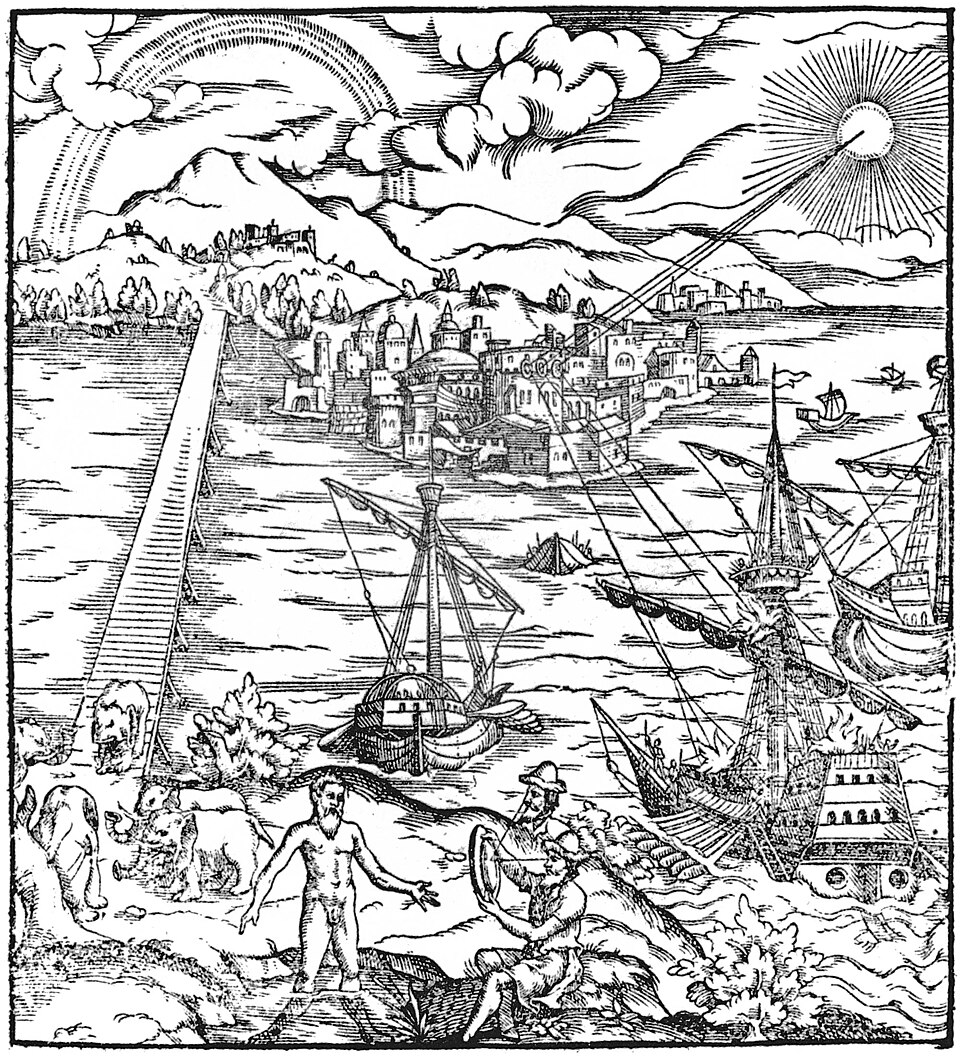
Picture: Optical imagery from the 1572 Opticae thesaurus, a Latin edition of Ibn al-Haytham’s work. The burning-mirror scene represents a later story about Archimedes, not an event established here.
Unidentified sixteenth-century engraver; Bayerische Staatsbibliothek; Wikimedia Commons; Public domain; faithful reproduction of a public-domain artwork. Image record, Public domain; faithful reproduction of a public-domain artwork.

The round picture in the lists of the personalities is cropped from it.