




9 min read
Sabian Scholar
Ibrahim ibn Hilal al-Sabi
author: High Priest Zevios Metathronos
Dates: 925–994 CE
Period: Darkness (800–1000 CE)
Abu Ishaq Ibrahim ibn Hilal al-Sabi was a secretary of the Buyid court at Baghdad, a poet, and a writer of state letters that were gathered into a collection. He was born in 925 and died in 994. He was also a Sabian, a member of the star-worshipping community of Harran. When the amir Izz al-Dawla Bakhtiyar offered him the vizierate on condition that he become Muslim, he said no.1
His greatest attainment was the state letter. In 960 he took charge of the office that drafted, corrected and sealed the correspondence of the caliph and the Buyid amirs, and for years the government spoke through his prose in its diplomas and appointments.2
Zevism reads him as a servant of Hermes, God of language and of messengers. His community was among the last to keep the old worship of the planets alive under the caliphs, and he never left it.3
LIFE AND CONTEXT
Ibrahim was born on 5 Ramadan 313 of the Hijra, in 925. On his mother's side he was the great-grandson of Thabit ibn Qurra, the mathematician who had left Harran for Baghdad and become court astronomer there. MacTutor sums up Thabit's community: “The Sabian religious sect were star worshippers from Harran often confused with the Mandaeans.” Ibrahim was born into that faith.4
He made his career at the secretary's desk. Ibn Khallikan's 13th-century biography names him secretary to the caliph and to Izz al-Dawla Bakhtiyar, and it records his appointment in 960 to lead the office of state correspondence. The translator, Mac Guckin de Slane, explains in his notes how that office worked: each letter was read and corrected, then sealed with clay that bore the caliph's device.5
He belonged to the circle of al-Muhallabi, who ran the government of the amir Muʿizz al-Dawla, held the title of vizier from 956 and died on 18 September 963. Encyclopaedia Iranica lists “the epistolographer Abu Esḥāq al-Ṣābi” among the jurists and men of letters who made up “the intellectual elite of Baghdad during the middle of the 10th century.”6
The court tested his faith with favours. Roberts quotes a medieval notice on Bakhtiyar's offer of the vizierate that ends drily: God didn't guide him to Islam “as he guided him to excellent speech.” He knew the Quran so well that it was “always at the tip of his tongue and the nib of his pen,” used its phrases in his letters, and kept the Ramadan fast alongside his Muslim colleagues.7
The Buyid civil war ended his good fortune. ʿAdud al-Dawla beat Bakhtiyar at Ahvaz on 1 July 977 and again at Qasr al-Jass near Samarra on 29 May 978, where Bakhtiyar was captured and sentenced to death. Ibn Khallikan traces the victor's anger at Ibrahim to letters he'd written in the years before. The new master of Baghdad put him in prison.8
He regained favour only after ʿAdud al-Dawla died on 26 March 983, under the patronage of the vizier Ibn ʿAbbad, known as al-Sahib. Mathematics was his other passion. MacTutor calls him “a high ranking official in Baghdad who was interested in mathematics,” and in June 988 he was among the guests at the opening of the observatory Abu Sahl al-Quhi built in the palace garden of the amir Sharaf al-Dawla. Ibrahim died on 12 Shawwal 384, in 994.9
ATTAINMENTS
- He headed the chancery of the caliph and the Buyid amirs from 960, drafting and correcting the diplomas, appointments and state letters that left Baghdad under clay seals.2
- His letters were gathered into a collection, and so was his exchange of letters and poems with al-Sharif al-Radi. The medieval biographers knew both.2
- Al-Thaʿalibi placed his verse in the anthology Yatimat al-dahr, including a ghazal that shows the beloved through the eyes of 5 religions in turn.10
- He wrote al-Kitab al-Taji, the official history of the Buyid house commissioned by ʿAdud al-Dawla, and he wrote it under house arrest between 978 and 981.11
- He argued geometry by letter with al-Quhi. At least 6 letters passed between them and 4 survive in detail, running from what “known” means in a problem to 6 theorems al-Quhi set out on centres of gravity.12
KEY STORIES
The Fava Beans at al-Muhallabi's Table
Al-Thaʿalibi, who anthologised the writers of that age, tells a story from the vizier's house. Ibrahim sat down one day at al-Muhallabi's table and then wouldn't eat. A dish of fava beans stood among the food, and beans were forbidden to Sabians.13
The vizier pressed him. “Don't be tedious,” al-Muhallabi said, “eat these fava beans with us.” Ibrahim answered: “O vizier, I do not wish to disobey God in anything I eat.” He had refused the vizier's food in the vizier's own house and named his God as the reason, and the reply pleased the host.
Roberts adds a note on the rule itself. The Sabian ban, he suggests, “may be related to the ban on (fava) beans that Aristotle ascribed to Pythagoras.” If he's right, a Harranian secretary at a Buyid dinner was keeping a rule that Greek writers had traced to Pythagoras, a Hellenic discipline carried from Harran into Baghdad.14
The Beloved and the 5 Religions
Al-Thaʿalibi preserved a love poem in which Ibrahim carries his beloved's face through the faiths of Baghdad. When Muslims see it, “they believe in all / the houris of the gardens of eternal ease.” The Christians “praise their trinity and call on you / as proof, since you have bound up three in one.” For the Jews the face is “the lightning-flash that the Merciful One / displayed to His praying prophet-confidant Moses.” The Magians find their sun in it: “how many bend to you / in prayer when darkness falls and bow!”10
His own community gets the line with the most astronomy in it: “Like Venus luminous are you to them, / propitious when with Jove and Mercury.” Then the poet turns the joke on himself: “You made them righteous, but me you seduced and left / to strive apart from them with a dīn corrupt.”10
The History Written in Prison
After his victory ʿAdud al-Dawla wanted a history of his dynasty, and he handed the task to the man he'd locked up. From 978 to 981 Ibrahim wrote al-Kitab al-Taji under house arrest, composing the official story of the house that had destroyed his patron.15
Ibn Khallikan tells what followed. Word reached the amir that the discontented writer had called the whole project, in Roberts's paraphrase, “a pack of lies.” ʿAdud al-Dawla ordered him thrown under the feet of the elephants. Nasr ibn Harun, al-Mutahhar ibn ʿAbd Allah and ʿAbd al-ʿAziz ibn Yusuf, 3 men of the court, spoke for him, and the amir relented.11
Ibrahim stayed a prisoner until ʿAdud al-Dawla died in 983. Encyclopaedia Iranica, surveying the sources for the reign, names the Taji as a book “written under pressure.”16
The Elegy of al-Sharif al-Radi
Ibrahim exchanged poems with al-Sharif al-Radi, an ʿAlid descended from Musa al-Kazim, the 7th Imam of the Twelver Shiʿa. In one of those poems the Sabian asked his Muslim friend for a favour: “Preserve in my sons my rights.”17
When Ibrahim died in 994, al-Radi wrote his elegy and answered the request inside it: “May I be cursed should I put off giving you protection (dhimma), / secretly in absence or openly.” In another couplet he named what had joined them: “By virtue we were bound together, since / no bond (munāsabatan) was my nobility or birth.”18
The poem caused talk. Ibn Khallikan reports that people objected because a descendant of Muhammad had mourned a Sabian. Al-Radi answered that he'd lamented the man's excellence.19
THE ZEVIST READING
Zevism is the chain of all spirituality from its beginnings to the present, and the Sabians of Harran are one of its links. They kept the worship of the planets alive under the caliphs. Roberts, following van Bladel, reads Ibrahim's poem on the 5 religions as evidence that Sabians like him “still considered the planets to be an important part of the Sabian religion.” Al-Masʿudi records that the Harranians identified Hermes with Enoch, whom the Quran calls Idris, and that Hermes was another name for the planet Mercury. Ibrahim held that inheritance under his own community's names.20
Plato's Egyptian story gives both halves of his life to a single God. In the Phaedrus Theuth invents number, calculation, geometry and astronomy, then letters, and brings them to the king so that the Egyptians may have them.21 Ibrahim spent his days on letters and his leisure on geometry and the heavens. Zevism reads the secretary at his desk and the guest at al-Quhi's observatory as the same servant of Theuth, lord of letters and number, and of Hermes, the messenger whom his own people honoured as a prophet.
The Taji is the test of the secretary's office. A chancery writes the record a state leaves behind. Egyptian religion named Ma'at “the personification of truth, justice, and the cosmic order” and set her against isfet.22 A history written under threat of death to flatter a conqueror bends the record toward Izfet. The Temple reads Ibrahim's reported verdict on his own book, the remark that nearly put him under the elephants, as a clerk's loyalty to Ma'at: he wrote what he was ordered to write and wouldn't call it true.
The last lesson concerns the source. Zevism holds that knowledge changes as it's handed on, while the source keeps priority. Ibrahim mastered the Quran, the Arabic of the chancery and the manners of the vizier's house, and at the vizier's table he still left the beans on the dish. He learned every language of the court and kept the rule of his fathers. That is the posture Zevism asks of anyone who carries an old worship through a world organised around a new one.
NOTES
1 Roberts, “Being a Sabian at Court,” p. 253.
4 Roberts, p. 253; O'Connor and Robertson, “Thabit ibn Qurra”.
5 Ibn Khallikan I, p. 33, notes 4 and 6.
8 Bürgel and Mottahedeh, “ʿAżod-al-Dawla”; Ibn Khallikan I, p. 31.
9 Roberts, pp. 253, 255; O'Connor and Robertson, “Al-Quhi”.
11 Roberts, p. 255.
12 O'Connor and Robertson, “Al-Quhi”.
13 Roberts, p. 260.
15 Roberts, p. 255; Ibn Khallikan I, p. 31.
16 Bürgel and Mottahedeh, “ʿAżod-al-Dawla”.
18 Roberts, p. 262.
BIBLIOGRAPHY
Ibn Khallikan, Biographical Dictionary, vol. I, translated by Mac Guckin de Slane, Oriental Translation Fund, 1843; entry “Abu Ishak as-Sabi,” pp. 31–33, with the translator's notes 4 and 6.
Alexandre M. Roberts, “Being a Sabian at Court in Tenth-Century Baghdad”, Journal of the American Oriental Society 137.2 (2017), pp. 253–277; especially pp. 253–255, 260–264 with n. 38, and 268. Verse translations by Roberts, the ghazal after Kevin van Bladel, The Arabic Hermes, pp. 107–108.
Maurice Pomerantz, “Mohallabi, Abu Moḥammad”, Encyclopaedia Iranica; the vizier's circle and dates.
Johann Christoph Bürgel and Roy Mottahedeh, “ʿAżod-al-Dawla, Abu Šojāʿ Fannā Ḵosrow”, Encyclopaedia Iranica; battles of 977 and 978, death on 26 March 983, sources section on the Taji.
J. J. O'Connor and E. F. Robertson, “Al-Quhi”, MacTutor History of Mathematics, University of St Andrews, 1999; the observatory of 988 and the correspondence with al-Sabi.
J. J. O'Connor and E. F. Robertson, “Thabit ibn Qurra”, MacTutor History of Mathematics, University of St Andrews.
Plato, Phaedrus 274c–275b, translated by Harold N. Fowler, Perseus Digital Library.
Encyclopaedia Britannica, “Maat”.
CREDIT
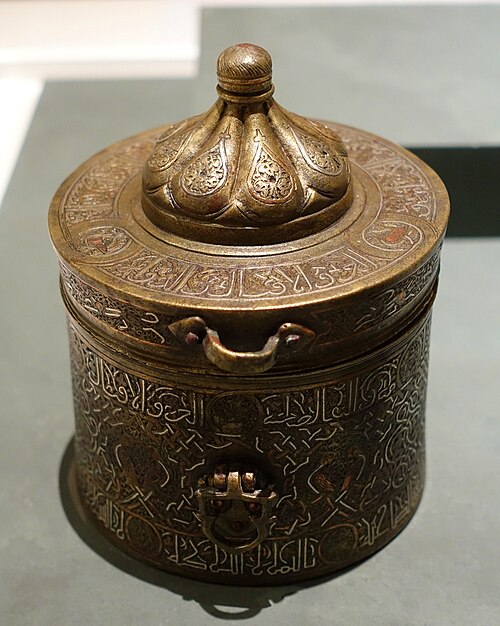
Picture: Inkwell from late twelfth-century Khorasan, Aga Khan Museum. A later illustration of the material culture of writing, not al-Sabi’s possession or portrait.
Daderot, photograph2015; Wikimedia Commons; CC0 1.0 Universal Public Domain Dedication. Image record, CC0 1.0 Universal Public Domain Dedication.

The round picture in the lists of the personalities is cropped from it.