



9 min read
Great Natural Philosopher
Isaac Newton
author: High Priest Zevios Metathronos
The Discipline of a Universal Order
Dates: 1643–1727 in the Gregorian calendar; his English birth record belongs to 1642 under the calendar then in use.
Period: Enlightenment.
Isaac Newton was an English mathematician who showed that the gravity pulling a body to the ground also holds the planets in their orbits. His Principia of 1687 put planetary orbits, projectiles, falling bodies and the tides under 1 mathematical account of motion and universal gravitation.1
He also split sunlight with a prism and proved that white light is a mixture of colours, and he laid the foundations of the calculus.2
Zevism reads Newton as a bearer of light into the dark of nature's order, and as a servant of Ma'at in 2 offices: the laws of motion in his books and the honest weight of the coin at the Royal Mint.
LIFE AND CONTEXT
Newton was born at Woolsthorpe in Lincolnshire on Christmas Day 1642 by the calendar then in use, 4 January 1643 by the Gregorian. His father had died 3 months before. When the boy was 2, his mother Hannah Ayscough married Barnabas Smith and left him with his grandmother Margery Ayscough at Woolsthorpe.3
He entered Trinity College, Cambridge, on 5 June 1661 as a sizar, a student who paid his way by serving others. Plague closed the university in the summer of 1665. Back at Woolsthorpe, he worked out the fundamentals of the calculus and separated white light by refraction.4
In 1669 Isaac Barrow resigned the Lucasian chair of mathematics, and Newton took it. The Royal Society elected him a fellow in 1672 after he gave it a reflecting telescope. His theological studies led him to judge the doctrine of the Trinity a heretical error of the 4th century, and in 1675 he secured a dispensation from taking holy orders.4
After the Principia, Cambridge University sent him to the Convention Parliament in 1689. He became Warden of the Royal Mint in 1696 and Master in 1699. As Warden he waged “vigorous campaigns against the institution's endemic corruption and inefficiency” while a silver recoinage ran until 1698.4
He was elected President of the Royal Society in 1703 and re-elected every year until his death. He'd kept a full account of his optics back until Robert Hooke died in 1703, and the Opticks appeared in 1704. When Leibniz's claim to the calculus came before the Society, Newton appointed an “impartial” committee, then wrote its official report and a review of it, both anonymously. Leibniz had developed the calculus independently.3
He died in London on 20 March 1727 by the English calendar, 31 March by the Gregorian, having refused the last rites. He was buried in Westminster Abbey on 28 March, with the Lord Chancellor among the pallbearers.5
ATTAINMENTS
- In 1665 and 1666 he worked out the method of fluxions, his form of the differential and integral calculus.3
- His paper of 1672 in the Philosophical Transactions showed that “Light consists of Rays differently refrangible,” and that white is “ever compounded” of all the primary colours.6
- He built a reflecting telescope and gave it to the Royal Society, which elected him a fellow in 1672.3
- The Principia (1687) set out the laws of motion and universal gravitation. His own copy of the 1st edition, annotated in the margins and on interleaved sheets for the 2nd, is in Cambridge University Library.7
- The Opticks (1704) set out the principles of refraction and argued that light is made of particles.8
- He served the Royal Mint as Warden from 1696 and as Master from 1699, through the silver recoinage that ran until 1698.8
- Queen Anne knighted him in 1705, the first scientist so honoured for his work.3
KEY STORIES
The Hole in the Window-Shutter
The account Newton sent to the Royal Society in February 1672 begins in 1666. “I procured me a Triangular glass-Prisme, to try therewith the celebrated Phænomena of Colours.” He darkened his room and “made a small hole in my window-shuts, to let in a convenient quantity of the Suns light.”9
“It was at first a very pleasing divertisement, to view the vivid and intense colours produced thereby.” Then something didn't fit: “I became surprised to see them in an oblong form; which, according to the received laws of Refraction, I expected should have been circular.” He measured it: “Comparing the length of this coloured Spectrum with its breadth, I found it about five times greater.”
He ruled out flaws in the glass and the angle of the light, one after another, until he reached his “Experimentum Crucis.” He set 2 boards about 12 feet apart, each with a small hole, and put a 2nd prism behind the far one. Then “I took the first Prisme in my hand, and turned it to and fro slowly about its Axis,” sending each colour in turn through the holes. Each colour bent by its own fixed amount at the 2nd prism.10
Tea Under the Apple Trees
On 15 April 1726, less than a year before Newton's death, William Stukeley called on him at his lodgings in Kensington. “After dinner, the weather being warm, we went into the garden, & drank thea under the shade of some appletrees, only he, & myself.”11
Stukeley reports that Newton told him “he was just in the same situation, as when formerly, the notion of gravitation came into his mind.” It was “occasion'd by the fall of an apple, as he sat in a comtemplative mood.” The question that had come to the young man then was “why should that apple always descend perpendicularly to the ground,” and “why should it not go sideways, or upwards? but constantly to the earths centre?”12
Stukeley put the conversation into his memoir of Newton, finished in 1752. The manuscript is MS/142 in the Royal Society Library.
Halley's Question
In 1684 the astronomer Edmond Halley came to see Newton at Cambridge. Tired of Robert Hooke's boasting, he asked Newton what orbit a body would follow under a force that falls off with the square of the distance. “Newton replied immediately that it would be an ellipse.”3
The tract he then wrote, De motu, proved only the converse: “if the orbit is an ellipse the force is inverse square.” Halley persuaded him to write a full treatment of his new physics and its application to astronomy, and more than a year later, in 1687, the Principia appeared. Even there the direct proof, that inverse-square forces give conic-section orbits, was sketched only in the 2nd and 3rd editions, in Corollary 1 to Proposition 13 of Book 1.3
Newton kept revising. His own interleaved copy of the 1st edition fills with corrections for the 2nd, which Roger Cotes edited for Cambridge University Press; it was later damaged by fire and damp.13
The Warden and the Coiner
William Chaloner was the son of a poor weaver in Warwickshire. He learned coining as a nailer's apprentice in Birmingham and turned to forging guineas, which, “being Gilded well, and Edg'd, might pass for Current.”14
He then attacked the Mint itself. He accused Newton, “Warden of his Majesties Mint, with several other of the Officers thereof,” of being “Connivers (at least) at many Abuses and Cheats.” In February 1697 a Commons committee ordered that Chaloner show them his own method of making guineas.15
At the Old Bailey “a whole Cloud of Witnesses” testified to his coining, and the jury found him guilty of high treason. Newton drafted amendments to a report on him. Chaloner went to the gallows at Tyburn on 22 March 1699, crying out to the crowd “that he was Murder'd by Perjury and Injustice.”16
THE ZEVIST READING
Alexander Pope wrote Newton an epitaph: “Nature and Nature's laws lay hid in night: God said, Let Newton be! and all was light.” The Abbey didn't allow it on the monument.17 The couplet puts Zevist teaching into verse. Darkness unexplored isn't evil; it's the ground one walks into with a light, and explored darkness becomes Light. Newton did it literally, in a darkened room with a beam of sun.
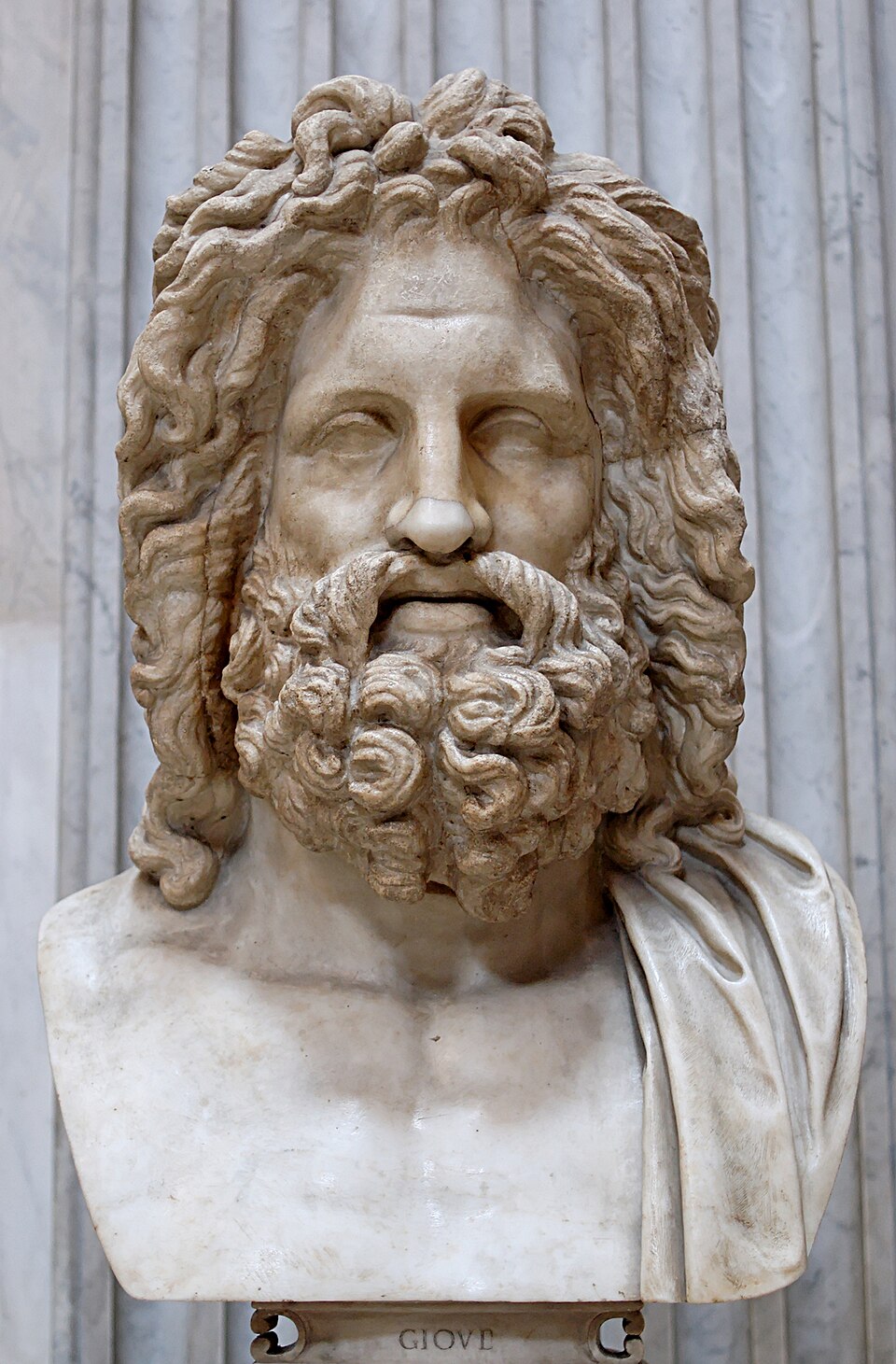
The Latin on his tomb says that “by a strength of mind almost divine” he “explored the course and figures of the planets, the paths of comets, the tides of the sea.”17 Zevism names the path toward such a mind ὁμοίωσις θεῷ κατὰ τὸ δυνατόν, likeness to the divine “as far as possible.”18 The Principia is a mind lifted toward the order that Zeus holds as Sovereign of the Cosmos.
The Mint is Ma'at in coin. Egypt named Ma'at “the personification of truth, justice, and the cosmic order” and set her against isfet, disorder.19 A clipped or forged coin is a lie in metal, Izfet passed from hand to hand, and the Warden who fought the Mint's corruption and the forgers of its coin served that order.
Newton was a Christian who rejected the Trinity, and the Temple leaves his faith as he held it. The Good in Zevism joins right order to right act, and the Leibniz affair fails that test. Newton had a true claim to his own calculus, but writing the verdict of an “impartial” committee in secret was a wrong act.
He was more honest at the edge of his own science. The General Scholium added to the Principia admits: “I have not been able to discover the cause of those properties of gravity from phænomena, and I frame no hypothesis.”20 In Zevist terms he marked where his light stopped and left the rest of the dark for those who'd follow.
NOTES
2 Newton Project, “His Life and Work at a Glance”.
3 MacTutor.
5 Newton Project; Westminster Abbey, “Sir Isaac Newton”.
6 Newton, “New Theory about Light and Colors”.
7 Cambridge Digital Library, Newton's annotated Principia.
9 Newton, “New Theory about Light and Colors,” pp. 3075–3079.
10 “New Theory about Light and Colors,” pp. 3075–3079.
11 Stukeley, Memoirs of Sir Isaac Newton's Life.
15 Guzman Redivivus; Newton Project, MINT 19/1/506.
16 Guzman Redivivus; Newton Project, MINT 19/1/505.
20 Newton, “General Scholium,” tr. Motte, p. 392; Newton Project, “Newton on Science and Religion”.
BIBLIOGRAPHY
J. J. O'Connor and E. F. Robertson, “Isaac Newton”, MacTutor History of Mathematics, University of St Andrews, January 2000; birth, Cambridge, the plague years, the Lucasian chair, the telescope, Halley's visit, De motu, the Principia, Parliament, the Mint, the knighthood and the Leibniz committee.
Isaac Newton, “A Letter ... containing his New Theory about Light and Colors”, Philosophical Transactions 80, 19 February 1671/2, pp. 3075–3087; normalized transcription, Newton Project, University of Oxford.
Isaac Newton, “General Scholium”, Andrew Motte's 1729 English translation of the Mathematical Principles of Natural Philosophy, vol. II, pp. 387–393; Newton Project.
Newton Project, “Newton on Science and Religion”, University of Oxford; the General Scholium as an addition to the 1713 edition.
Newton Project, “His Life and Work at a Glance”, University of Oxford; Woolsthorpe years, the Trinity, the dispensation of 1675, the Mint, the Opticks and his death.
William Stukeley, Memoirs of Sir Isaac Newton's Life, 1752, Royal Society MS/142; normalized transcription, Newton Project; conversation of 15 April 1726.
Anonymous, Guzman Redivivus: A Short View of the Life of Will. Chaloner, London, 1699; with the Newton Project catalogue records of the Commons committee's order of 15 February 1697, MINT 19/1/506, and Newton's draft amendments to a report on Chaloner, MINT 19/1/505, The National Archives, Kew.
Cambridge University Library, Newton's annotated copy of the Principia, 1st edition with manuscript amendments, Cambridge Digital Library.
Westminster Abbey, “Sir Isaac Newton”; burial, pallbearers, monument inscription and Pope's epitaph.
Encyclopaedia Britannica, “Maat”.
Plato, Theaetetus 176a–b, Greek text, Perseus Digital Library.
CREDIT
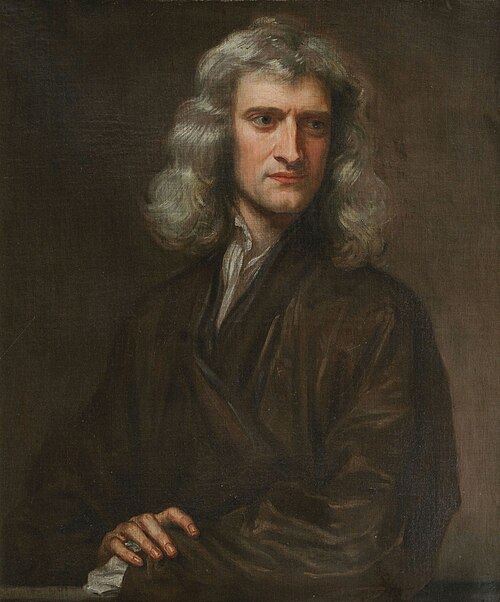
Picture: Godfrey Kneller’s portrait of Isaac Newton, 1689.
Godfrey Kneller; Cambridge University Library / Wikimedia Commons. Image record, Public domain, faithful reproduction of public-domain painting.

The round picture in the lists of the personalities is cropped from it.