



9 min read
Great Physicist
James Clerk Maxwell
author: High Priest Zevios Metathronos
Learning to Recognise Order
Dates: 1831–1879 CE
Period: Imperial period (1804–1900)
James Clerk Maxwell was an Edinburgh-born physicist who put Michael Faraday's lines of force into mathematics and found that light belongs to them. In papers of 1861 and 1862 he calculated that electric and magnetic effects travel at the speed of light, and he concluded that light is an electromagnetic wave.1
Electricity, magnetism and light, which had seemed 3 separate subjects, became a single theory, summed up in the equations that carry his name. Albert Einstein said of him: “One scientific epoch ended and another began with James Clerk Maxwell.”2
Zevism reads that unification as a recovery of the Logos, the single ordering word that Heraclitus said all things follow. Maxwell also explained light itself, and the Temple counts the man who shows what light is among those who carry it into darkness.
LIFE AND CONTEXT
Maxwell was born on 13 June 1831 at 14 India Street in Edinburgh, and the family moved to the estate of Glenlair in Kirkcudbrightshire. His mother died when he was 8. He entered the Edinburgh Academy in November 1841 and Edinburgh University in November 1847.3
In October 1850 he went up to Peterhouse, Cambridge, and after 1 term moved to Trinity. He graduated in 1854 as 2nd Wrangler and equal 1st Smith's Prizeman. In 1855 and 1856 he read his paper “On Faraday's lines of force” to the Cambridge Philosophical Society, giving Faraday's physical picture a mathematical form.4
He was 25 when Marischal College, Aberdeen, made him Professor of Natural Philosophy in 1856, and in Aberdeen he married Katherine Mary Dewar. In 1860 he took the chair of Natural Philosophy at King's College London and held it until 1865.5
The London years brought the electromagnetic papers of 1861 and 1862, and in 1861 he demonstrated colour reproduction at the Royal Institution. In the spring of 1865 he left King's and went back to Glenlair.4
Maxwell was a Christian, and his faith mattered to him. He became an elder of Corsock Parish Church in 1863. In 1871 Cambridge made him its first Cavendish Professor. He died of stomach cancer in Cambridge on 5 November 1879, aged 48, and was buried at Parton in Galloway.6
ATTAINMENTS
- At 14 he wrote “On the description of oval curves, and those having a plurality of foci,” read to the Royal Society of Edinburgh on 6 April 1846.7
- His Adams Prize essay of 1857 showed that Saturn's rings could be stable only if they consisted of numerous small solid particles.7
- In 1860 his paper “Illustrations of the Dynamical Theory of Gases” derived the distribution of molecular velocities in a gas, now called the Maxwell-Boltzmann distribution. The Royal Society gave him its Rumford Medal the same year.8
- In 1861 he gave the first demonstration of colour reproduction at the Royal Institution, and his work there led to the first colour photographs.9
- In 3 papers of 1861 and 1862 he joined electricity, magnetism and light in a single theory of electromagnetic radiation.2
- His Treatise on Electricity and Magnetism, published by Oxford University Press in 1873, gave his equations in their fully developed form.4
- As first Cavendish Professor he designed the Cavendish Laboratory, formally opened on 16 June 1874, and edited Henry Cavendish's papers, published in 1879 as The Electrical Researches of the Honourable Henry Cavendish.7
KEY STORIES
Dafty and the Ovals
Maxwell arrived at the Edinburgh Academy in November 1841, a country boy from Galloway who'd lost his mother 2 years before. MacTutor's biographers record that “at school he was at first regarded as shy and rather dull,” and the boys gave him a nickname to match: Dafty.10
At 14 he turned to geometry. An ellipse is the set of points whose distances from 2 fixed points add up to a constant. Maxwell weighted the distances and studied “the locus of a point where the sum of m times the distance from one fixed point plus n times the distance from a second fixed point is constant.” With both weights equal to 1, as MacTutor explains, “the curve is an ellipse.” He went on to curves with more than 2 foci.7
The paper was read to the Royal Society of Edinburgh on 6 April 1846 and printed in its Proceedings. Descartes had described such curves before, as MacTutor notes, “but the work was remarkable for a 14 year old.”11
The Rings of Saturn
Maxwell had first puzzled over Saturn's rings in 1847 with his schoolfellow Tait, while both were still pupils at the Edinburgh Academy. A decade later St John's College, Cambridge, set the subject for the Adams Prize of 1857: “The Motion of Saturn's Rings.” The question was what the rings could be made of and still hold together.7
Maxwell, newly installed at Aberdeen, decided to compete, and his first 2 years of research there went into the problem. He worked through the possibilities with mathematics alone, and he showed that stability “could be achieved only if the rings consisted of numerous small solid particles.” His essay won the prize.11
George Airy judged it this way: “It is one of the most remarkable applications of mathematics to physics that I have ever seen.” More than a century later the Voyager spacecraft flew past Saturn and confirmed the explanation. In the Temple's terms that's order read from afar: the rings keep their shape because every grain in them obeys the same law.7
Light Out of Electricity
At King's College in 1861 and 1862, Maxwell calculated how fast electric and magnetic effects would travel through the medium that carried Faraday's lines of force. The answer wasn't far from the speed of light. In “On physical lines of force” he wrote that “we can scarcely avoid the inference that light consists in the transverse undulations of the same medium which is the cause of electric and magnetic phenomena.”4
He didn't stop there. The full theory followed in “A dynamical theory of the electromagnetic field,” printed in the Philosophical Transactions of the Royal Society in 1865, and the fully developed equations in his Treatise of 1873.8
Richard Feynman later put the result on a scale of 10,000 years: “there can be little doubt that the most significant event of the 19th century will be judged as Maxwell's discovery of the laws of electrodynamics.”8
The Words over the Door
The 7th Duke of Devonshire, William Cavendish, gave £6,300 to build a physics laboratory at Cambridge, on condition that the Colleges paid for a Professorship of Experimental Physics. In 1871 Maxwell became the first Cavendish Professor. He designed and equipped the new laboratory, and it was formally opened on 16 June 1874.12
He also decided what it would say to everyone who came in. Mark McCartney calls it “a final Maxwellian touch”: Maxwell had the main doors inscribed with the words of Psalm 111:2, Magna opera Domini exquisita in omnes voluntates ejus, “Great are the works of the Lord; they are pondered by all who delight in them.”13
His last years went into another man's work. Editing Henry Cavendish's papers took much of his time between 1874 and 1879, and the edition came out in 1879. That May his health began to fail, but “he continued to give his lectures up to the end of the term.” He died in November, at 48, and he didn't live to see his theories of electricity, magnetism and statistical physics fully confirmed.14
THE ZEVIST READING
Heraclitus wrote of the Logos that “although all things happen according to this Word,” most people don't grasp it, and his task was to “distinguish each thing according to its nature and show how it is.”15 Zevism calls itself the Logos restored. Maxwell's equations are the Logos at work in one field of nature: a spark, a compass needle and a sunbeam, once thought to be separate things, follow the same laws.
Light and Darkness give the 2nd reading. Zevism holds that unexplored darkness is ground to be walked into with a light, and that explored darkness becomes Light, which is knowledge. Maxwell went further than most. He explained what light itself is: a wave in the same field that turns a compass needle.
His own faith was Christian. He wrote that “Christians whose minds are scientific are bound to study science that their view of the glory of God may be as extensive as their being is capable of.”13 The Temple's reading is its own: a mind that joins itself to the order of the cosmos is walking the path of ὁμοίωσις θεῷ κατὰ τὸ δυνατόν, likeness to the divine “as far as possible.”16
His last labour fits the Temple's honour for keepers of the source. Maxwell spent his final years editing another man's electrical researches so that they could be read, and he left Cambridge a laboratory built to carry the work on.
NOTES
1 King's College London, “James Clerk Maxwell”; James Clerk Maxwell Foundation, “Who was James Clerk Maxwell?”.
3 James Clerk Maxwell Foundation; O'Connor and Robertson, “James Clerk Maxwell,” MacTutor.
4 James Clerk Maxwell Foundation; O'Connor and Robertson, MacTutor.
5 King's College London; O'Connor and Robertson, MacTutor.
6 Mark McCartney, “'Great are the works of the Lord': The Christian faith of James Clerk Maxwell”; James Clerk Maxwell Foundation.
7 O'Connor and Robertson, MacTutor.
8 James Clerk Maxwell Foundation.
9 James Clerk Maxwell Foundation; King's College London.
10 O'Connor and Robertson, MacTutor; King's College London.
11 O'Connor and Robertson, MacTutor; James Clerk Maxwell Foundation.
12 University of Cambridge, Cavendish Laboratory, “History”; O'Connor and Robertson, MacTutor.
13 McCartney, “The Christian faith of James Clerk Maxwell”.
14 O'Connor and Robertson, MacTutor; Cavendish Laboratory, “History”.
15 Graham, “Heraclitus,” Stanford Encyclopedia of Philosophy, §2.
BIBLIOGRAPHY
King's College London, “James Clerk Maxwell”, institutional biography; King's years, electromagnetic theory, colour photography and Einstein's remark.
J. J. O'Connor and E. F. Robertson, “James Clerk Maxwell”, MacTutor History of Mathematics, University of St Andrews; school, oval curves, Faraday paper, Saturn's rings and Airy's verdict, King's College, Cavendish Laboratory and edition.
James Clerk Maxwell Foundation, “Who was James Clerk Maxwell?”, biography and timeline; birthplace, Tripos, gases, Rumford Medal, colour reproduction, “On physical lines of force,” the 1865 paper, the Treatise, death and the Feynman quotation.
Mark McCartney, Ulster University, “'Great are the works of the Lord': The Christian faith of James Clerk Maxwell”, James Clerk Maxwell Foundation.
Daniel W. Graham, “Heraclitus”, Stanford Encyclopedia of Philosophy, §2, fragment B1.
Plato, Theaetetus 176a–b, Greek text, Perseus Digital Library.
University of Cambridge, Cavendish Laboratory, “History”; the Duke of Devonshire's gift of £6,300 and the first Cavendish Professor.
CREDIT
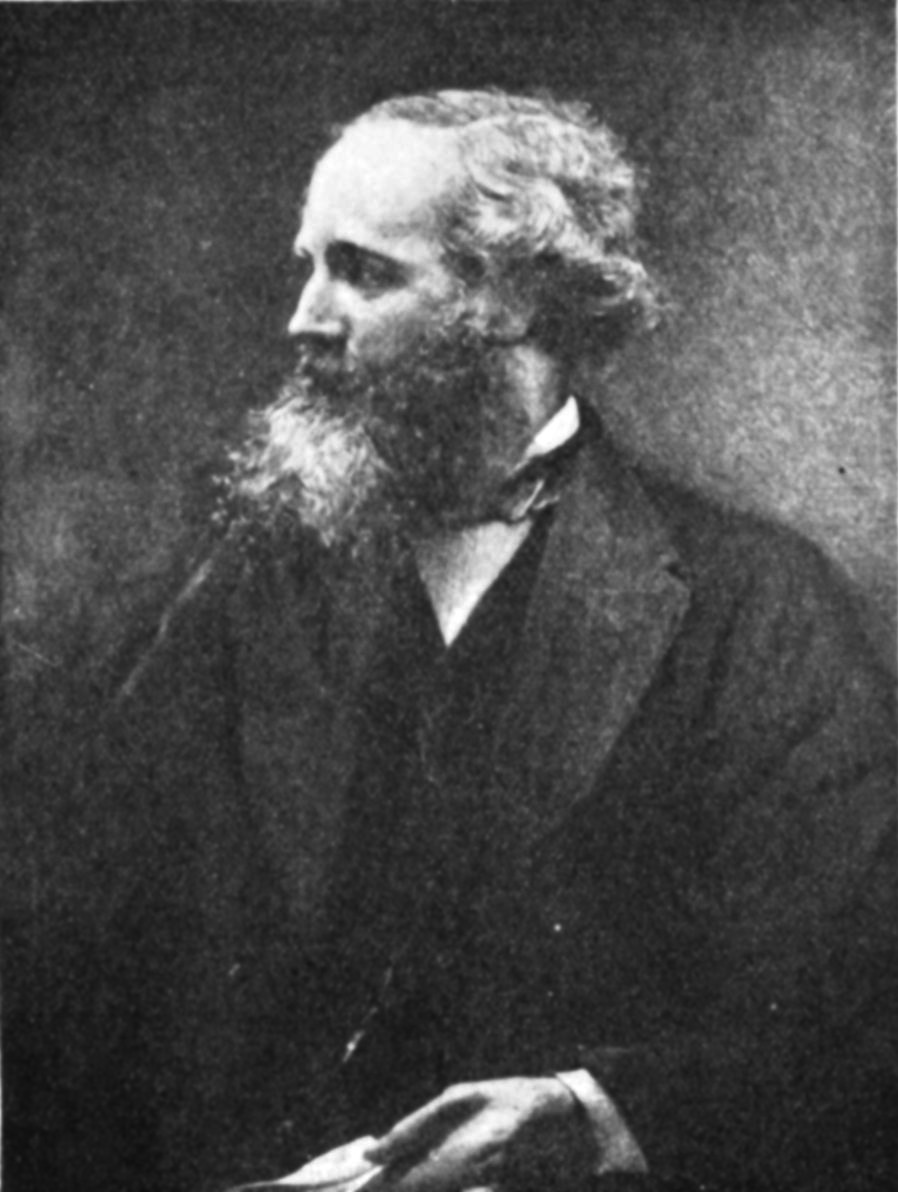
Image: photograph of James Clerk Maxwell reproduced in Millikan and Gale's Practical Physics (1920), photographer not identified in the file record; scan by B. Crowell. Public domain; verified Commons file record.

James Clerk Maxwell, from Millikan and Gale, Practical Physics (1920), scan by B. Crowell, via Wikimedia Commons; public domain. Image record, Public domain, as stated on Commons; publication1920.
The round picture in the lists of the personalities is cropped from it.