




9 min read
Discoverer of the Helix
James Dewey Watson
author: High Priest Zevios Metathronos
The Form That Suggested a Mechanism
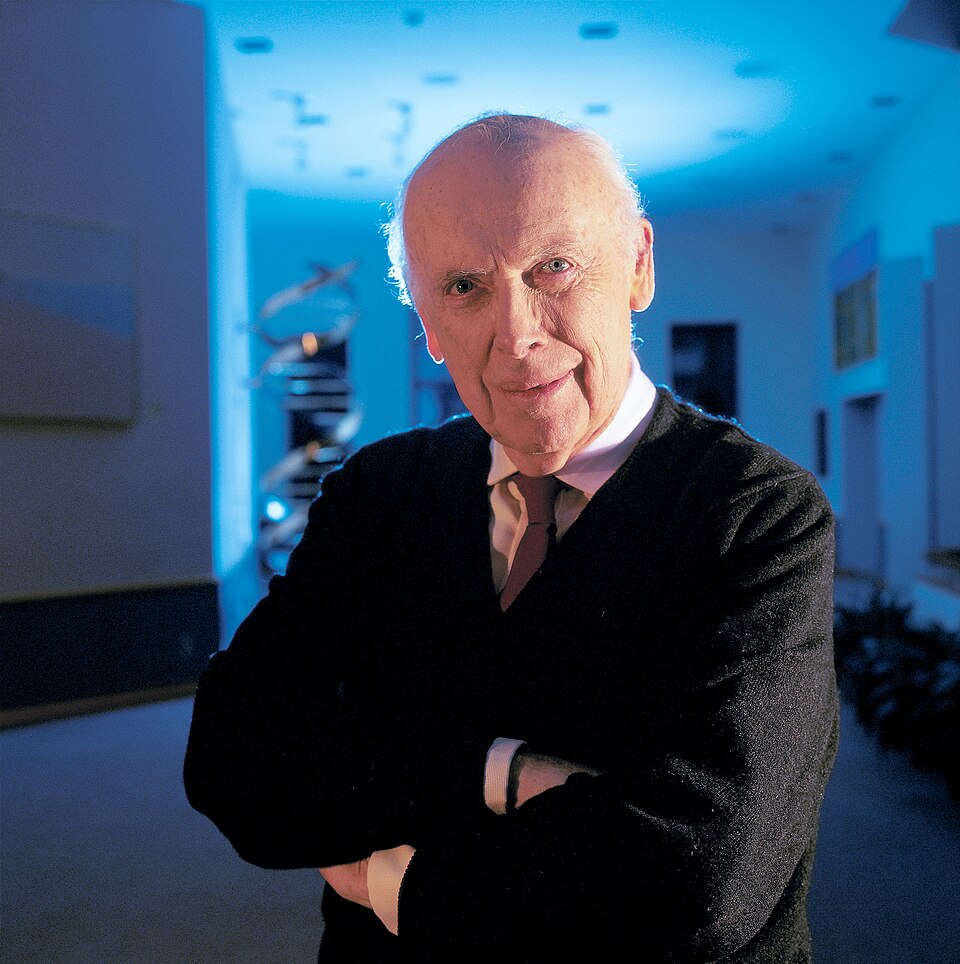
Dates: 1928–2025
Period: Modern period, 1900–present
James Dewey Watson was an American biologist who worked out the structure of DNA with Francis Crick at the Cavendish Laboratory in Cambridge in February 1953. Their model set 2 sugar-phosphate backbones on the outside of the molecule and paired bases on the inside, and it appeared in Nature on 25 April 1953.1
In 1962 he shared the Nobel Prize in Physiology or Medicine with Crick and Maurice Wilkins “for their discoveries concerning the molecular structure of nucleic acids and its significance for information transfer in living material.” He went on to write Molecular Biology of the Gene, to run Cold Spring Harbor Laboratory from 1968 and to serve as the first director of the genome centre of the National Institutes of Health.2
Zevism reads the double helix under Theuth, who in Plato's account invented number and, “most important of all, letters.”3 The pairing rule showed how a script of 4 chemical letters could be copied.
LIFE AND CONTEXT
Watson was born in Chicago on 6 April 1928. He studied zoology at the University of Chicago and took his doctorate at Indiana University in 1950. Under Salvador Luria he studied the effects of X-rays on the multiplication of bacteriophages, the viruses that infect bacteria.4
Postdoctoral work took him to Copenhagen. In 1951, at a meeting in Naples, he saw Maurice Wilkins present X-ray diffraction results on DNA, and the pictures turned him toward molecular structure. He joined the Cavendish Laboratory that October. There he found Crick, and the 2 men brought “complementary scientific backgrounds in physics and X-ray crystallography (Crick) and viral and bacterial genetics (Watson).”5
They built models; the measurements came from others. Rosalind Franklin and Raymond Gosling produced the diffraction evidence at King's College London, Wilkins and his colleagues there pursued the same structure, and Erwin Chargaff had measured fixed ratios between the bases.6
At Harvard he turned to RNA and protein synthesis with Alfred Tissières, François Gros and Walter Gilbert. His textbook Molecular Biology of the Gene appeared in 1965 and “changed the nature of science textbooks.” His memoir The Double Helix followed in 1968. It presented Franklin as “Rosy,” in the National Library of Medicine's summary “a bad-tempered, arrogant bluestocking who jealously guarded her data from colleagues.”7
In 1968, at 40, he became the 2nd director of Cold Spring Harbor Laboratory, which was then “not far short of being destitute.” In 1989 he became the first director of the National Center for Human Genome Research at the National Institutes of Health, and he resigned in 1992.8
His public statements on race ended his institutional life. After remarks on race and IQ, the Laboratory's board removed him from all administrative roles. In January 2019, after he made similar claims in the documentary American Masters: Decoding Watson, Cold Spring Harbor rejected them as unsupported by science and revoked his honorary titles. He died in New York on 6 November 2025.9
ATTAINMENTS
- With Crick he built the double-helix model of DNA, published in Nature on 25 April 1953 as “A Structure for Deoxyribose Nucleic Acid.” It showed DNA as “a long spiralling molecule, with a double ‘backbone’ of sugar and phosphates.”10
- He found the base pairs with cardboard models on 28 February 1953: adenine with thymine and guanine with cytosine, 2 pairs of the same shape held by hydrogen bonds. The rule explained why Chargaff's A and T, and his G and C, always came out in ratios of 1 to 1.11
- The pairing suggested a way for each strand to guide the building of its partner, and that physical account of gene copying opened a programme of experiments for molecular biology.12
- He took a 1/3 share of the 1962 Nobel Prize in Physiology or Medicine, while at Harvard, and gave his Nobel lecture on 11 December 1962 as “The Involvement of RNA in the Synthesis of Proteins.”13
- He wrote Molecular Biology of the Gene (1965), a textbook whose style “was widely emulated.”14
- He ran Cold Spring Harbor Laboratory from 1968 and backed its DNA Learning Center, “unique in providing hands-on genetic education for high-school students.”14
- He directed the National Center for Human Genome Research from 1989 to 1992 and created its programme on the Ethical, Legal and Social Issues of genome research “because of his concerns about misuse of the fruits of the project.”15
KEY STORIES
Photograph 51
At King's College London in May 1952, Rosalind Franklin took “a very clear photo of the B form” of DNA and labelled it “51.”16
Her evidence reached Cambridge by 2 routes. Wilkins showed the photograph to Watson “without Franklin's knowledge.” Max Perutz, who sat on the Medical Research Council committee that reviewed the King's laboratory, handed Watson and Crick the committee's report with her data in it.17
The pressure came from Linus Pauling. In February 1953 he proposed a model of his own, and Watson and Crick “feared that they would be upstaged.” Pauling's 3-stranded helix “quickly proved erroneous.” Their own first attempt, also 3-stranded, had failed as well. Franklin's evidence told them what Pauling had missed: “the two sugar-phosphate backbones lay on the outside of the molecule.”11
The Cardboard Bases
Watson and Crick shared their office that year with Jerry Donohue, a visiting physical chemist from the United States. Donohue pointed out that the ring configuration of thymine and guanine “given in most textbooks of chemistry was incorrect.” Watson, acting on the advice, “put the two bases into their correct form in cardboard models” and began to fit the pieces together.11
On 28 February 1953 the pieces fell into place. The National Library of Medicine's account says “Watson realized in a stroke of inspiration that A, when joined with T, very nearly resembled a combination of C and G, and that each pair could hold together by forming hydrogen bonds.” The pairs also explained Chargaff's rule, by which “A and T always appeared in ratios of one-to-one, as did G and C.”18
That day Crick told “the assembled lunch patrons at The Eagle” that they had “found the secret of life.”18
One Page in Nature
The paper they sent to Nature was short. It filled a single page, carried the title “A Structure for Deoxyribose Nucleic Acid” and was “illustrated with a schematic drawing of the double helix by Crick's wife, Odile.”11
It opened with a demolition. Watson and Crick explained why the 3-chain structure of Pauling and Corey couldn't be right: it packed negatively charged phosphates near the centre, where they'd repel one another.19
The issue of 25 April carried Franklin's own work too, which “appeared, in expanded and modified form, with Watson and Crick's announcement.” The model and the measurement came out side by side.17
Stockholm, December 1962
In December 1962 the 3 laureates from Cambridge and London came to Stockholm, and Professor A. Engström of the Royal Caroline Institute presented them. “Watson and Crick showed that the organic bases were paired in a specific manner in the two intertwined helices,” he said, and then he turned to them: “Dr. Francis Crick, Dr. James Watson, and Dr. Maurice Wilkins. Your discovery of the molecular structure of the deoxyribonucleic acid, the substance carrying the heredity, is of utmost importance for our understanding of one of the most vital biological processes.”20
Watson's own lecture, on 11 December, bore the title “The Involvement of RNA in the Synthesis of Proteins,” the subject of his Harvard years.21
Franklin wasn't there. She had died in London on 16 April 1958. The National Library of Medicine records that of the 3 laureates, “None gave Franklin credit for her contributions at that time.”22
THE ZEVIST READING
Plato's Theuth “invented numbers and arithmetic and geometry and astronomy, also draughts and dice, and, most important of all, letters.”23 Zevism holds that Egypt kept early forms of the Logos in the powers of Thoth. The double helix showed the living cell writing with 4 letters and copying its script by a rule of pairs. Watson's cardboard bases read a text the divine order had written long before any scribe.
The discovery belongs to the doctrine of Light and Darkness. Unexplored darkness isn't evil; it's the ground one enters with light. In 1951 the form of the gene was such darkness. By April 1953 it was knowledge any chemist could test, and the Temple counts that passage from dark to light as the work of the path.
The Temple also reads Watson by the doctrine of the Good, which requires Ma'at, right order, and Right, a right act from a right will. Egyptian religion named Ma'at “the personification of truth, justice, and the cosmic order.”24 The model restored order to the record of life, but data seen without its maker's knowledge and later claims that his own laboratory found unsupported by science fall short of Right, and Zevism doesn't let the first cover the second.
Zevism honours the source. Franklin's photograph was the measurement on which the synthesis stood, and her paper in the same issue of Nature is part of the discovery's text. Watson's textbook and the laboratory he rebuilt passed that text to students who never met its authors, and in Zevist terms that transmission is service to the source.
NOTES
1 MRC Laboratory of Molecular Biology, “1962: Francis Crick & James Watson”; NLM, “The Discovery of the Double Helix”.
2 Nobel Prize, “James Watson: Facts”; Cold Spring Harbor Laboratory, “In remembrance”.
4 Nobel Prize, “James Watson: Biographical”.
5 Nobel Prize, “Biographical”; NLM, “The Discovery of the Double Helix”.
6 Science History Institute, “Francis Crick, Rosalind Franklin, James Watson, and Maurice Wilkins”.
7 Nobel Prize, “Biographical”; Cold Spring Harbor Laboratory, “In remembrance”; NLM, “Rosalind Franklin: Biographical Overview”.
8 CSHL, “In remembrance”; NHGRI, “Human Genome Project Timeline of Events”.
9 CSHL, statement of 11 January 2019; Nobel Prize, “Facts”.
10 MRC LMB; Watson and Crick, Nature 171.
11 NLM, “The Discovery of the Double Helix”.
12 MRC LMB.
13 Nobel Prize, “Facts”; Nobel Prize, “Nobel Lecture”.
15 NHGRI, “Timeline”; CSHL, “In remembrance”.
16 NLM, “The DNA Riddle: King's College, London, 1951–1953”.
18 NLM.
19 Watson and Crick, Nature 171 (1953), 737–738.
20 Nobel Prize, “Award ceremony speech,” 1962.
21 Nobel Prize, “Nobel Lecture”.
22 NLM, “Rosalind Franklin: Biographical Overview”.
23 Plato, Phaedrus 274c–d, tr. Fowler.
BIBLIOGRAPHY
J. D. Watson and F. H. C. Crick, “Molecular Structure of Nucleic Acids: A Structure for Deoxyribose Nucleic Acid”, Nature 171 (25 April 1953), 737–738; opening paragraphs.
Nobel Prize Outreach, “James Watson: Biographical”, from Les Prix Nobel and Nobel Lectures, Physiology or Medicine 1942–1962 (Elsevier, 1964); “James Watson: Facts”; “Nobel Lecture”, 11 December 1962.
A. Engström, “Award ceremony speech”, Nobel Prize in Physiology or Medicine 1962, Nobel Prize Outreach.
U.S. National Library of Medicine, Profiles in Science, Francis Crick Papers, “The Discovery of the Double Helix, 1951–1953”.
U.S. National Library of Medicine, Profiles in Science, Rosalind Franklin Papers, “The DNA Riddle: King's College, London, 1951–1953” and “Biographical Overview”.
MRC Laboratory of Molecular Biology, “1962: Francis Crick & James Watson”.
Science History Institute, “Francis Crick, Rosalind Franklin, James Watson, and Maurice Wilkins”, updated 8 September 2025.
Cold Spring Harbor Laboratory, “In remembrance of Dr. James D. Watson”, 7 November 2025; statement addressing Watson's remarks in American Masters: Decoding Watson, 11 January 2019.
National Human Genome Research Institute, “Human Genome Project Timeline of Events”; entries for 1988, 1989 and 1992.
Plato, Phaedrus 274c–d, translated by H. N. Fowler, Perseus Digital Library; Encyclopaedia Britannica, “Maat”.
CREDIT
Portrait: James D. Watson, photograph by Miriam Chua/Cold Spring Harbor Laboratory, cropped and adjusted by Jan Arkesteijn. Wikimedia Commons file, copyright-holder permission for unrestricted use.

Miriam Chua / Cold Spring Harbor Laboratory; crop, colour and exposure adjustment by Jan Arkesteijn; via Wikimedia Commons. Image record, Copyrighted free use: copyright holder permits unrestricted redistribution, commercial use and modification.

The round picture in the lists of the personalities is cropped from it.