



9 min read
Harmonist of the Worlds
Johannes Kepler
author: High Priest Zevios Metathronos
Harmony Answerable to the Heavens
Dates: 1571–1630
Period: Renaissance, through the laws published in 1609 and 1619.
Johannes Kepler was a German mathematician who found the true shape of the planets' paths. Working from Tycho Brahe's observations of Mars, he showed in 1609 that a planet moves on an ellipse with the Sun at 1 focus. In 1619 he tied every planet's period to its distance from the Sun by a single rule.1
He was a Lutheran who held that God shows himself in the arrangement of the universe as well as in Scripture, and he called his great book of 1619 the Harmony of the World.2
Zevism reads the work under 2 powers: the harmony that Greek tradition gave to Apollo, and Ma'at, the order that keeps a record true. Kepler let 8 minutes of arc in Tycho's data overturn his own hypothesis, and that choice opened the way to the new astronomy.
LIFE AND CONTEXT
Kepler was born on 27 December 1571 in the small Swabian town of Weil der Stadt, and his parents moved to nearby Leonberg in 1576. At the University of Tübingen, Michael Mästlin taught him astronomy, including the heliocentric system of Copernicus. Even as a student, his religious views weren't entirely in line with the orthodox Lutheranism of Tübingen.3
He was studying theology, but in March or April 1594, before he'd finished, he accepted Mästlin's recommendation and an offer to teach mathematics at the Protestant school in Graz, succeeding Georg Stadius. He worked there until 1600, composing calendars and writing his earliest book, the Mysterium cosmographicum of 1596.4 In Prague, the capital of the Empire, Tycho Brahe had already written to Mästlin in search of a mathematical assistant.5
In 1600 Kepler joined Tycho in Prague as his assistant. Tycho gave him the orbit of Mars, but he held back most of his observations, partly because he didn't want them used to prove Copernicus right.6 Tycho died in 1601, and Kepler succeeded him as Imperial Mathematician.5
Late 1611 broke his household. His 7-year-old son died, then his wife, and Emperor Rudolf was forced to abdicate in favour of his brother Matthias, who didn't believe in tolerating Protestants.5 In 1612 Kepler moved to Linz, where he taught at the provincial school and served the Upper Austrian Estates as mathematician.7 His church excommunicated him that year. It caused him much pain, and even as Imperial Mathematician he never got the ban lifted.5
He left Linz in 1626. The Rudolphine Tables, named for the Emperor and built on Tycho's observations and Kepler's own first 2 laws, came out at Ulm in 1627. Kepler died after a short illness at Regensburg on 15 November 1630, on his way to collect money still owed to him for the tables.8
ATTAINMENTS
- The Mysterium cosmographicum (Tübingen, 1596) set the 5 regular solids between the spheres of the 6 known planets, and it matched Copernicus's distances with a greatest error under 10%.5
- His optics of 1604 gave the first correct mathematical theory of the camera obscura and the first correct explanation of the human eye, “with an upside-down picture formed on the retina.”5
- De stella nova (Prague, 1606) described the new star of 1604, now called Kepler's supernova.5
- The Astronomia nova (Heidelberg, 1609) published his first 2 laws: the orbit is an ellipse with the Sun at 1 focus, and the line from Sun to planet sweeps out equal areas in equal times.1
- The Dioptrice (Prague, 1611) designed a telescope with 2 convex lenses.5
- The Harmonices mundi (1619) stated the 3rd law: the square of a planet's period is proportional to the cube of its orbit's semi-major axis.1
- The Rudolphine Tables (1627) stayed accurate for decades, while other tables built on new observations held only for their first few years.5
KEY STORIES
The Figure on the Board
In July 1595 Kepler was 23 and teaching at Graz. He was showing his class how the conjunctions of Jupiter and Saturn move through the constellations of the zodiac, and he'd drawn the pattern for them. The drawing “suddenly hit him with a force he described as akin to divine revelation.”9
The question he'd carried was why there were 6 planets and why their spheres sat at those distances. He found the answer in Euclid: “There are only five convex regular solids (as is proved in Euclid's Elements, Book 13).” Nest them one inside another between the 6 spheres, and the sphere of Saturn closes round the cube with no solid left over for a 7th planet.10
He tested the scheme against Copernicus's figures. The greatest error came out under 10%. Georg Gruppenbach printed the book at Tübingen in 1596, and Kepler posted copies to the leading astronomers of Europe.11
Eight Minutes of Arc
The orbit of Mars was the intractable problem of the day, and Tycho gave it to the newcomer. After Tycho's death Kepler kept at it as his successor.12
In chapters 17 to 21 of the Astronomia nova he tested his “vicarious hypothesis” against the nights when Mars, the Earth and the Sun stood in 1 line at midnight. It worked there: the calculated positions fell within 2 minutes of arc of the observed ones, inside the limits of acceptability. Then he brought in the observations of Mars's latitudes, and the calculations left a gap of 8 minutes. Tycho's observations were too good to allow it.13
Kepler wouldn't blame the observer. “These eight minutes alone will have led the way to the reformation of all of astronomy,” he wrote.14
He started again, and this time he let go of the circle. He concluded that “the orbit of Mars was an ellipse with the Sun in one of its foci.” The orbit he calculated agrees with modern results “so exactly that the comparison has to make allowance for secular changes in the orbit since Kepler's time.” It was printed at Heidelberg in 1609.5
A Mother on Trial
In August 1615 Katharina Kepler, aged 68, was accused of witchcraft in Württemberg. She'd allegedly given the local glazier's wife a poisonous brew, and the trial lasted from 1615 until 1621.15
Kepler was writing the Harmony of the World at the time. He conducted the defence himself and enlisted the legal faculty at Tübingen.16 One plea failed to convince the ducal court's advocate. The appeal to Tübingen went better: “the six professors were more compassionate, concluding that, at 75, Katharina was too old to be tortured.” She'd be shown the tools of torture instead, to “scare the truth out of her.”17
“In the torture chamber, Katharina impressed the witnesses with her pious behavior.” Within days she was released from her iron shackles and allowed to go home. She died 6 months later.17 The authorities had failed to follow the correct legal procedure on torture, and that objection helped set her free.5
The Law That Came Back on 15 May
Kepler recorded the birth of his 3rd law to the day. It “was conceived mentally on 8th March in this year one thousand six hundred and eighteen, but submitted to calculation in an unlucky way, and therefore rejected as false.” Then, “finally returning on the 15th of May and adopting a new line of attack,” it “stormed the darkness of my mind.”18
The fit was so close that he didn't trust it. “So strong was the support from the combination of my labour of seventeen years on the observations of Brahe and the present study, which conspired together, that at first I believed I was dreaming.”5
It wasn't a dream. “The proportion between the periodic times of any two planets is precisely the sesquialterate proportion of their mean distances”: the periods go as the distances raised to the power 3/2. A planet 4 times farther from the Sun than another takes 8 times as long to go round it.19
THE ZEVIST READING
Kepler's own words for his discovery were that the law “stormed the darkness of my mind.” Zevism teaches the same passage from the other side. Unexplored darkness isn't evil; one enters it carrying a light, and darkness explored becomes Light. The 17 years on Tycho's numbers were that walk, and the 3rd law was the light he carried out.
Plato ends the Republic with a vision of the heavens as music. On each of the rims of the circles “a Siren stood, borne around in its revolution and uttering one sound, one note, and from all the eight there was the concord of a single harmony.”20 Harmony belongs to Apollo, into whose hands the Homeric Hymn places the lyre.21 Kepler took the old image and gave it ratios that anyone with the tables could check.
The 8 minutes of arc are his service to Ma'at, “the personification of truth, justice, and the cosmic order,” set against isfet, disorder.22 A model that fits only by doubting an honest record is a small act of Izfet. Kepler trusted Tycho's observations and threw away his own hypothesis. In Zevist terms that's measurement restoring order. The order held by Zeus as Sovereign of the Cosmos is found in the record, and it outranks any mind's preference.
He was a Lutheran whose own church barred him from communion, and the Temple leaves his faith as he held it. Its reading concerns what he did. He put the same care into his mother's defence, answering a charge of witchcraft with the law of procedure, and the authorities let her go. Law against the torture chamber is Ma'at against Izfet in a single household.
NOTES
1 NASA, “Orbits and Kepler's Laws”.
2 SEP, “Johannes Kepler,” §§2, 7.
3 MacTutor, “Johannes Kepler”.
5 MacTutor.
6 NASA Earth Observatory, “Planetary Motion”; SEP, §1.
7 SEP, §1.
12 NASA Earth Observatory; MacTutor.
13 SEP, §5.
14 Astronomia nova, quoted in SEP, §5.
15 Damsma, review of Rublack; Snyder, review of Rublack.
17 Snyder.
18 Harmonices mundi, quoted in MacTutor.
20 Plato, Republic 10.617b, tr. Shorey.
21 Homeric Hymn to Hermes 496–498.
BIBLIOGRAPHY
J. V. Field, “Johannes Kepler”, MacTutor History of Mathematics, University of St Andrews; education, Graz, Tycho, Mars, optics, excommunication, his mother's trial, the 3rd law passage from Harmonices mundi and the Rudolphine Tables.
Daniel A. Di Liscia, “Johannes Kepler”, Stanford Encyclopedia of Philosophy, revision of 14 September 2025; §1 (life), §5 (Astronomia nova, chapters 17 to 21 and the 8 minutes), §7 (Harmonice mundi).
NASA Earth Observatory, “Planetary Motion: The History of an Idea That Launched the Scientific Revolution”, 7 July 2009; Brahe's observations and the Mars problem.
NASA Science Editorial Team, “Orbits and Kepler's Laws”, 2 May 2024; the 3 laws.
Karl Galle, “Johannes Kepler's Mysterium Cosmographicum”, Thinking 3D, 8 January 2018; the insight of July 1595 and the 1596 edition (ETH-Bibliothek Zürich, RAR 1367).
Alinda Damsma, review of Ulinka Rublack, The Astronomer and the Witch, Magic, Ritual, and Witchcraft 12.1 (Spring 2017), author copy, UCL Discovery.
Laura J. Snyder, review of Ulinka Rublack, The Astronomer and the Witch, Wall Street Journal, 26 January 2016, reprinted on the author's site.
Plato, Republic 10.617b, translated by Paul Shorey, Perseus Digital Library.
Homeric Hymn to Hermes 496–498, H. G. Evelyn-White translation, Theoi Classical Texts Library.
Encyclopaedia Britannica, “Maat”.
CREDIT
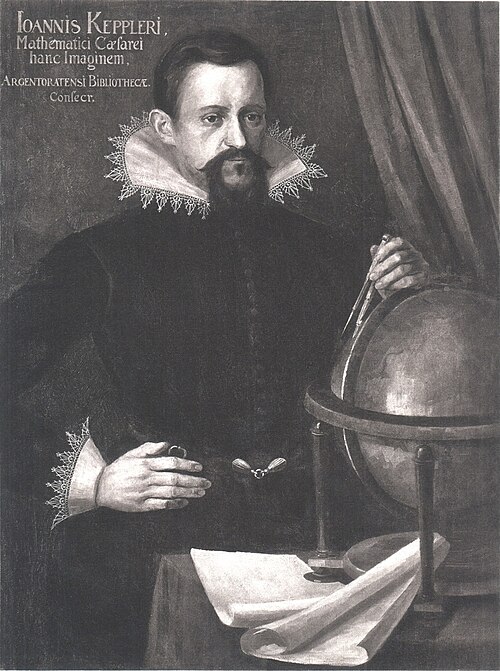
Picture: Portrait of Johannes Kepler, reproduced by Photographische Gesellschaft, Berlin; Smithsonian Libraries. The reproduction’s date is unspecified here.
Smithsonian Libraries, SIL14-K001-08, via Wikimedia Commons. Image record, Public domain.

The round picture in the lists of the personalities is cropped from it.