




4 min read
Bearer of Greek Philosophy
John Scottus Eriugena
author: High Priest Zevios Metathronos
The mind that carried Greek philosophy into a Latin world
Dates: ninth century CE
Period: Darkness (800–1000 CE)
Region: Ireland and Francia
Tradition: Christian Neoplatonism and condemned philosophy
Religion or tradition: Christianity: a Christian Neoplatonist working in the Carolingian Latin Christian world.
Heresy status: Christian Heretic: condemned Christian philosophical writings.
John Scottus Eriugena was an Irish scholar working at the court of Charles the Bald. His learning gave Greek Christian and Neoplatonic traditions a powerful new expression in Latin. He is included here as a philosopher whose speculative work exceeded the boundaries later ecclesiastical authorities were willing to permit, while retaining his actual Christian identity.1
WHY HE IS IDENTIFIED AS A CHRISTIAN HERETIC
The designation refers to ecclesiastical condemnation of Eriugena’s Christian philosophical writings. His On Divine Predestination, written against Gottschalk’s teaching, was condemned at Valence in 855 and Langres in 859. His Periphyseon received further condemnation in 1210 and 1225, long after his death. The grounds concerned his theological reasoning and its implications for God, creation and human freedom.2
Knowledge of the Gods: a Zevist interpretation. Eriugena carried a Neoplatonic inheritance through Greek Christian authors into Latin philosophical life. His inquiry into divine manifestation, the causes of nature and the mind’s return to its source kept that inheritance active. Within Zevism, this is a significant service to the knowledge of the Gods: the mind continued to investigate divine order through philosophy even where ecclesiastical authorities disputed its conclusions. His stated religious purpose was Christian; the connection developed here is the survival and exercise of a philosophical capacity rooted in antiquity.
OPENING GREEK LEARNING TO LATIN READERS
Eriugena’s translations widened access to Greek theological and philosophical writing in a Latin intellectual world. His work on the Dionysian corpus, together with his own sustained inquiry in the Periphyseon, placed difficult ideas about divine manifestation and the return of creation before readers who could not necessarily consult their Greek sources. His treatment of predestination also brought an argument for human freedom into a contentious public debate.3
These are constructive services to human learning: translation, conceptual development and the exercise of reason. For Zevist study, they matter because the preservation of philosophical capacity helps later generations investigate divine principles seriously. His contribution belongs to that history of intellectual transmission. It provides a substantial basis for appreciation while respecting his Christian identity and the actual subjects of his work.
INQUIRY BEYOND AN ASSIGNED CONTROVERSY
Around 851, Eriugena was asked to intervene in the dispute over predestination associated with Gottschalk of Orbais. His response defended human freedom and employed philosophical reasoning in ways that dissatisfied the authorities who had sought assistance. The treatise was condemned at Valence in 855 and Langres in 859. His case shows that an intellectual commissioned to settle a controversy could himself become controversial.4
Eriugena subsequently translated Greek works, including those attributed to Dionysius the Areopagite, and developed the Periphyseon in the 860s. Its dialogue between teacher and student investigates the relation of God, creation and return. The work’s later condemnations belong to its medieval reception, centuries after its author’s life; they should not be confused with a ninth-century trial of the Periphyseon.5
THE WORLD AS AN OBJECT OF CONTEMPLATION
The Periphyseon organizes inquiry through a fourfold division of nature, considering divine source, primordial causes, created effects and ultimate return. Dermot Moran interprets these divisions through the activity of contemplation, rather than as a simple stack of separate things. The philosophical structure therefore concerns what the mind can come to understand about reality.6
HIS ZEVIST SIGNIFICANCE
Eriugena represents the preservation and renewed exercise of philosophical capacity under restrictive conditions. His example is useful because it is specific: language study opened sources; translation made them available; sustained argument gave them a new form.
A Zevist reader can recognize the value of this work without calling its author a secret polytheist. The shared concern is the mind’s development through serious engagement with divine and cosmic principles. His career also demonstrates why the freedom to reason matters to religious learning. An institution that commissions inquiry may discover that the inquiry raises questions beyond the original commission.
NOTES
1 John J. O’Meara’s scholarly account.
2 Stanford Encyclopedia of Philosophy, biography and reception.
3 Stanford account of his works and thought.
4 Stanford Encyclopedia of Philosophy.
5 Stanford account, biography and reception.
6 Moran, “The Meaning of Nature”.
BIBLIOGRAPHY
John J. O’Meara, Eriugena (Oxford University Press, 1988), abstract and contents.
Dermot Moran, “John Scottus Eriugena,” Stanford Encyclopedia of Philosophy, entry.
Dermot Moran, “The Meaning of Nature,” in The Philosophy of John Scottus Eriugena (Cambridge University Press, 1989), pp. 241–268, chapter summary.
CREDIT
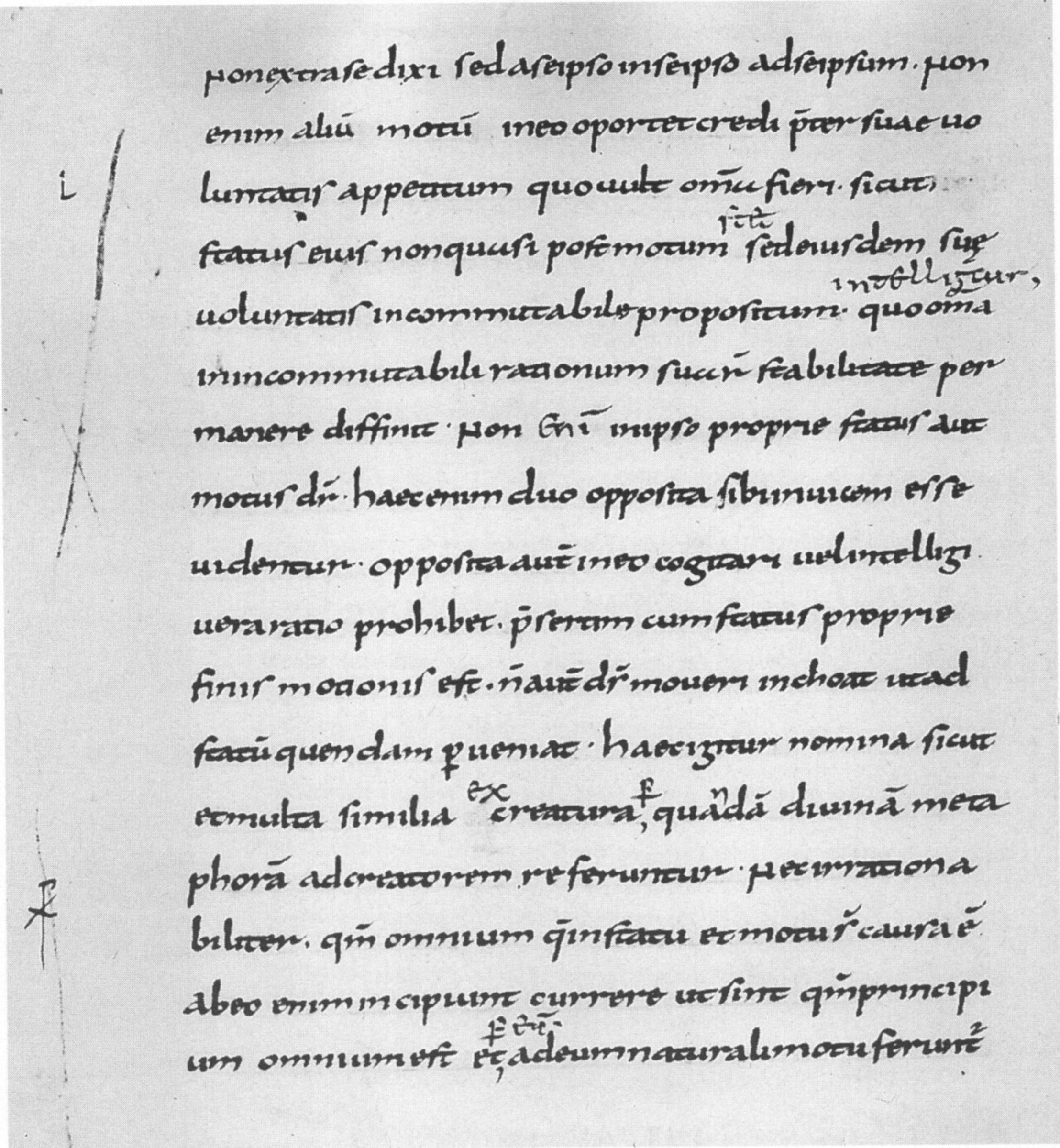
Picture: Early manuscript witness. Eriugena’s Periphyseon, Reims, Bibliothèque municipale MS 875, folio 15v, ninth century. The manuscript is considered partly autograph; this is a textual witness, not a portrait.
Credit: Attributed partly to Johannes Scotus Eriugena; Bibliothèque municipale de Reims. Source record, Public domain.

The round picture in the lists of the personalities is cropped from it.