




9 min read
Scholar of Ancient Poetry
Kamo no Mabuchi
author: High Priest Zevios Metathronos
Recovering the Voice of Prayer
Dates: 1697–1769 CE
Period: Enlightenment
Kamo no Mabuchi was a scholar of Japan's oldest poems and prayers and the teacher who set Motoori Norinaga on his life's work. Born in 1697 into a branch of the old Kamo family, “who served as priests of the famous Kamo shrine,” he died in Edo in 1769.1
His greatest attainment was the Noritokō, a commentary on the ritual prayers of the Engishiki. He began the work at 50, reworked it through more than 20 years and finished it in 1768, the year before he died. The Encyclopedia of Shinto calls it “the first thorough commentary on the entire body of norito in the Engishiki.”2
Mabuchi served the kami under their own names. Zevism reads his labour as a return to the source, the recovery of a sacred language so that its prayers could be heard again, and it places that labour under Hermes, God of speech, and the Muses of song.
LIFE AND CONTEXT
Mabuchi was born in the domain of Enshū Hamamatsu, in present-day Shizuoka Prefecture, “as the third son of Okabe Masanobu (1653-1732).” Britannica traces the family to the Kamo priests and says he began to study Japanese literature “under the tutelage of Shintō priests.”3
His teacher was the Kyoto scholar Kada no Azumamaro, whose academy he entered in 1728. After Kada's death in 1737 Mabuchi moved to Edo and made it his base for the rest of his life, lecturing and writing.4
In 1746, at 50, he became wagaku goyō, “Special Consultant for Japanese Studies,” to the Tayasu house, and he served Tayasu Munetake until 1760. His writing of these years “reflected his veneration of the strength and simplicity of the unadorned poetics of ancient times,” with the Man'yōshū as the model.4
His thought had a hard edge. Britannica says he held the oldest Japanese works to be “free of foreign influence” and “representative of the pure Japanese spirit.” It calls the Kokuikō, “A Study of the Idea of the Nation,” his “chief original work” and says it “contains a biting rejection of Chinese thought and literature.” Mori Mizue describes his thinking as “tinged with an anti-Confucianist intellectual depth based on the principle of imperial rule.”5
After he left the Tayasu service he moved to Hamachō in Edo and, in 1764, opened his own academy, the Agatai. He drew disciples “from among the Shinto priesthood, the samurai class and urban commoners.” The best known were Motoori Norinaga and Murata Harumi.6
His students went their own ways. Harumi, his leading disciple, kept Confucianism in his thought and preferred the Kokin wakashū to his teacher's Man'yōshū. Mabuchi died “on the thirtieth day of the tenth month of 1769 at the age of seventy-three,” and his writings fill 12 volumes.7
ATTAINMENTS
- He wrote the Noritokō, completed in 1768, the first full commentary on the ritual prayers of the Engishiki; the Encyclopedia of Shinto calls it “the foundational text for norito research.”8
- In 1746 he became Special Consultant for Japanese Studies to the Tayasu house and held the post for 14 years under Tayasu Munetake.4
- In 1764 he founded the Agatai academy in Edo and taught priests, samurai and townsmen, among them Motoori Norinaga and Murata Harumi.6
- He made the Man'yōshū, “the earliest collection of Japanese poems,” the standard of poetic style, and his works include the Man'yōkai.9
- He wrote the Goikō, studies of “Five Ancient Matters”: literature, poetry, nativism, language and writing. His other works include the Kanjikō, the Niimanabi and the Kokuikō.4
- He trained himself to write in the old manner. He “strived to achieve the point where he had mastered the ideal of the ancient Way through the proper understanding of the ancient language” and could express it “in poetry.”10
- He turned Norinaga toward the Kojiki. After their meeting in 1763, “research on the ancient text Kojiki thereafter formed the core” of Norinaga's scholarship.11
KEY STORIES
The Long Commentary
The Engishiki holds the norito, the ritual prayers addressed to the kami. In one of them the speaker addresses the sovereign Gods of the harvest and asks for the late-ripening harvest in many-bundled ears; in return he promises first-fruits in 1,000 ears, beer, and a white horse, a white boar and a white cock. The same collection holds rituals for the Gods of wind, fire and the roads, a ritual against evil spirits and rituals to the Sun-Goddess. Mabuchi's commentary would cover the whole body of them.12
In 1746, the year he entered the Tayasu service, Tayasu Munetake commissioned a commentary on these prayers, and Mabuchi, then 50, wrote it in 5 volumes.8
He kept at it. Over the next 2 decades he returned to the same prayers again and again, and he “substantially revised the text based on more than twenty years of research.” He finished the new version, the Noritokō, in 3 books, “at the age of seventy-two, the year before his death.”8
He didn't see it printed. His disciple Arakida Hisaoyu brought it out in 1800, “more than thirty years after Mabuchi's death.” The Encyclopedia of Shinto ranks it as the foundational text of norito research.8
The Night at the Shinjō-ya
In May 1763 Mabuchi was travelling home from the Ise Shrine with his students. They stopped at Matsusaka, at an inn called the Shinjō-ya, and there he met a local doctor, Motoori Norinaga, 33 years old, who'd been lecturing on The Tale of Genji for 5 years. Mabuchi was 66.13
Norinaga said he meant to write a commentary on the Kojiki. Mabuchi said he'd wanted to explicate the Kojiki too, but that the study of the classics had to begin with the spiritual world of the ancient Japanese. The museum gives his advice: “Eschew Chinese ways of thinking, he advised, and learn the language of the ancient Japanese if you would like to know their spiritual world.”14
The 2 men “are said to have talked through the night.” Mabuchi told Norinaga that his own work on the Man'yōshū would give him a firm base, and he handed him an annotated copy of the Kojiki. The next year Norinaga became his disciple formally, and the teaching went on by letter between Edo and Matsusaka.15
The advice held. “Following Kamo's encouragement,” the Encyclopedia of Shinto says, the Kojiki became the core of Norinaga's scholarship. He finished the Kojiki-den in 44 volumes in 1798, “after thirty-four years of study.”16
From the Kamo Priests to Kada's School
Mabuchi was born at Iba, in the domain of Hamamatsu, a 3rd son in a family descended from the priests of the Kamo shrine. Priests taught him his first Japanese literature.9
In 1720, at a poetry gathering, he met Kada no Azumamaro. In 1728 he travelled to Kyoto to enter Kada's academy, and in 1735 he made the journey again and studied under Kada in person for about 6 months. Kada died in 1737. Mabuchi was 40. He went to Edo for the first time, where Kada no Arimaro and others helped him, and he “began lecturing to students and writing, establishing Edo as his base of operations.”4
The help didn't stop there. In 1746 it was Arimaro who recommended him to the Tayasu as Special Consultant for Japanese Studies, the post that brought him Tayasu Munetake's commission for his first commentary on the norito.17
THE ZEVIST READING
Zevism holds that spirituality is one chain from its inception to today, and Japan is part of it under the names of its own kami. Mabuchi served those kami, and the Temple lets them keep their names while it reads his work as a link in the chain.
His method was a return to the source. He held that the spirit of the ancients can only be reached through their language, and he read the Man'yōshū and the norito for their words before their doctrines. Zevism holds the same order of priority: knowledge evolves in transmission, but the source comes first. Mabuchi went back to it and told Norinaga to do the same.
Plato's Theuth invented letters, along with number and astronomy.18 Mabuchi spent his working life making old letters speak again, and he tried to write new poems in the ancient style. In Zevist terms that's the work of Hermes, God of language and messengers, and of the Muses, who keep song. His commentary lets later worshippers understand the words they speak to their Gods.
Egyptian religion named Ma'at “the personification of truth, justice, and the cosmic order.”19 A prayer misread is a small disorder in the rite, and an exact commentary puts the words back in order. The Noritokō reached print through a disciple 31 years after Mabuchi's death, and Zevism honours such transmitters as keepers of the source. That's why Arakida Hisaoyu belongs in this entry beside his teacher.
The Temple takes Mabuchi's method and leaves his exclusions. His Kokuikō rejected Chinese thought, yet the chain Zevism traces runs through China as it runs through Japan, and the Confucian classics are links in it. His leading disciple, Murata Harumi, never shut Confucianism out of his own thought.
NOTES
2 Motosawa Masafumi, “Noritokō,” Encyclopedia of Shinto.
3 Mori Mizue, “Kamo no Mabuchi,” Encyclopedia of Shinto; Britannica.
5 Britannica; Mori, “Kokugaku,” Encyclopedia of Shinto.
6 Mori, “Kamo no Mabuchi”; Mori, “Kokugaku”.
7 Mori, “Kokugaku”; Mori, “Kamo no Mabuchi”; Britannica.
9 Britannica; Mori, “Kamo no Mabuchi”.
10 Mori, “Kokugaku”.
11 Mori, “Motoori Norinaga,” Encyclopedia of Shinto.
12 The Yengishiki or Shinto Rituals, “The Harvest Ritual”.
13 Motoori Norinaga Memorial Museum, “About Norinaga”; Mori, “Motoori Norinaga”.
14 Memorial Museum.
15 Memorial Museum; Mori, “Motoori Norinaga”.
16 Mori, “Motoori Norinaga”; Memorial Museum.
17 Mori, “Kamo no Mabuchi”; Motosawa, “Noritokō”.
BIBLIOGRAPHY
Mori Mizue, “Kamo no Mabuchi,” Encyclopedia of Shinto, Kokugakuin University; birth, study with Kada no Azumamaro, Edo, the Tayasu post, poetics, the Agatai, students, works and death.
Motosawa Masafumi, “Noritokō,” Encyclopedia of Shinto, Kokugakuin University; the commentary of 1746, the revision, completion in 1768 and publication in 1800.
Mori Mizue, “Kokugaku,” Encyclopedia of Shinto, Kokugakuin University; section A, Mabuchi's aim, his disciples and Murata Harumi.
Mori Mizue, “Motoori Norinaga,” Encyclopedia of Shinto, Kokugakuin University; the meeting of 1763 and the discipleship by letter.
Motoori Norinaga Memorial Museum, Matsusaka, “About Norinaga”; the meeting at the Shinjō-ya and the completion of the Kojiki-den.
Encyclopaedia Britannica, “Kamo Mabuchi”.
The Yengishiki or Shinto Rituals, Internet Sacred Text Archive; “The Harvest Ritual.”
Encyclopaedia Britannica, “Maat”.
Plato, Phaedrus 274c–275b, translated by H. N. Fowler, Perseus Digital Library.
CREDIT
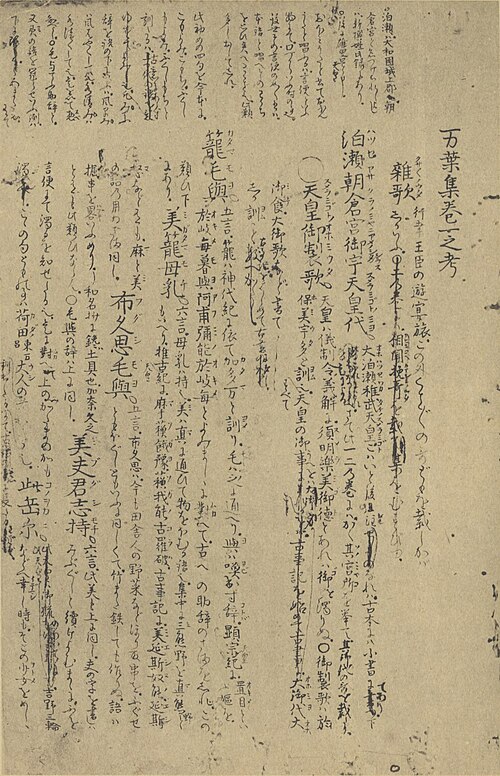
Picture: Kamo no Mabuchi’s handwritten Man’yōkō manuscript, held by Tenri Central Library, reproduced in a 1941 catalogue. An artifact of his scholarship, not a portrait.
Kamo no Mabuchi (manuscript); photographer unidentified; Public domain (Commons PD-Japan-oldphoto and PD-1996); Wikimedia Commons. Image record, Public domain (Commons PD-Japan-oldphoto and PD-1996).

The round picture in the lists of the personalities is cropped from it.