





9 min read
Human Computer
Katherine Johnson
author: High Priest Zevios Metathronos
Accuracy in the Service of Human Ascent
Dates: 1918–2020
Period: Modern
Katherine Johnson was a research mathematician at NASA's Langley Research Center in Hampton, Virginia, for 33 years, from 1953 to 1986. She calculated the 1961 trajectory for Alan Shepard, the first American in space, checked by hand the orbit an electronic computer had worked out for John Glenn in 1962, and computed the 1969 Apollo 11 trajectory to the Moon.1
Asked to name her greatest contribution, she'd point to the calculations that helped synchronise Apollo's Lunar Module with the Command and Service Module orbiting the Moon. A crew leaving the surface of the Moon had to meet its ship in lunar orbit, and her calculations helped bring the 2 together.2
Zevism reads her work under Theuth, who in Plato's myth invented number, calculation and astronomy, and under Ma'at, the order of true measure. A trajectory is a promise made in numbers, and she kept it for men whose lives depended on it.
LIFE AND CONTEXT
She was born Katherine Coleman on 26 August 1918 in White Sulphur Springs, West Virginia. Her curiosity and her gift with numbers carried her several grades ahead in school: she finished high school at 14 and college at 18, taking a B.S. in mathematics and French at West Virginia State College in 1937.3
She taught school, and in 1939 she became one of the first Black students offered a place in graduate study at West Virginia University. In 1952, on vacation from a teaching job that paid 100 dollars a month, she heard something that took her to Virginia: “I heard that Langley was looking for Black women computers.”4
The family moved to Newport News, and she started at Langley, then part of the National Advisory Committee for Aeronautics, in the summer of 1953. The agency had opened its hiring to African Americans and women. Only 2 weeks in, Dorothy Vaughan assigned her to a project in the Maneuver Loads Branch of the Flight Research Division, and the temporary post soon became permanent. She spent the next 4 years analysing data from flight tests and worked on the investigation of a plane crash caused by wake turbulence. Her husband, James Goble, died of cancer in December 1956.5
She worked alongside Dorothy Vaughan and Mary Jackson, who later became an engineer, and NASA records that the 3 of them “broke through racial barriers” in their careers there. She moved on to the Space Shuttle and to the Earth Resources Technology Satellite, later renamed Landsat, and retired in 1986.6
She summed up her years there herself: “I went to work every day for 33 years happy. Never did I get up and say I don't want to go to work.” Afterwards she spoke often to students, urged them into science and gave them her rule: “Do your best. But like it! Like what you do and then you will do your best.” Margot Lee Shetterly's book Hidden Figures told her story in 2016, and the film followed in 2017. She died at her home in Newport News on 24 February 2020, aged 101.7
ATTAINMENTS
- With the engineer Ted Skopinski she wrote NASA Technical Note D-233, September 1960, which presents expressions “for relating the satellite position in the orbital plane with the projected latitude and longitude on a rotating earth surface.” It was 1 of 26 research reports she wrote or co-wrote.8
- In 1957 she supplied some of the mathematics for Notes on Space Technology, a 1958 compendium of lectures by engineers of the Flight Research Division.9
- She did the trajectory analysis for Alan Shepard's Freedom 7 in May 1961, the first American human spaceflight.9
- In 1962 she verified the first flight calculation made by an electronic computer, the orbit for John Glenn's Friendship 7.10
- She computed the 1969 Apollo 11 trajectory to the Moon and worked on the rendezvous of the Lunar Module with the Command and Service Module.11
- President Obama gave her the Presidential Medal of Freedom at the White House on 24 November 2015, when she was 97; its citation says her computations “influenced every major space program from Mercury through the Shuttle program.” In 2017 Langley named its new Computational Research Facility after her, and in 2019 she received the Congressional Gold Medal.12
KEY STORIES
Claytor's Promise
At West Virginia State College a young professor, W. W. Schieffelin Claytor, noticed what she could do with numbers. He told her: “You'd make a good research mathematician and I'm going to see that you're prepared.”13
The next door opened in 1939. That year West Virginia “decided to quietly integrate its graduate schools,” and the president of West Virginia State, John W. Davis, picked her and 2 men “to be the first black students offered spots at the state's flagship school, West Virginia University.” She left her teaching job and enrolled in the graduate mathematics programme.9
She didn't stay long. At the end of the first session she left to start a family with her first husband, James Goble. The research career Claytor had prepared her for waited 14 years, until Langley hired her in 1953.9
Backward from the Landing Point
The Soviet satellite Sputnik went up in 1957, and Shetterly writes that it “changed history,” Johnson's life included. Flight Research Division engineers formed the core of the Space Task Group, the NACA's first official move into space travel, and they had nothing to learn it from. Johnson later recalled: “We wrote our own textbook because there was no other text about space. We just started from what we knew.”4
The engineers wanted a capsule to come down at a set place and were trying to compute when it should start. She offered to turn the problem round: “Let me do it. You tell me when you want it and where you want it to land, and I'll do it backward and tell you when to take off.”13
A problem of the same kind went into print in September 1960. The report she wrote with Skopinski worked from “elliptical orbits about a rotating spherical earth” and gave examples of a satellite launched eastward and another launched westward, each passing over a chosen place “after having completed three orbits.” For the first time in her division, a woman's name stood on the cover.8
The report handled the Earth's flattening at the poles as a correction to be worked in by iteration, and it checked its answers against a computing programme that used an oblate, rotating Earth. Glenn's orbital flight was 17 months away.14
Get the Girl
In 1962, as NASA prepared John Glenn's orbital mission, Johnson was called on for the work she'd be best known for. It wasn't her first flight: the year before she'd done the trajectory analysis for Shepard's Freedom 7. Glenn's orbital flight needed a worldwide network. Tracking stations fed IBM computers in Washington, at Cape Canaveral and in Bermuda, programmed with the equations that would steer Friendship 7 from liftoff to splashdown. The astronauts were wary of them, since the machines were “prone to hiccups and blackouts.”9
So Glenn added an item to his preflight checklist. He asked the engineers to “get the girl,” Johnson, to run the same numbers through the same equations by hand, on her desktop mechanical calculating machine. “If she says they're good,” she remembered him saying, “then I'm ready to go.”9
Her own account was plain. “You could do much more, much faster on the computer. But when they went to computers, they called over and said, ‘Tell her to check and see if the computer trajectory they had calculated was correct.’ So I checked it, and it was correct.” Glenn flew in February 1962, and the flight was a success.15
THE ZEVIST READING
In Plato's Phaedrus, Theuth invents number and calculation, geometry and astronomy.16 Johnson's work stood where those gifts meet: the calculation of a path through the heavens. Zevism reads a trajectory as astronomy put to work, the paths of the sky learned well enough to send a man along one and bring him home.
Ma'at is “the personification of truth, justice, and the cosmic order,” set against isfet, disorder.17 An error in an orbital equation is Izfet of the most literal kind: a capsule in the wrong place and a crew lost. Glenn's request was a request for Ma'at. He wanted a 2nd, independent reckoning from a person who understood the equations, and Johnson gave it.
The doctrine of Light and Darkness fits her too. Unexplored darkness isn't evil in Zevist teaching; it's ground one walks into with a light. Space in 1958 was such ground, unexplored and without a textbook. Johnson and her colleagues wrote the textbook, and the dark became a set of equations others could use. Her method of working backward from the landing point is the same act in small: she began from the place a man had to reach and carried the reckoning back to the pad.
She put it to students at a NASA conference at Cape Canaveral in 2010: “there will always be science, engineering and technology. And there will always, always be mathematics.”18 Zevism holds that number belongs to the order of the cosmos under Zeus. The one who reckons it truly, for others who'll stake their lives on it, is doing sacred work.
NOTES
1 The White House, Presidential Medal of Freedom recipients, 16 November 2015; NASA, “Katherine Johnson's STEM Contributions”.
2 Shetterly, “Katherine Johnson Biography,” NASA.
3 NASA Science, “Katherine Johnson”; Britannica, “Katherine Johnson,” Quick Facts; Shetterly.
6 NASA, “STEM Contributions”; Shetterly.
7 NASA Science; NASA, “STEM Contributions”.
8 Skopinski and Johnson, TN D-233; Shetterly.
9 Shetterly.
10 The White House.
11 The White House; Shetterly.
12 The White House; NASA Science.
13 NASA Science.
14 Skopinski and Johnson, TN D-233, pp. 1–3.
15 NASA, “STEM Contributions”; NASA Science; Shetterly.
18 NASA, “STEM Contributions”.
BIBLIOGRAPHY
NASA Science, “Katherine Johnson (1918–2020)”; birth, education, Claytor, Langley, Glenn and her own recollections, honours and death.
Margot Lee Shetterly, “Katherine Johnson Biography”, NASA, 22 November 2016; West Virginia University in 1939, Langley in 1953, the 1960 report, Freedom 7, Friendship 7, Apollo, later work and 26 reports.
NASA, “Katherine Johnson's STEM Contributions Marked on Her 103rd Birthday”, 26 August 2021.
T. H. Skopinski and Katherine G. Johnson, Determination of Azimuth Angle at Burnout for Placing a Satellite Over a Selected Earth Position, NASA Technical Note D-233, Langley Research Center, September 1960; cover and summary.
The White House, “President Obama Names Recipients of the Presidential Medal of Freedom”, 16 November 2015; citation for Katherine G. Johnson.
Plato, Phaedrus 274c–d, translated by H. N. Fowler, Perseus Digital Library.
Encyclopaedia Britannica, “Katherine Johnson”, Quick Facts; birth name.
Encyclopaedia Britannica, “Maat”.
CREDIT
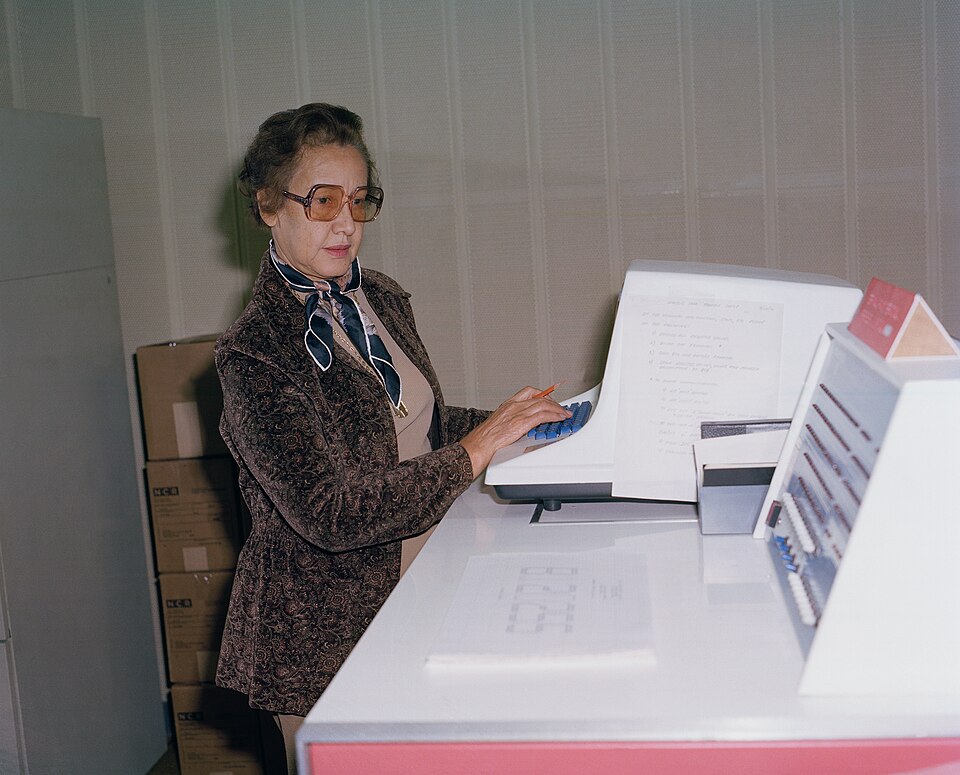
Picture: Katherine Johnson at NASA Langley Research Center in 1980.
NASA, via Wikimedia Commons. Public domain. Image record, Public domain: United States government work.

The round picture in the lists of the personalities is cropped from it.