




9 min read
High Priest of Ptah
Khaemwaset
author: High Priest Zevios Metathronos
Keeping the Names of the Sacred Past
Dates: 13th century BCE.
Period: Ancient (6000–500 BCE).
Khaemwaset was the 4th son of Ramesses II and high priest of Ptah at Memphis. On pyramids of kings dead for centuries he had inscriptions cut “to keep alive the name of himself, his father and the king of the dismantled monument.”1
He took stone from those monuments for his father's temple, and on what still stood he set the old king's name beside his own. He also seems to have carried the cults of those kings into the new temples of his father's reign. Egypt didn't forget him: in later literature “Setne Khaemwaset” became the hero of tales of the supernatural.1 They're the Demotic tales that F. Ll. Griffith edited as the stories of the high priests of Memphis.2
Zevism reads him under 2 powers of Egypt. Ptah was the “god of material creation, crafts” and the main deity at Memphis; Thoth was the “god of knowledge and writing,” whose book the later tales set Khaemwaset to steal.3 A priest who keeps the names of the dead in stone is a keeper of the source.
LIFE AND CONTEXT
Ramesses II ruled Egypt from 1279 to 1213 BCE.4 Khaemwaset was his 4th son, and he rose to the high priesthood of Ptah in Memphis.1
He was also a sem priest, the title given to him on a small steatite shabti now in the Petrie Museum. The figure has lost its head. Its inscription hasn't, and it still names the king's son and sem priest Khaemwaset.5
Ptah had sacred animals of his own. The Apis bulls were “sacred animals of the god Ptah,” and they were buried in a cemetery near Saqqara from about 1400 BCE. Ramesses II designed a main gallery and side chambers for their burials, which later kings kept enlarging. Auguste Mariette found its ruins in 1850 and in 1851 entered the chambers underground, where he found the burials of 64 Apis bulls.4
The great building works of Ramesses needed stone. The old monuments around Memphis supplied it. The high priest took blocks from earlier buildings “for the building-projects of his father at Memphis” and added hieroglyphic inscriptions to what he quarried.6 Those inscriptions later gave the impression that he'd renovated the old monuments. Scholars now think he dismantled them “as a source of stone for the temple of his father.”1
The same inscriptions “emphasise his piety in reviving the earlier cults, probably in new religious precincts.”6 UCL's account of him ends the matter in Egyptian terms: “perhaps by perpetuating the cult of the ancient king in the new Ramesside temples, Khaemwaset met his obligations on Ancient Egyptian terms.”1
His afterlife in books began long after his death. The tales of Setne Khaemwaset are known “principally from manuscripts of the Roman Period.”1 Wallis Budge took his version from “a papyrus of the Ptolemaic period.” These are later literature. They show what Egypt made of his name, and they don't add events to his life.7
ATTAINMENTS
- He held the high priesthood of Ptah at Memphis while his father reigned, the senior office of the city's chief God.1
- He held the office of sem priest, the title carried by his steatite shabti, UC2311 in the Petrie Museum.5
- He left inscriptions on pyramids of the Old and Middle Kingdoms, naming the king who'd built each one beside himself and Ramesses II.1
- He quarried older monuments to supply stone for his father's building projects at Memphis, including his father's temple.6
- He revived the cults of earlier kings, probably in new sacred precincts, and perhaps kept those kings' worship going in the Ramesside temples.8
- He had a statue of the Old Kingdom prince Kawab inscribed with a restoration inscription.6
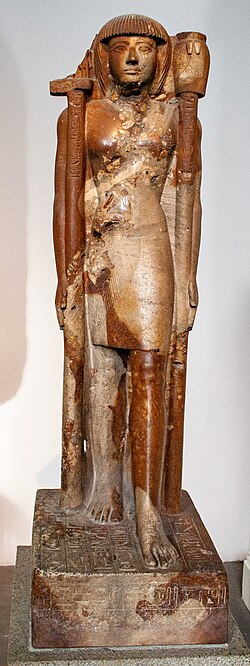
- A statue of him in quartzite conglomerate, made about 1260 BCE and found at Asyut, carries a prayer to Atum around its base and a prayer to Osiris on its back pillar. It's on display in Room 4 of the British Museum.9
KEY STORIES
The Names on the Old Stones
Ramesses II was building at Memphis, and his son found him stone. Khaemwaset took it from monuments of the Old and Middle Kingdoms, and he had buildings taken down to supply his father's temple.1
He didn't let the owners vanish with their blocks. On the parts still standing he had new texts cut, naming himself, his father and the king who had raised the monument. The inscriptions spoke of piety toward the old cults, which he revived, UCL suggests, in new religious precincts.6
One object from those years was a statue of prince Kawab, a king's son of the Old Kingdom. Khaemwaset had a restoration inscription added to it, so the old prince's image now carried a text in the name of a prince of Ramesses' age.6
The Book in the Boxes at Coptos
Wallis Budge retold this later Demotic tale in 1901. Its hero is “a prince called Setnau Khâ-em-Uast,” who “knew how to use the powers of amulets and talismans.” In the tomb of the dead prince Ptah-nefer-ka he found “his wife Ahura, and Merhu their son.” When he reached for the book of Thoth, “Ahura begged him not to do so, and related to him the misfortunes which had already followed.”10
A priest of Ptah had once sold Ptah-nefer-ka the secret of where the book lay, for “a hundred pieces of silver” and “two handsome coffins.” “The recital of the first will enchant (or bewitch) heaven, earth, hell, sea, and mountains,” ran the promise of its 1st formula. The 2nd would let a dead man in his tomb “take the form which he had upon earth.”
It lay “in an iron box in the middle of the river at Coptos,” inside boxes of bronze, palm wood, ebony and ivory, silver and gold, and “round it is coiled a serpent which cannot die.” Ptah-nefer-ka sailed there in the royal barge. He killed the serpent twice, “but it came to life again.” Then “the third time he cut it into two pieces, and laid sand between them.”11
He bewitched heaven and earth with the book, then copied it onto new papyrus, dissolved the papyrus in water and drank it. “These acts had stirred the god Thoth to wrath, and he told Râ what Ptah-nefer-ka had done.” Ahura and Merhu fell into the river and drowned, and “while returning to Memphis with the book Ptah-nefer-ka himself was drowned also.”12
The Game of Draughts in the Tomb
Setnau wouldn't listen. He'd come into the tomb with his brother Anhaherurau and found it “brilliantly lit up by the light which came forth from the book.” He “refused to be diverted from his purpose,” and Ptah-nefer-ka offered to play draughts for it, the winner to keep it.13
Budge compresses the game into one sentence: “The game was for fifty-two points, and although Ptah-nefer-ka tried to cheat Setnau, he lost the game.” Then Setnau sent his brother up to the earth for “his talismans of Ptah and his other magical writings.” When Anhaherurau laid them on him, Setnau “straightway flew up to heaven grasping the wonderful book in his hand.”14
“As he went up from the tomb light went before him, and the darkness closed in behind him.” The dead prince spoke a promise to his wife: “I will make him bring back this book soon, with a knife and a rod in his hand and a vessel of fire upon his head.” Budge passes quickly over what came next, the bewitchment of Setnau by “a beautiful woman called Tabubu” and the troubles that followed. The story ends with the king's command “to take the book back to its place,” and Ptah-nefer-ka's words came true.14
THE ZEVIST READING
In Plato's Phaedrus the Egyptian God Theuth, Thoth, “invented numbers and arithmetic and geometry and astronomy, also draughts and dice, and, most important of all, letters.”15 The Demotic tale sets a prince over a draughts board, playing for a book of writing, in a tomb lit by the book itself. Both the game and the book belong to the same God. Zevism reads the story as a teaching about the source: the knowledge is Thoth's, and whoever seizes it for himself pays until it goes back.
The historical Khaemwaset did the opposite with the names of the dead. Egyptian religion named Ma'at “the personification of truth, justice, and the cosmic order” and set her against isfet.16 A king whose name is lost from his pyramid has fallen into Izfet, the dissolution of existence. Cutting the name again brings him back into order. Zevism counts the priest who does this among the keepers of the source, with the copyists and translators.
The Temple states the record plainly. Khaemwaset took the old buildings apart for his father's temple, and the doctrine of the Good asks for right order and right act together. The quarrying served the living king. The inscriptions and the revived cults gave the old kings their due, and those are the acts Zevism honours.
Ptah governed his work. A God of “material creation, crafts” stands in the domain the Greeks gave Hephaestus, “famed for inventions,” who with Athena “taught men glorious gifts throughout the world.”17 Khaemwaset served that power with stone and chisel. The name he kept alive on an old wall is a small piece of Light held against the dark, and Zevism reads such work as a step toward ὁμοίωσις θεῷ κατὰ τὸ δυνατόν, likeness to the divine “as far as possible.”18
NOTES
2 Griffith, Stories of the High Priests of Memphis.
3 UCL, “Gods and goddesses in ancient Egypt”.
6 UCL, “Museum: House of Life”.
7 Budge, Egyptian Magic, p. 142.
8 UCL, “Museum: House of Life”; UCL, “Khaemwaset”.
10 Budge, Egyptian Magic, pp. 142–143.
13 Budge, Egyptian Magic, pp. 143, 146.
14 Budge, p. 146.
17 UCL, “Gods and goddesses in ancient Egypt”; Homeric Hymn to Hephaestus 1–4.
BIBLIOGRAPHY
University College London, Digital Egypt for Universities, “Khaemwaset”; parentage, high priesthood of Ptah, inscriptions on Old and Middle Kingdom pyramids, dismantling, cult continuity and the later Setne tales.
University College London, Digital Egypt for Universities, “Museum: House of Life”, section “Appreciation of the single object”; quarrying for Ramesses II's building projects, revived cults and the Kawab statue.
University College London, Digital Egypt for Universities, “Gods and goddesses in ancient Egypt: the main names at the main places”; entries for Ptah and Thoth.
British Museum, statue of Khaemwaset, EA947; material, date, findspot at Asyut, standards, prayers to Atum and Osiris, donor and display location.
UCL Collections, Petrie Museum, shabti of Khaemwaset, LDUCE-UC2311; object description and inscription.
Encyclopaedia Britannica, “Serapeum”; Apis burials, Ramesses II's gallery and Mariette's discovery of 1850–1851.
F. Ll. Griffith, Stories of the High Priests of Memphis: The Sethon of Herodotus and the Demotic Tales of Khamuas, Clarendon Press, Oxford, 1900, Internet Archive.
E. A. Wallis Budge, Egyptian Magic, chapter 4, Kegan Paul, Trench, Trübner, London, 1901, Internet Sacred Text Archive; pp. 142–146, the story of Setnau and the book of Thoth.
Plato, Phaedrus 274c–d, translated by H. N. Fowler, Perseus Digital Library.
Homeric Hymn 20 to Hephaestus 1–4, H. G. Evelyn-White translation, Theoi Classical Texts Library.
Encyclopaedia Britannica, “Maat”.
Plato, Theaetetus 176a–b, Greek text, Perseus Digital Library.
CREDIT
Picture: Ancient statue of Khaemwaset with sacred standards, around 1260 BCE, British Museum EA947. Photograph by Szilas, 2010.
Szilas (photograph); ancient sculptor unknown; CC BY-SA 4.0; Wikimedia Commons. Image record, CC BY-SA 4.0.

The round picture in the lists of the personalities is cropped from it.