




9 min read
The Old Master
Laozi
author: High Priest Zevios Metathronos
The Strength of Measured Action
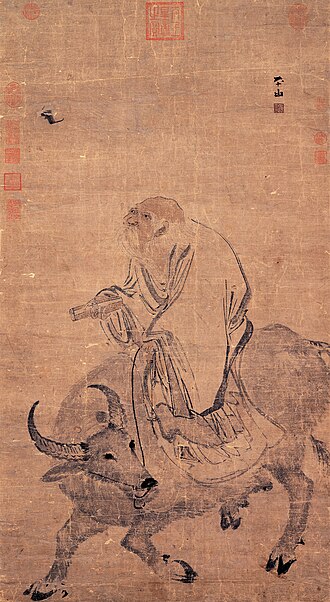
Dates: Traditionally 6th century BCE; historical identity disputed. The text associated with him developed chiefly during the 4th and 3rd centuries BCE.
Period: Hellenistic, assigned by the text's development rather than a claim of Greek cultural identity.
Laozi, the Old Master, is the name that Chinese tradition gives to the author of the Daodejing, a book of about 5,000 characters in 2 parts. The historian Sima Qian made him Li Er, also called Dan, a keeper of archival records at the court of Zhou.1
The book is the attainment. Its 81 short chapters teach that water does good by taking the low place, that a wheel works through its empty hub and that the one who overcomes himself is mightier than the one who overcomes others. About 2,000 of its characters, written on bamboo, went into a tomb at Guodian around 300 BCE.2
Laozi belongs to Chinese religion, and in Daoism he became a God. Zevism reads him as a link in the chain of spirituality: his Dao answers to the order that Heraclitus called the Logos and Egypt called Ma'at, and his deification is the path of ὁμοίωσις θεῷ carried to its end.
LIFE AND CONTEXT
Sima Qian's Shiji, the Records of the Historian, gives the biography. James Legge's translation gives the essentials: “His surname was Lî,” he “was a native of the state of Khû,” and “He was a curator in the Royal Library” of Zhou. Alan Chan's version of the office is keeper of archival records, which isn't far from Legge's.3
The historian wasn't sure he had the right man. Ronnie Littlejohn notes that the same chapter offers 2 other candidates: Lao Laizi of Chu, a contemporary of Confucius who wrote a work in 15 sections, and Dan, historiographer of Zhou. It also reports a belief “that Laozi lived 160 years or even 200 years, as a result of cultivating the dao and nurturing his longevity.”4
The book has a clearer history than its author. The received text has “two parts (pian) and 81 sections (zhang)”: chapters 1–37 form the Daojing, the Classic of the Way, and chapters 38–81 the Dejing, the Classic of Virtue. Chan concludes that “by the middle of the third century B.C.E., the Laozi probably had reached a relatively stable form.” It may preserve sayings shaped by several hands.5
Archaeology pushed the evidence back. The silk manuscripts from Mawangdui, found in 1973, came from a tomb that was “sealed in 168 B.C.E.” The older of the 2 was copied “in all likelihood before 195 B.C.E.” Both put the Dejing first. The bamboo slips from Guodian, excavated in 1993, came from a tomb dated around 300 BCE.6
Religious Daoism made the man divine. When the Way of the Celestial Masters arose in the 2nd century CE, Chan writes, “the story of Laozi gained an important hagiographic dimension.” For believers “the Dao is a divine reality, and Laozi is seen as the personification of the Dao.” Under the Tang, whose ruling house shared his surname Li, he was honoured as protector of the state.7
ATTAINMENTS
- He is credited with a book of “some five thousand Chinese characters or graphs, divided into two parts,” on “the meaning of Dao and virtue,” now arranged in 81 chapters.8
- Chapter 8 made water the model of conduct: “The highest excellence is like (that of) water. The excellence of water appears in its benefiting all things.”9
- Chapter 11 showed the use of empty space in 3 plain objects: “The thirty spokes unite in the one nave; but it is on the empty space (for the axle), that the use of the wheel depends.” The clay vessel and the room follow.10
- Chapter 33 turned strength inward: “He who overcomes others is strong; he who overcomes himself is mighty.”11
- Chapter 30 set a limit on war. “Wherever a host is stationed, briars and thorns spring up,” and the good commander “strikes a decisive blow, and stops.”12
- The text survives in manuscripts far older than the received edition: about 2,000 characters on bamboo at Guodian from around 300 BCE and 2 silk copies at Mawangdui from before 168 BCE.6
- He received worship as a God. Emperor Huan (reigned 147–167 CE) “built a palace on the traditional site of Laozi's birthplace and authorized veneration and sacrifice to Laozi.” Britannica lists his divine titles as Lao Jun, Tai Shang Lao-Jun and Tai Shang Xuanyuan Huangdi.13
KEY STORIES
Confucius Meets the Dragon
Sima Qian tells how Confucius came to Zhou to consult the old archivist on matters of ritual. He got a lecture. “The men about whom you talk are dead, and their bones are mouldered to dust; only their words are left,” Laozi told him. A good merchant hides his treasures and looks poor, he went on, and the superior man, “though his virtue be complete, is yet to outward seeming stupid.”14
Then he told the younger man exactly what to drop: “Put away your proud air and many desires, your insinuating habit and wild will. They are of no advantage to you,” he said, and that was “all I have to tell you.”15
Confucius went back to his disciples and struggled to describe the man. “I know how birds can fly, fishes swim, and animals run,” he said. Each can be caught with a snare, a hook or an arrow. “But there is the dragon.” He couldn't say how it flew: “I cannot tell how he mounts on the wind through the clouds, and rises to heaven. To-day I have seen Lâo-dze, and can only compare him to the dragon.”15
The Warden at the Pass
Laozi, Sima Qian writes, made it “the chief aim of his studies” to keep himself “concealed and remain unknown.” He stayed at the Zhou capital for a long time. When he saw the dynasty decaying, he left and went west “to the barrier-gate, leading out of the kingdom on the north-west.”16
The warden of the gate, Yin Xi, wouldn't let the chance pass. “You are about to withdraw yourself out of sight,” he said. “Let me insist on your (first) composing for me a book.”15
So the man who'd spent his life hiding sat down at a frontier post and wrote. He produced “a book in two parts, setting forth his views on the Tâo and its attributes, in more than 5000 characters.” Then he handed it over. Sima Qian ends the scene flatly: “He then went away, and it is not known where he died.” In this telling the whole teaching exists because a border official asked for it.15
The Slips in Tomb M1
Late in 1993, archaeologists opened a tomb labelled M1 at Guodian in Hubei province. Inside lay “some 800 bamboo slips, of which 730 are inscribed, containing over 13,000 Chinese characters.” The tomb dates to around 300 BCE.6
When the slips were read, “some of these, amounting to about 2,000 characters, match the Laozi.” That's about 40 percent of the received book, buried half a century before the date by which Chan thinks the full text had settled.6
The find joined the 2 silk scrolls taken from Mawangdui, near Changsha, 20 years earlier. Those copies, labelled A and B, begin with the Dejing, the reverse of the received order. Littlejohn calls them “two incomplete editions of the DDJ on silk scrolls.” Between them the 2 tombs put into scholars' hands copies that had lain underground for more than 2,000 years.17
The Old Child Becomes a God
Around 166 CE Bian Shao wrote the Inscription to Laozi as a marker for Emperor Huan's palace at the traditional birthplace, and Littlejohn says it “goes well beyond Sima Qian's biography.” A scripture of the late 2nd century, the Classic on the Transformations of Laozi, survives in a Dunhuang manuscript of 612 CE and went further still.18
The legends counted his births and transformations. In his 2nd birth, Littlejohn relates, he came to a woman called Mother Li after “an eighty-one year pregnancy,” and was born from her left armpit. “At birth he had white hair and so he was called laozi,” the Old Child. His 58th transformation was an “appearance in the clouds to Zhang Daoling,” founder of the Celestial Master movement.18
The archivist who wanted to stay unknown ended as Laojun, a God who could appear “in any time of unrest” and bring Great Peace. The elite at the imperial court, Littlejohn writes, “divinized Laozi and regarded him as an embodiment or incarnation of the dao.”18
THE ZEVIST READING
Heraclitus opened his book with a Word that men don't grasp even after hearing it: “For although all things happen according to this Word, they are like the unexperienced”.19 Laozi's Dao is the same kind of principle, an order that runs through all things and that most people never notice. Zevism reads the Dao and the Logos as 2 names, given at the 2 ends of Eurasia, for a single order, and Zevism itself is that Logos restored.
That order is Ma'at, “the personification of truth, justice, and the cosmic order,” set against isfet.20 Chapter 8 of the Daodejing says the excellence of government “is in its securing good order,” and chapter 30 shows the opposite: wherever an army camps, briars and thorns spring up, and bad years follow great armies. War carried past its purpose is Izfet. The commander who strikes once and stops restores Ma'at, and he serves the justice that Zeus holds as Sovereign of the Cosmos.
Chapter 33 gives the path its inner discipline. “He who overcomes himself is mighty” names the power the Temple trains in Meditation, the capacity of τὸ δυνατόν, and in Ethics, the Φρόνησις that governs the self before it governs others.11
The last lesson is the deification itself. Plato set the aim of human life as likeness to God “as far as possible,” ὁμοίωσις θεῷ κατὰ τὸ δυνατόν.21 Zevism reads the phrase as the literal elevation of human nature toward the divine. Daoism's faithful claim exactly that elevation for Laozi, whom they see as “the personification of the Dao.”8
NOTES
2 Chan, §§1–2; Tao Teh King, tr. Legge, chapters 8, 11, 33.
3 Sima Qian, in Legge, Texts of Taoism, introduction, chapter 4; Chan, §1.
5 Chan, §§1–2.
6 Chan, §2.
8 Chan, §1.
9 Tao Teh King, tr. Legge, chapter 8.
13 Littlejohn, IEP; Ames, “Laozi,” Britannica.
14 Sima Qian, in Legge, Texts of Taoism, introduction, chapter 4.
15 Legge, chapter 4.
16 Legge, Texts of Taoism, introduction, chapter 4.
17 Chan, §2; Littlejohn, IEP.
18 Littlejohn, IEP.
19 Graham, “Heraclitus,” fragment B1.
BIBLIOGRAPHY
Alan Chan, “Laozi”, Stanford Encyclopedia of Philosophy, substantive revision 22 October 2025; §§1–2, the Shiji account, text history, Mawangdui and Guodian, and the divine Laozi.
Ronnie Littlejohn, “Laozi (Lao-tzu, fl. 6th cn. B.C.E.)”, Internet Encyclopedia of Philosophy; other candidates in the Shiji, Emperor Huan, the Laozi ming, the Laozi bianhua jing and the Tang.
Sima Qian, Shiji 63, “Accounts of Lâo-dze and Kwang-dze given by Sze-mâ Khien”, translated by James Legge, The Texts of Taoism, part 1, Sacred Books of the East 39 (Oxford, 1891), introduction, chapter 4; Internet Sacred Text Archive.
The Tao Teh King, or the Tao and Its Characteristics, translated by James Legge, Project Gutenberg ebook 216; chapters 8, 11, 30 and 33.
Roger T. Ames, “Laozi”, Encyclopaedia Britannica; divine titles.
Daniel W. Graham, “Heraclitus”, Stanford Encyclopedia of Philosophy; fragment B1.
Encyclopaedia Britannica, “Maat”.
Plato, Theaetetus 176a–b, Greek text, Perseus Digital Library.
CREDIT
Picture: Zhang Lu, Laozi Riding an Ox, Ming dynasty, National Palace Museum, Taipei. A much later artistic depiction of the traditional master, not a contemporary likeness. Public-domain artwork and reproduction as documented by Commons.

Zhang Lu, Laozi Riding an Ox, National Palace Museum, Taipei; Wikimedia Commons; public domain. Image record, Public domain; PD-Art faithful reproduction.
The round picture in the lists of the personalities is cropped from it.