



9 min read
Defender of Temples
Libanius of Antioch
author: High Priest Zevios Metathronos
Dates: 314–c. 393 CE
Period: Roman period (30 BCE–800 CE)
Libanius was the official sophist of Antioch from 355 until his death, and he wrote through most of those years. What survives is an autobiography, 63 other speeches, 51 declamations on invented themes, a large collection of school exercises and more than 1,500 letters.1
His boldest work was a single petition. In For the Temples, his 30th oration, he told Theodosius I that the shrines of the countryside were “the soul of the country” and asked him to stop the men who were stripping their roofs and overturning their altars.2
Libanius kept the worship of the Gods in an empire that was turning Christian, and his Loeb publisher calls him “one of the last great publicists and teachers of Greek paganism.”3 Zevism reads his speech as a gift of the Muses and his defence of the temples as a defence of Ma'at, the order a community keeps in stone and rite.
LIFE AND CONTEXT
He was born in 314 to a prominent family of Antioch. His father died in 324, and his mother and 2 maternal uncles raised him. At 15 he chose rhetoric as his career, and when his first teacher of rhetoric died he went to a grammar teacher instead of a new rhetorician.4
In 336 he left for 4 years of study at Athens, “where he found his teachers incompetent and his fellow students undedicated and rowdy.” During the 340s he taught briefly at Constantinople and Nicaea and then spent 5 very happy years at Nicomedia.4 The church historian Socrates says the move had a cause: Libanius had been “driven at that time from Constantinople, by a combination of the educators there.”5
In 349 the emperor recalled him to the chair of rhetoric at Constantinople. He hated the city, yet he turned down a chair at Athens. After a summer at Antioch in 353, taken on grounds of health, he persuaded the emperor in 354 to let him stay. The city appointed him its official sophist in 355, and he didn't leave again.6
The school filled his life. Many of his surviving letters are written to or for students, past and present. The Oxford Classical Dictionary sums him up as a “pagan Greek orator and teacher of rhetoric from Antioch.”7
Charges of sorcery followed him through his career. Under Valens he was investigated at the emperor's own request and acquitted.8 The date of For the Temples is disputed: it falls in the 380s or the early 390s. He probably died in 393.9
ATTAINMENTS
- He held the official sophist's chair at Antioch from 355 until about 393, close to 40 years, after holding the chair of rhetoric at Constantinople from 349.6
- He wrote an autobiography, Oration 1, and 63 further speeches, For the Temples among them.10
- More than 1,500 of his letters survive, many written to or for his students.11
- He composed 51 declamations on fictional themes and a large set of model exercises, the progymnasmata, for training students in Greek prose.12
- Between 362 and 365 he composed the orations on the emperor Julian, whose memory he kept for the rest of his life.13
- In For the Temples he put the case for the rural shrines before Theodosius I, reminding him that his own law had not closed them: “You, therefore, have not ordered the temples to be shut up, nor forbidden any to frequent them.”14
- He trained John Chrysostom in rhetoric, together with John's companions Theodore and Maximus.15
KEY STORIES
The Lectures Julian Read in Secret
The young prince Julian was studying at Constantinople, and he studied too well. Socrates reports that people began to say “he was capable of governing the Roman empire.” The rumour “greatly disquieted the emperor's mind,” and Constantius had him moved to Nicomedia, “forbidding him at the same time to frequent the school of Libanius the Syrian Sophist.”5
The ban on Libanius had a religious reason. Julian “was, however, interdicted from being his auditor, because Libanius was a pagan in religion.” Julian couldn't attend, so he “privately procured his orations,” which he admired and read over and over with close attention.16
The pupil who never sat in the room reached the throne and died of a spear wound on the Persian campaign, “in the thirty-second year of his age.”17 Libanius wrote for him while he lived and kept writing after his death. The orations on Julian date from 362 to 365.13
The Chameleon in the Lecture Hall
In 386 Libanius was past 70, and his body failed him. Jeremy Swist describes “a sharp decline in his physical and mental health that compromised his ability to declaim, which his doctors diagnosed as magically caused.”8
Then someone found a dead chameleon in his lecture hall. For Libanius it confirmed that he'd been hexed, and he answered with a speech, Oration 36, On the Magic Spells. The speech defends his whole career against every possible culprit and accuses no one by name.18
His friends wanted more. They urged him to prosecute certain men as sorcerers, and he refused. In the Autobiography he gave his reason plainly: “I was not of that attitude.” Charges of sorcery had been a hazard of his own career for decades.19
Wood, Stones and Iron
Late in life Libanius composed a speech for Theodosius I. He began by asking for a hearing: an emperor could reject advice without punishing the one who offered it, and he begged Theodosius “to turn your countenance to me while I am speaking.”20
Then he described the villages. Sacrifice had been banned, incense was still lawful, and the emperor hadn't closed the temples. Yet “those black-garbed people, who eat more than elephants,” would “run to the temples, bringing with them wood, and stones, and iron, and when they have not these, hands and feet.” After them, “the roofs are uncovered, walls are pulled down, images are carried off, and altars are overturned,” and “the priests all the while must be silent upon pain of death.”21
He turned next to the farmers. The temples “are the soul of the country,” he said, and the peasants' hopes for the harvest lived in them; strip the shrine and the field goes badly worked, and the emperor's revenue shrinks with it.22
He closed with 2 images. A man forced to change his worship is like an actor, since “he who acts the part of a king is not a king, but the same person he was before.” And cities that mourn their earthquake ruins shouldn't make ruins by choice: “Do we think it a cruel thing to cut off a man's hand, and a small matter to pluck out the eyes of cities?”23 In Zevist terms, he was asking an emperor to keep Ma'at standing in the villages.
The Successor the Christians Took
Among the boys of Antioch in Libanius's school was John, later called Chrysostom, from a noble family of the city. Sozomen says John “learned rhetoric from Libanius, and philosophy from Andragathius.” His family expected him to become an advocate. He “determined to exercise himself in the sacred books” and took with him Theodore and Maximus, “who had been his companions under the instruction of Libanius.”15
The same chapter tells how the clergy and people of Constantinople later elected John their bishop. Sozomen closes the portrait at the old sophist's bedside: “When this sophist was on his death-bed he was asked by his friends who should take his place.” “It would have been John,” he replied, “had not the Christians taken him from us.”24
THE ZEVIST READING
Hesiod names the source of a speaker's power. When the daughters of great Zeus honour a prince at birth, “they pour sweet dew upon his tongue, and from his lips flow gracious words,” and the people watch him “while he settles causes with true judgements.” Hesiod calls it “the holy gift of the Muses to men.”25 Libanius held that gift without a crown and spent it on those who wore one: Julian, whom he taught through the page, and Theodosius, whom he asked to judge the temples' case straight.
Ma'at gives the 2nd measure. Egyptian religion named her “the personification of truth, justice, and the cosmic order” and set her against isfet, disorder.26 A village shrine where farmers pray for the harvest is Ma'at held in a small place. A crowd with iron bars pulling off its roof is Izfet. Libanius weighed the damage on both sides of the scale: the Gods lost their houses, the farmers lost their hope, and the treasury lost its taxes.
Zevism honours the keepers of the source, and Libanius kept it for more than 40 years. He trained boys in the Greek of the classical authors and wrote out model exercises for them to imitate. Some of his pupils became leaders of the Church, John among them. The training still passed through him, and the source held priority over the use each pupil made of it.
His actor argument states a point of doctrine in the plainest terms. The aim of the path is likeness to the divine “as far as possible,” ὁμοίωσις θεῷ κατὰ τὸ δυνατόν.27 That likeness is an inward elevation of the whole person, and force can't produce it any more than a costume makes a king. Libanius saw that in the 4th century and put it in writing to an emperor.
NOTES
1 Gibson, Libanius's Progymnasmata, pp. xvii–xix.
2 Libanius, For the Temples, pp. 76–77.
3 Harvard University Press, Libanius: Selected Orations, vol. 1.
5 Socrates, Church History 3.1.
7 Gibson, pp. xviii–xix; Van Hoof, “Libanius,” OCD.
8 Swist, “Sophistry and Sorcery,” GRBS 57.
9 Jones, “Three Temples”; Gibson, p. xviii.
10 Gibson, p. xviii.
11 Van Hoof, OCD; Gibson, pp. xviii–xix.
12 Gibson, p. xix.
13 Harvard University Press, Selected Orations, vol. 1.
15 Sozomen, Ecclesiastical History 8.2.
16 Socrates 3.1.
17 Ammianus Marcellinus 25.3.6, 25.3.23.
18 Swist, GRBS 57.
19 Swist, GRBS 57, citing Or. 1.
20 For the Temples, pp. 72–74.
21 For the Temples, pp. 76–77.
22 For the Temples, pp. 77–80.
23 For the Temples, pp. 83, 89.
24 Sozomen 8.2.
BIBLIOGRAPHY
Craig A. Gibson, Libanius's Progymnasmata: Model Exercises in Greek Prose Composition and Rhetoric, Writings from the Greco-Roman World 27, Society of Biblical Literature, 2008; introduction, pp. xvii–xix.
Libanius, Oration 30: For the Temples, abridged English translation drawn from Nathaniel Lardner, reprinted in Arguments of Celsus, Porphyry, and the Emperor Julian, 1830, pp. 72–96; transcription by Roger Pearse, CCEL.
Christopher P. Jones, “Three Temples in Libanius and the Theodosian Code”, The Classical Quarterly 63 (2013); opening discussion of chronology.
Lieve Van Hoof, “Libanius”, Oxford Classical Dictionary, Oxford University Press, online edition; summary.
Harvard University Press, Libanius: Selected Orations, Volume I, Julianic Orations, ed. and tr. A. F. Norman, Loeb Classical Library 451, 1969; publisher's description.
Socrates Scholasticus, Church History 3.1, tr. A. C. Zenos, Nicene and Post-Nicene Fathers, 2nd series, vol. 2, 1890; New Advent.
Sozomen, Ecclesiastical History 8.2, tr. Chester D. Hartranft, Nicene and Post-Nicene Fathers, 2nd series, vol. 2, 1890; New Advent.
Jeremy J. Swist, “Sophistry and Sorcery in Libanius' Declamations”, Greek, Roman, and Byzantine Studies 57 (2017), pp. 431–453.
Ammianus Marcellinus, Res Gestae 25.3, tr. J. C. Rolfe, Loeb Classical Library, vol. 2, 1940; LacusCurtius; 25.3.6 and 25.3.23.
Hesiod, Theogony 80–93, tr. H. G. Evelyn-White, Theoi Classical Texts Library.
Encyclopaedia Britannica, “Maat”.
Plato, Theaetetus 176a–b, Greek text, Perseus Digital Library.
CREDIT
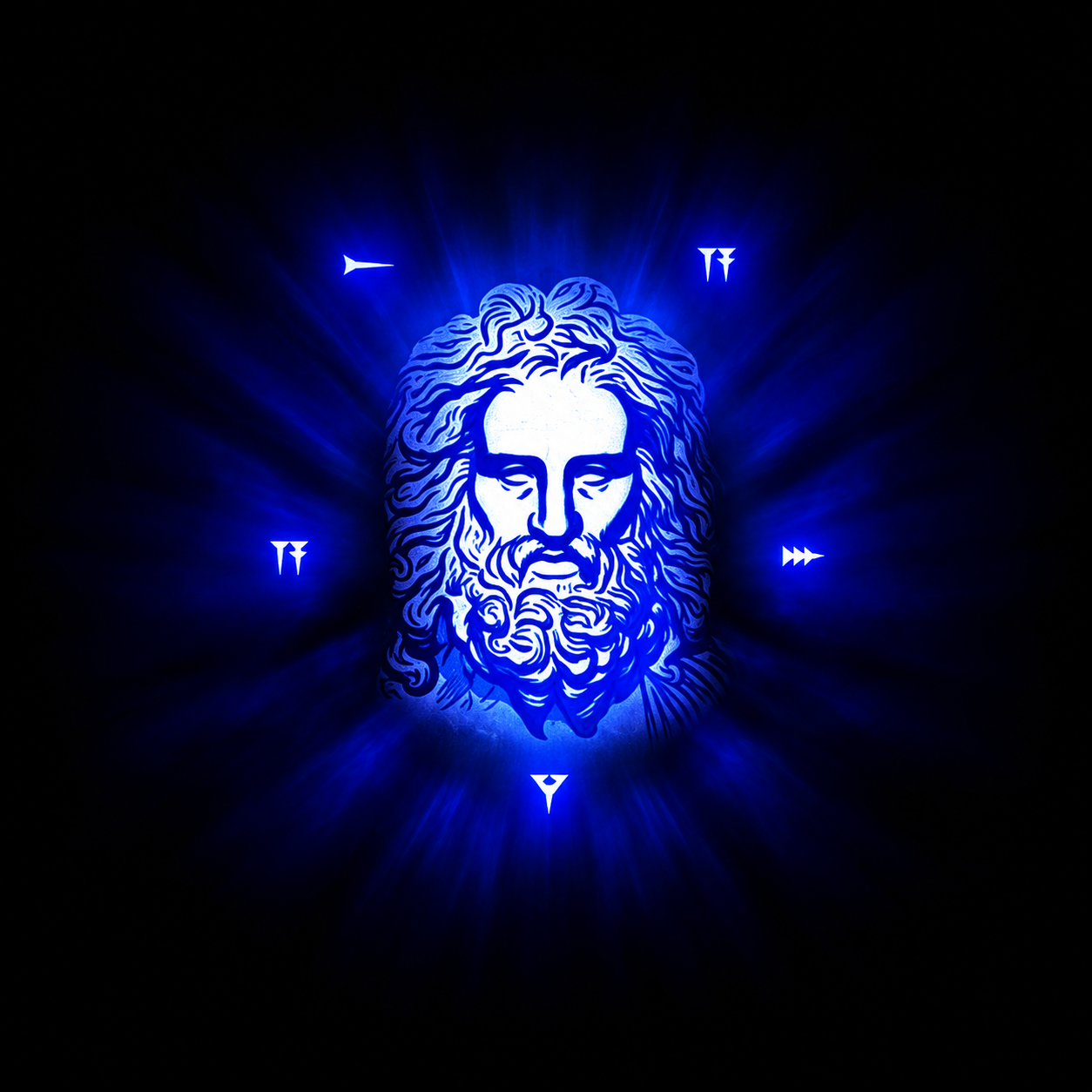
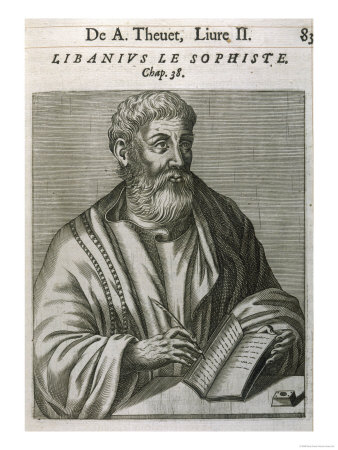
Picture: Later imagined portrait of Libanius, catalogued as an eighteenth-century French woodcut. No contemporary likeness is implied.
Unknown artist; scan uploaded by Philafrenzy; Wikimedia Commons; Public domain; eighteenth-century work. Image record, Public domain; eighteenth-century work.

The round picture in the lists of the personalities is cropped from it.