




3 min read
Sacred King of Uxmal
Lord Chaahk of Uxmal
author: High Priest Zevios Metathronos
The sacred kingship of Uxmal
Dates: around 900 CE
Period: Darkness (800–1000 CE)
Region: Yucatán, Maya world
Tradition: divine impersonation and royal ritual
Religion or tradition: Maya polytheism; royal ritual associated with Chaahk.
Heresy status: No designation documented.
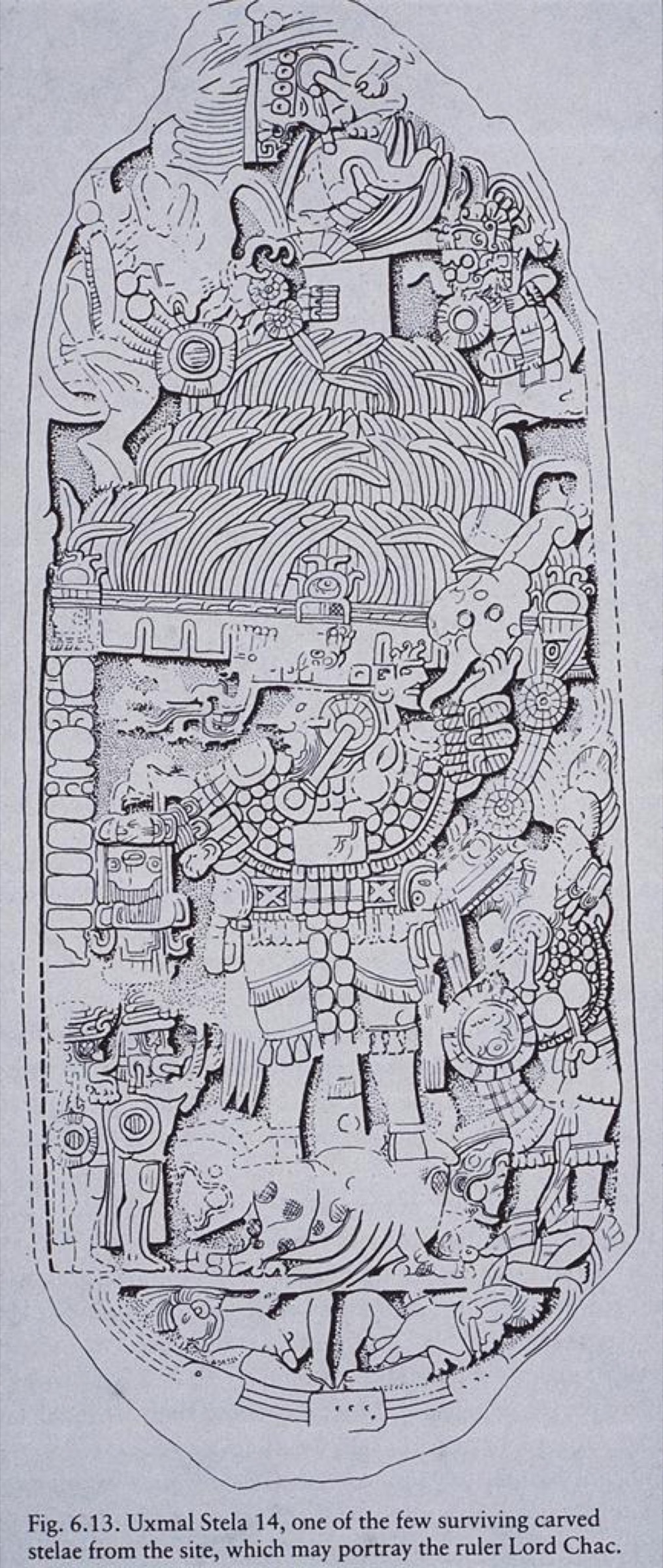
The ruler of Uxmal long known to scholarship as “Lord Chac” is represented on Stela 14, dated approximately to 900 CE. Readings of his name have developed with the study of the inscriptions. García Barrios gives K’ahk’ P’ulaj[?] Chan Chaahk, marking an uncertain element; the conventional designation Lord Chaahk is retained here. The monument places him within an explicitly divine visual world.1
A SURVIVING RECORD OF MAYA SACRED IDENTITY
Stela 14 preserves a named ruler within a richly articulated image of Chaahk. Its inscription, costume and divine attributes make it possible to study how a Maya court represented sacred kingship. The record gives later generations a specific religious vocabulary to recover and interpret, rather than leaving Uxmal’s worship known only through outside descriptions.2
The positive legacy identifiable here is cultural and religious: a public expression of the relationship between kingship and a God has survived. The ruler participated in that commemorative setting; the unnamed artists and scribes gave it its executed form. Its value to humanity lies in the knowledge of Maya civilization it preserves. Its Zevist significance lies in the continued visibility of an Indigenous divine tradition, studied through its own surviving evidence.
A RULER REPRESENTED THROUGH CHAAHK
Ana García Barrios interprets the figure on Stela 14 as the ruler personifying Chaahk in a martial setting. The scene includes divine attributes, attendants and captives. The God’s imagery supplies the language through which royal power is displayed. This is evidence of religious representation and ritual identity, rather than a modern portrait of private belief.3
The distinction between a human ruler and the divine power he represents remains essential. Religious impersonation gives an office a sacred form; it does not allow the historian to certify every claimed divine quality in the individual. The monument shows how the ruler wished his authority to be understood and remembered.
READING THE MONUMENT FULLY
The imagery joins grandeur with domination. Captives are part of its political message and should remain part of its description. Omitting them would turn a complex royal monument into an imagined picture of purely contemplative religion. The scholarly discussion of Stela 14 examines precisely this integration of divine imagery, royal identity and the display of power.4
HIS PLACE IN A ZEVIST COLLECTION
This profile extends the collection beyond the Mediterranean and Asia to an independently developed religious civilization of the Americas. Its relevance lies in the presence of the Gods at the centre of a public office and in the careful visual forms through which that relationship was expressed.
For the Zevist reader, the monument invites a demanding question: what obligations follow when power is presented as sacred? The ethical value of the comparison lies in asking how authority should serve an order greater than personal appetite. Historical description supplies the monument and its context; the present religious reading supplies that question. The two should remain distinguishable.
NOTES
1 Erik Velásquez García’s study.
2 Velásquez García’s analysis of the monument.
3 García Barrios, discussion of Stela 14.
4 Velásquez García, especially figure 14 and accompanying discussion.
BIBLIOGRAPHY
Erik Velásquez García, “La máscara de ‘rayos X’. Historia de un artilugio iconográfico en el arte maya,” Anales del Instituto de Investigaciones Estéticas 29, no. 90 (2007), DOI 10.22201/iie.18703062e.2007.90.2233, especially p. 32, figure 14, UNAM publication.
Ana García Barrios, “El aspecto bélico de Chaahk, el dios de la lluvia, en el Periodo Clásico maya,” Revista Española de Antropología Americana 39.1 (2009), pp. 7–29, especially p. 15 and figure 6c, Universidad Rey Juan Carlos repository text. Name readings and iconographic identifications are scholarly interpretations of the monument.
CREDIT
Picture: Modern drawing of an ancient monument. Shalis22’s 2017 reconstruction drawing of Uxmal Stela 14, showing the ruler personifying Chaahk. It records ancient iconography through a modern drawing; it is not a photograph of the original stone.
Credit: Shalis22. Source record, CC BY-SA 4.0.

The round picture in the lists of the personalities is cropped from it.