




8 min read
Father of Microbiology
Louis Pasteur
author: High Priest Zevios Metathronos
Healing and the Longing for the Eternal
Dates: 1822–1895 CE
Period: Imperial period (1804–1900)
Louis Pasteur was a chemist from Dole who was never a physician. He showed that fermentation is the work of living microbes, that a broth kept from dust stays sterile, and that a weakened germ can protect an animal against the strong one.1
His greatest single act came on 6 July 1885. A 9-year-old boy from Alsace, bitten 14 times by a rabid dog, arrived at his laboratory, and after 13 injections over 10 days the boy never developed rabies. By March 1886 Pasteur had vaccinated 350 people against rabies with 1 failure.2
Zevism receives this work under Asclepius and Hygieia, the powers of healing and of health. Disease is a form of Izfet, the collapse of ordered life, and every life Pasteur's method saved was a piece of Ma'at restored.
LIFE AND CONTEXT
Pasteur was born in Dole on 27 December 1822. He was a chemist, and his early work was on crystals: he showed that tartrate comes in 2 forms with the same composition, each the mirror image of the other.3
In 1857 he turned to fermentation and found that it's a living process, with a specific microbe for each kind: the microbe of lactic fermentation, used in cheese-making, isn't the ferment behind wine or beer. His paper on lactic fermentation came to be treated as the founding text of microbiology. In 1858 he set up his laboratory in the attic of the École Normale Supérieure in the rue d'Ulm in Paris.4
The state kept calling on him. In 1863 Napoleon III asked him to study the diseases of wine, and he traced them to microbes and proposed heating the wine to between 60 and 100°C. In 1865 a former professor of his, by then a senator for the Gard, summoned him to save the silk industry. Pasteur set up a laboratory in the Cévennes and identified 2 silkworm diseases, pébrine and flacherie.4
A stroke struck him at 46, and he kept working. In 1879 he obtained, somewhat by chance, a weakened strain of the fowl cholera bacterium. The anthrax vaccine of 1881 and the rabies treatment of 1885 followed.4
The Académie française elected him to the seat of Émile Littré, and he gave his reception speech on 27 April 1882. The Institut Pasteur, founded by decree on 4 June 1887, opened on 14 November 1888. He died on 28 September 1895, aged 72.5
ATTAINMENTS
- In 1857 he showed that “fermentation, far from being a lifeless phenomenon, is a living process,” each kind caused by its own microbe.4
- With his swan-neck flasks he showed that a nutrient broth open to the air “remained sterile as long as it was protected from dust particles,” and that microbes multiplied as soon as the dust reached it.4
- Asked by Napoleon III in 1863 to study spoiled wine, he found the microbes responsible and prevented the damage by heating the wine to between 60 and 100°C, the process that now bears his name.4
- His work on fermentation convinced the surgeon Joseph Lister that wound infection came from microscopic organisms, and Lister published his carbolic acid method in 1867. Pasteur went further and asked surgeons to wash their hands between operations and to sterilise linen, dressings and instruments. In the surgical wards of the time, 4 deaths in 5 came from infection.4
- At Pouilly-le-Fort in June 1881 the 25 sheep he had vaccinated survived inoculation with anthrax, while the 25 unvaccinated sheep died.4
- On 1 March 1886 he reported that he'd vaccinated 350 people against rabies, with just 1 failure.4
- He founded the Institut Pasteur, which opened in 1888 with a rabies vaccination service and 5 research laboratories, paid for by an international subscription.6
KEY STORIES
The Boy Bitten 14 Times
On 6 July 1885 a 9-year-old Alsatian boy named Joseph Meister arrived at Pasteur's laboratory in Paris. A rabid dog had bitten him 14 times.7
Pasteur agreed to act, “despite some reservations.” He wasn't a physician, and he entrusted the boy's treatment to Dr Jacques-Joseph Grancher. “En 10 jours, celui-ci recevra treize injections de préparation de moelles rabiques”: in 10 days the boy received 13 injections of a preparation made from the spinal cords of rabid animals.8
Meister never developed the disease. The Institut Pasteur calls him the first human being vaccinated against rabies. In October the shepherd Jean-Baptiste Jupille, 15 years old, came in deeply bitten. He'd thrown himself on a rabid dog to cover the escape of 6 other shepherd boys, and he became the 2nd person to receive the treatment.9
A God Within
On 27 April 1882 Pasteur took his seat at the Académie française in place of Émile Littré. His speech on his predecessor turned into a defence of the idea of the infinite. “La notion de l'infini dans le monde, j'en vois partout l'inévitable expression,” he said: he saw the notion of the infinite expressed everywhere.10
Near the end he turned to Greece. “Les Grecs avaient compris la mystérieuse puissance de ce dessous de choses.” It was the Greeks, he went on, who left French “un des plus beaux mots de notre langue, le mot enthousiasme.” The printed speech gives the Greek, Εν Θεος, and glosses it: “Un Dieu intérieur,” a God within. “La grandeur des actions humaines se mesure à l'inspiration qui les fait naître.”11
He blessed whoever keeps such a god: “Heureux celui qui porte en soi un dieu, un idéal de la beauté et qui lui obéit,” happy the one who carries a god within, an ideal of beauty, and obeys it. He named the ideals of art, of science, of the homeland and of the virtues of the Gospel. The same speech held the experimenter to hard discipline: a hypothesis serves only “à titre de guide et d'aiguillon pour la recherche et sous la réserve d'un sévère contrôle,” as a guide and a spur, under severe testing.11
The House of Generous Thoughts
After the success of the rabies vaccinations, the Académie des sciences launched a public subscription for an institute. The Institut Pasteur was founded by decree on 4 June 1887.12
On 14 November 1888 about 600 guests crowded into its library, turned into a reception hall, with the President of the Republic, Sadi Carnot, among them. The brick and stone building covered 11,000 square metres; some called it “Le palais de la rage,” and its pediment read “Souscription publique 1888.” Before it stood a bronze statue of the shepherd Jupille.13
Pasteur was 65 and too moved to read his own speech, so his son read it for him. “La voici donc bâtie, cette grande maison dont on pourrait dire qu'il n'y a pas une pierre qui ne soit le signe matériel d'une généreuse pensée”: here it stands, a great house of which it could be said that every stone is the material sign of a generous thought. The house opened with a rabies service and 5 laboratories, each under one of his collaborators: Grancher for rabies, Émile Duclaux, Émile Roux and Élie Metchnikoff for 3 branches of microbiology, and Charles Chamberland for vaccines.13
THE ZEVIST READING
The physicians of Greece swore their oath “by Apollo the physician, and Asclepius, and Hygieia and Panacea and all the gods.”14 Pasteur wasn't a physician, but his work fell under the same powers. Asclepius heals the sick, and Grancher's needle saved Meister. Hygieia keeps the healthy whole, and her name stands behind the washed hands, sterilised linen and clean instruments Pasteur demanded of surgeons.
Ma'at gives the doctrine. Egyptian religion named her “the personification of truth, justice, and the cosmic order” and set her against isfet, disorder.15 Zevism counts disease among the forms of Izfet, the dissolution of ordered life. A wound turning septic, a flock dying of anthrax and a child's nerves failing to rabies are Izfet at work. Pasteur's flasks and field trials were measurements, and measurement restores Ma'at.
The causes of fermentation and infection lay in a darkness the eye couldn't reach. Zevism holds that such darkness is ground to be walked into with a light, and that explored darkness becomes Light. Pasteur walked into it with a flask whose curved neck kept out the dust, and he brought out a rule anyone could test: keep the dust away and the broth stays clear.
Pasteur's faith drew on the Gospel, and he didn't identify his God with Zeus. The Temple's reading of his speech is its own claim. Still, the word he chose to praise came from the Greeks, and he glossed it himself: ἐν θεός, a God within. Zevism names the aim of the path ὁμοίωσις θεῷ κατὰ τὸ δυνατόν, likeness to the divine “as far as possible.”16 A man who said human deeds are measured by the inspiration behind them, and who built a house of research from public gifts, walked a good way along that path.
NOTES
1 Institut Pasteur, “Louis Pasteur: a universal legacy”.
2 Institut Pasteur, “Du vaccin contre la rage à la création de l'Institut”; Institut Pasteur, “A universal legacy”.
3 Encyclopaedia Britannica, “Louis Pasteur,” by Agnes Ullmann; Institut Pasteur, “A universal legacy”.
4 Institut Pasteur, “A universal legacy”.
5 Académie française, “Discours de réception de Louis Pasteur”; Institut Pasteur, “Du vaccin contre la rage”; Britannica, “Louis Pasteur”.
6 Institut Pasteur, “Il y a 130 ans, l'inauguration de l'Institut Pasteur,” 14 November 2018.
7 Institut Pasteur, “Du vaccin contre la rage”; Institut Pasteur, “A universal legacy”.
8 Institut Pasteur, “Du vaccin contre la rage”.
9 Institut Pasteur, “Du vaccin contre la rage”; Institut Pasteur, “Il y a 130 ans”.
10 Pasteur, “Discours de réception,” Académie française, 27 April 1882.
11 Pasteur, “Discours de réception”.
12 Institut Pasteur, “Il y a 130 ans”; Institut Pasteur, “Du vaccin contre la rage”.
13 Institut Pasteur, “Il y a 130 ans”.
14 Hippocratic Oath, tr. Michael North, National Library of Medicine, 2002.
BIBLIOGRAPHY
Institut Pasteur, “Louis Pasteur: a universal legacy”, 28 March 2022, updated 16 April 2024; sections on molecules and ferments, microbiology, wine and silkworms, hospital hygiene and vaccination.
Institut Pasteur, “Du vaccin contre la rage à la création de l'Institut”; Joseph Meister, Jean-Baptiste Jupille and the foundation.
Institut Pasteur, “Il y a 130 ans, l'inauguration de l'Institut Pasteur”, 14 November 2018.
Louis Pasteur, “Discours de réception”, Académie française, 27 April 1882; passages on the infinite, experimental method and enthusiasm. English renderings in the text are the article's own.
Agnes Ullmann, “Louis Pasteur”, Encyclopaedia Britannica; dates of birth and death.
Hippocratic Oath, tr. Michael North, National Library of Medicine, 2002.
Encyclopaedia Britannica, “Maat”.
Plato, Theaetetus 176a–b, Greek text, Perseus Digital Library.
CREDIT
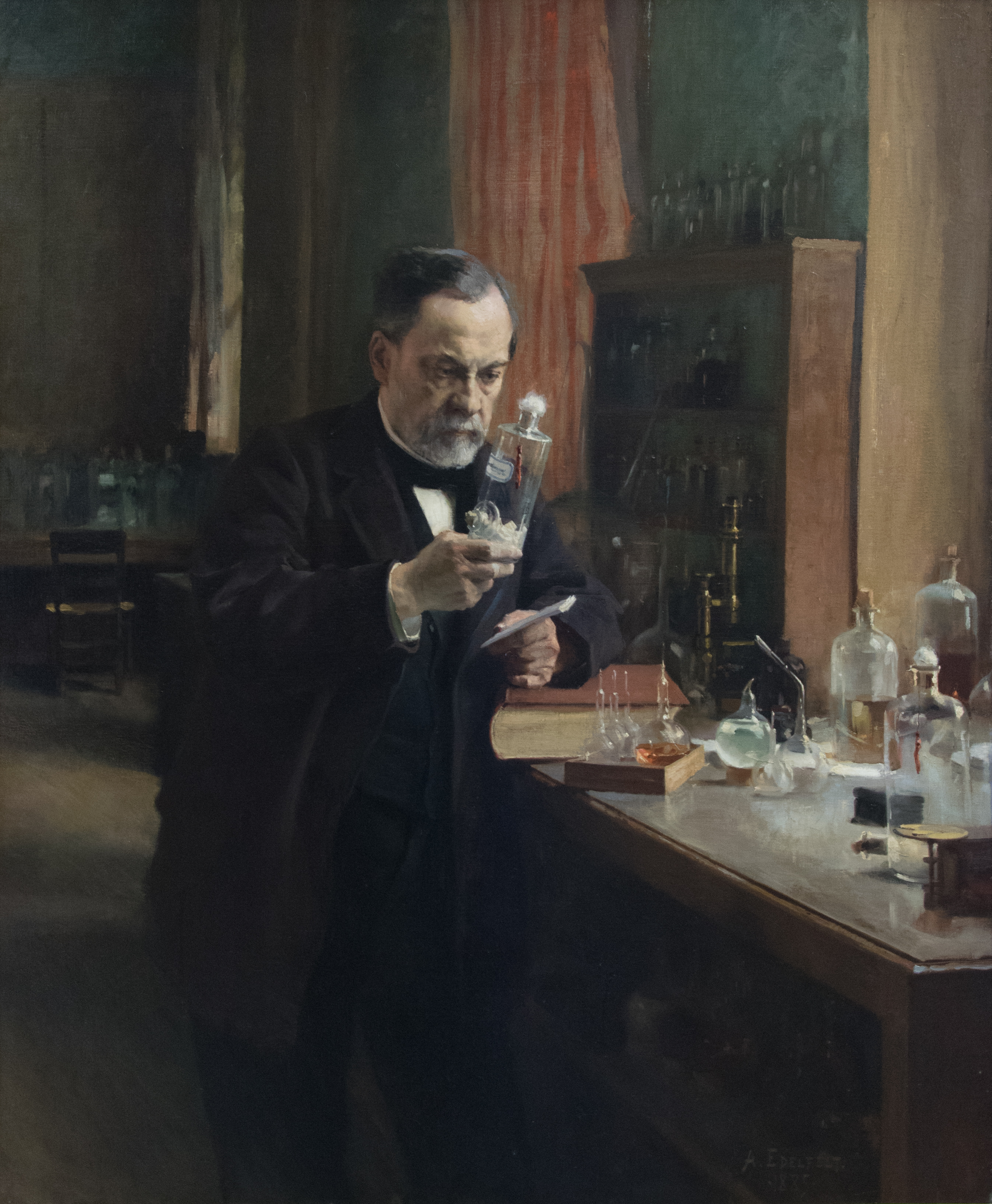
Image: Albert Edelfelt, portrait of Louis Pasteur, 1885. Public-domain artwork and reproduction; verified Commons file record.

Albert Edelfelt, Louis Pasteur (1885), via Wikimedia Commons; public domain. Image record, Public domain: PD-Art / author died1905; pre1931 publication.
The round picture in the lists of the personalities is cropped from it.