




9 min read
Master of Liturgy
Lu Xiujing
author: High Priest Zevios Metathronos
Ritual Understood and Conduct Renewed
Dates: 406–477 CE.
Period: Roman, the collection's chronological category for 30 BCE–800 CE.
Lu Xiujing was a Daoist master of 5th-century China whom modern scholarship calls the Lingbao patriarch. He gathered the Daoist scriptures of his age, sorted them into the Three Caverns and in April 471 presented to Emperor Ming of the Liu Song the Sandong jingshu mulu, the oldest comprehensive catalogue of the Daoist canon.1
He also set the rules of Daoist ritual and taught that a rite performed without understanding can't show the practitioner his own merits and failings. His sermons and precepts show a teacher who took Buddhist forms into Daoist practice and told a prince that the 2 religions led to the same destination.2
Lu was a Daoist, and he served the Dao and its Heavenly Worthies. Zevism reads him as a link in the chain of spirituality and a keeper of the source: a cataloguer and lawgiver of rites whose work Zevism places under Thoth and Ma'at.
LIFE AND CONTEXT
Lu Xiujing was born in 406 at Dongqian in Wuxing, in present-day Zhejiang. His style name was Yuande. He took the name Master Jianji, and after his death he received the title Gaodao chushi.3
He grew up while a new body of scripture was taking shape. Ronnie Littlejohn writes that Ge Chaofu, “a descendent of Ge Hong,” went into a trance and produced the Numinous Treasure, or Lingbao, teachings: “ritual recitation texts similar to Buddhist sutras,” which “borrowed heavily from Buddhism.” Kobayashi Masayoshi calls them Daoist scriptures of the Great Vehicle, built from Mahayana thought in the Liu Song period.4
Lu made order out of them. He collated and edited the Lingbao scriptures and divided them into 2 lines, those revealed by the Primordial Heavenly Worthy and those handed down through the Immortal Duke, Ge Xuan.3
He first settled on Mount Lu, where he built the Jianji Lodge at the southern foot of the mountain. Later Emperor Ming called him to the capital, Jiankang. Mugitani Kunio adds that he set rules for Daoist ritual and worked to fix its doctrine. Kobayashi says that he reformed the Celestial Master community, which had fallen into corruption, and put its precepts and rites in order.5
His teaching on ritual survives in the Fazhu jing, which Verellen renders The Light of Ritual, a set of 10 lessons on the retreat. Verellen reads their framework as “the classical Daoist soteriology of return,” a journey inward and back to the origin. Lo doubts the image: “Perhaps Verellen's metaphor of ‘interior journey’ is not entirely apt.”6
He died in 477. Most modern studies, Lo Yuet Keung notes, have treated him as a reformer of institutions. Lo's review of Franciscus Verellen's Imperiled Destinies: The Daoist Quest for Deliverance in Medieval China (Harvard University Asia Center, 2019) turns to Lu's own words on self-cultivation and on Buddhism.7
ATTAINMENTS
- In April 471, by order of Emperor Ming, he presented the Sandong jingshu mulu, the Catalogue of the Scriptures of the Three Caverns, which Kobayashi calls the oldest comprehensive catalogue of Daoist scripture.3
- He devised the Three Caverns classification of Daoist texts and based the catalogue on it.8
- He collated the Lingbao scriptures and sorted them into 2 lineages, that of the Primordial Heavenly Worthy and that of Ge Xuan.3
- He preached 10 sermons on the zhai, the ritual retreat. A report on Verellen's UCLA lecture of 2005 says that Lu “employed the authority of antiquity and tradition” to bring in the newest ritual method of his day, Buddhist retreats, and sums him up: “Lu reviewed the old and taught the new.”9
- He joined rite to understanding: “Without ritual, deviation cannot right itself. If you practice ritual without understanding, you cannot discern your merits or failings.”10
- He taught that the practitioner's body holds the cosmos: “It is within our own body that we know the substance of Heaven and Earth, extending to the Eighty-one Regions and comprising the Four Seas and Five Peaks.” The breaths of the adept, the passage goes on, “raise the clouds and bring rain.”11
- He wrote precepts for practice. His 10th precept in Lo's translation reads: “Let your acts and deeds be impartial and single-minded so that men and gods will become harmonious and peaceful together.”12
KEY STORIES
The Abbey North of the Capital
In 467 Emperor Ming of the Liu Song wanted Lu Xiujing in his capital. Kobayashi Masayoshi records the gesture that made the episode famous: the emperor built the Chongxu Abbey, the Abbey for Venerating Emptiness, in the northern suburbs of Jiankang, and received Lu there.3
Lu left his lodge on Mount Lu and went to work. Mugitani Kunio writes that at the Chongxu Abbey he collected the Daoist scriptures and put them in order, set up the classification of the Three Caverns, and on that basis compiled the oldest catalogue of Daoist books.8
In the 4th month of 471, 4 years after the summons, Lu presented the Catalogue of the Scriptures of the Three Caverns to the throne, by the emperor's order.3
Lu had given a whole tradition its first full inventory. It's here that Zevism finds Lu's likeness to Thoth, whom Plato's Egyptian story made the inventor of letters: the keeper who writes the record and orders it.13
The Prince's Question
Lo Yuet Keung relates an exchange between Lu and his host, Prince Jiujiang, who asked him about “the advantages and disadvantages, as well as the differences and similarities, between the two religions,” Daoism and Buddhism.14
Lu's reply, as it was reported, didn't set one faith against the other. Laozi, he said, “manifested himself as the Buddha during his ‘sojourn in the state of Qin;’ when revealed as the Dao itself, he is Jade Sovereign. But this is just another case of differing paths leading to the same destination.”14
Lo treats the answer as part of a wider record. “Lu Xiujing himself acknowledged that Daoism and Buddhism were fundamentally identical,” he writes, and in Lu's precepts “the borrowing is unmistakable.” Even the word for impartial in the 10th precept, pingdeng, “was Buddhist in origin.”15
The report on Verellen's lecture of 2005 finds the same pattern in ritual. Lu, it says, used antiquity to introduce “something that was not archaic at all, but was in fact the latest development in ritual technology: Buddhist ritual retreats.” The prince had asked for a verdict between 2 faiths, and he got a working answer: Lu was already using both.9
Three Laughs at Tiger Creek
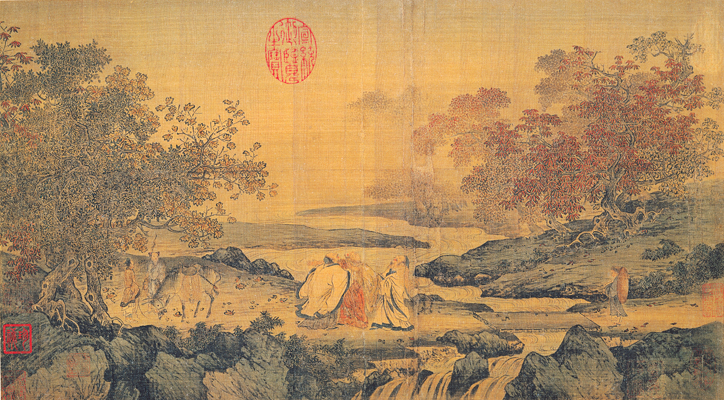
The Record of Mount Lu tells a story that painters loved. The Buddhist master Huiyuan (334–416) lived on Mount Lu and, the Nipponica says, didn't leave the mountain for 30 years. When he saw guests off, he always stopped at the stone bridge over Tiger Creek.16
One day 2 visitors came, Tao Yuanming and the Daoist Lu Xiujing. They passed the time in pure conversation at the temple, and when Huiyuan walked them out, he was so absorbed that he crossed the bridge without noticing. Only when a tiger roared did he realise he'd gone well past the creek. The 3 men burst out laughing and parted.17
Mugitani Kunio states plainly that the meeting isn't historical, and Huiyuan's dates bear him out: he died in 416, when Lu was 10. The scene lived on in painting, in China from the Song onward in Chan painting and in Japan from the Muromachi period.18
THE ZEVIST READING
Zevism honours the transmitters: translators, copyists, editors and cataloguers who keep the source. Knowledge changes as it passes from hand to hand, and the source keeps its priority only when someone gathers the texts and records what they are. Lu did that for an entire tradition. Plato's Theuth invented “numbers and arithmetic and geometry and astronomy” and letters; the catalogue of 471 is the work of Theuth's servants, the true record that holds a canon in order.13
Order in the record and order in the rite belong to Ma'at, “the personification of truth, justice, and the cosmic order,” set against isfet.19 Lu reformed a priesthood that had fallen into corruption and wrote its rules again. Zevism reads that as Ma'at restored in a religious community.
His teaching on ritual matches the dimension the Temple calls Theurgy: Σοφία, the joining of human intelligence to the intelligence of the Gods. “If you practice ritual without understanding, you cannot discern your merits or failings.” His precept asked for acts “impartial and single-minded so that men and gods will become harmonious and peaceful together.”20
The body that knows “the substance of Heaven and Earth” is the ground of the dimension of Meditation, τὸ δυνατόν, the capacity of power. Lu's school held that “destiny resides in one's person” and “long life is vested in the self.”11 The Temple reads those sayings as a charge laid on each practitioner: the elevation toward the divine starts in the person who breathes and keeps the rite, and nobody else can do it for him.
Lu told Prince Jiujiang that different teachings were “differing paths leading to the same destination.” Zevism makes a related claim on a larger scale. It reads all spirituality, from its inception to today, as a single chain, and it counts the Lingbao patriarch among its links under his own tradition's names.
NOTES
1 Kobayashi, Nipponica; Lo, “Let the Lingbao Patriarch Speak,” p. 187.
4 Littlejohn, “Daoist Philosophy,” IEP; Kobayashi, Nipponica.
5 Mugitani, Sekai Daihyakka Jiten; Kobayashi, Nipponica.
8 Mugitani, Sekai Daihyakka Jiten.
9 UCLA Center for Chinese Studies.
12 Lo, p. 215.
14 Lo, p. 212.
15 Lo, pp. 205, 215.
16 Nipponica and Digital Daijisen, “Kokei sanshō”.
18 Sekai Daihyakka Jiten, “Kokei sanshō”; Mugitani, Sekai Daihyakka Jiten.
20 Lo, pp. 189, 215.
BIBLIOGRAPHY
Lo Yuet Keung, “Let the Lingbao Patriarch Speak: Lu Xiujing (406–477) on Self-Cultivation and Buddhism”, Journal of Chinese Studies 75 (July 2022), pp. 187–231, especially pp. 187–189, 205, 212 and 215; a review article on Franciscus Verellen, Imperiled Destinies (Harvard University Asia Center, 2019).
UCLA Center for Chinese Studies, A Look at Community and Ritual in Medieval Taoism, 25 October 2005, report on a lecture by Franciscus Verellen on 10 October 2005.
Kobayashi Masayoshi, “Riku Shūsei,” Nihon Daihyakka Zensho (Nipponica) (Shogakukan), and Mugitani Kunio, “Riku Shūsei,” Kaitei shinban Sekai Daihyakka Jiten (Heibonsha), both at Kotobank, “陸修静”; birthplace, names, Mount Lu, the Chongxu Abbey, the catalogue of 471, the Lingbao lineages and the reform of the Celestial Masters. Translations from the Japanese are the author's.
Nihon Daihyakka Zensho (Nipponica), Digital Daijisen and Kaitei shinban Sekai Daihyakka Jiten, “虎渓三笑” (Kokei sanshō), Kotobank; the Tiger Creek story, its source in the Record of Mount Lu, Huiyuan's dates and the tradition in painting.
Ronnie Littlejohn, “Daoist Philosophy”, Internet Encyclopedia of Philosophy; Ge Chaofu and the Lingbao scriptures.
Plato, Phaedrus 274c–d, translated by H. N. Fowler, Perseus Digital Library.
Encyclopaedia Britannica, “Maat”.
CREDIT
Picture: Three Men Laughing by Tiger Creek, anonymous later painting, National Palace Museum, Taipei. Lu Xiujing appears at the left in the traditional story. This illustrates later religious reception; it does not establish that the depicted meeting occurred. Public-domain artwork and faithful reproduction.

Anonymous, Three Men Laughing by Tiger Creek, National Palace Museum, Taipei; Wikimedia Commons; public domain. Image record, Public domain; PD-Art faithful reproduction.
The round picture in the lists of the personalities is cropped from it.