




10 min read
Pioneer of Radioactivity
Marie Skłodowska Curie
author: High Priest Zevios Metathronos
Perseverance in the Service of Life
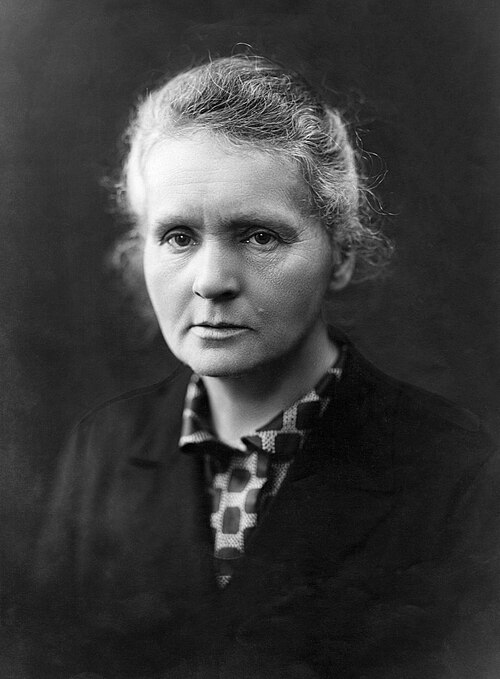
Dates: 1867–1934
Period: Modern
Marie Skłodowska Curie was a Polish-born physicist and chemist who found 2 new elements, polonium and radium, and named the property that gave them away: radioactivity. She was the first person to win 2 Nobel Prizes, in physics in 1903 and in chemistry in 1911.1
Her greatest single labour took more than 3 years in a badly ventilated shed in Paris. Out of pitchblende, waste from Austrian mining that the government gave away by the ton, she drew a tenth of a gram of pure radium chloride, and with it the proof that radium was a real element.2
Zevism reads her work under the doctrine of Light and Darkness and under Asclepius and Hygieia, the powers of healing. She carried light out of a black ore, then drove X-ray cars to the front in 1914 to find the metal inside wounded men.
LIFE AND CONTEXT
Maria Skłodowska was born in Warsaw on 7 November 1867, when Poland hadn't been an independent country for most of a century. Her father taught mathematics and physics. As a young woman she studied at the Floating University, an illegal night school whose classes kept changing location to avoid the tsarist police.3
She enrolled at the Sorbonne in the autumn of 1891 and became Marie. She finished first in the physics degree course in 1893 and 2nd in mathematics the next year. In the spring of 1894 her search for laboratory space led to Pierre Curie, and they married in a civil ceremony in July 1895, then toured France by bicycle.4
For her doctorate she took up the uranium rays that Henri Becquerel had found and few people were studying. She worked in a crowded, damp storeroom at the Paris school where Pierre taught, with an electrometer that Pierre and his brother Jacques had invented. She showed that the rays stayed constant whatever the uranium's form, wet or dry, pure or compound, and proposed that they came from the atom itself. She coined the word “radioactivity.”5
Pierre died on 19 April 1906, run over by a horse-drawn wagon in the rain. Marie took his chair. On 23 January 1911 she lost an election to the Académie des Sciences to Edouard Branly by 2 votes, and that autumn the press got hold of her letters to the physicist Paul Langevin. Svante Arrhenius of the Nobel committee advised her to decline the prize until her name was cleared. She went to Stockholm anyway, with her sister and her daughter, and received it on 10 December 1911.6
The Radium Institute rose from a joint decision of the University of Paris and the Institut Pasteur in 1909. It had 2 laboratories: hers for physics, and the physician Claudius Regaud's for the biological and medical effects of radiation. Its building on the new rue Pierre-Curie was finished in August 1914.7
In 1921 she crossed to the United States to fetch a precious gram of radium. She was diagnosed with pernicious anaemia and died on 4 July 1934 at Sallanches, aged 66.8
ATTAINMENTS
- She showed in 1898 that thorium compounds emit rays like uranium and proposed that radioactivity is an atomic property, in the AIP's words “something built into the very structure of its atoms.”5
- With Pierre she announced polonium in July 1898 and radium in December 1898, the first named in honour of Poland, the country of her birth, and the 2nd from the Latin word for ray.2
- She isolated radium as a pure salt and fixed its character as an element by spectrum and atomic weight, after thousands of fractional crystallizations. In 1910, with André Debierne, she obtained radium as a metal.9
- She shared the 1903 Nobel Prize in Physics, a 1/4 share, “in recognition of the extraordinary services they have rendered by their joint researches on the radiation phenomena discovered by Professor Henri Becquerel.”10
- The 1911 Nobel Prize in Chemistry was hers alone, awarded “by the discovery of the elements radium and polonium, by the isolation of radium and the study of the nature and compounds of this remarkable element.”11
- In 1906 she became the first woman professor at the Sorbonne.12
- In the First World War she equipped mobile X-ray vehicles, set up 200 fixed radiology units and trained about 150 women as X-ray operators.13
KEY STORIES
The Shed Across the Courtyard
Radium was so scarce in pitchblende that the Curies needed ore by the ton. The Austrian government gave them a ton, hoping she'd find a use for what its mines threw away. The storeroom was far too small, so they moved to an abandoned shed across the school courtyard, once a dissecting room of the medical school and poorly fitted and ventilated. André Debierne scaled their methods up for a chemical firm, which treated the bulk ore and took a share of the radium.2
In the shed Marie did the chemistry herself. “Sometimes I had to spend a whole day mixing a boiling mass with a heavy iron rod nearly as large as myself,” she wrote in her Autobiographical Notes. She crystallized the fractions thousands of times, following the activity with the electrometer, and it took her more than 3 years to isolate a tenth of a gram of pure radium chloride.14
The product glowed. “One of our joys was to go into our workroom at night,” she remembered, and “the glowing tubes looked like faint, fairy lights.” They published every step of the process and patented none of it. Both did permanent damage to their fingertips handling the material unshielded.15
The Paper of 26 December 1898
By the end of 1898 the Curies had a barium fraction far more active than barium could account for. With G. Bémont they reported it to the Académie des Sciences. “We have obtained in this manner chlorides having an activity 900 times greater than that of uranium,” they wrote.16
The spectrum pointed the same way. “Demarçay has found one line in the spectrum which does not seem due to any known element.” Barium itself isn't radioactive, and “one of us has shown that radio-activity appears to be an atomic property.”17
The note closed on a name. “The various reasons which we have enumerated lead us to believe that the new radio-active substance contains a new element to which we propose to give the name of radium.”17
The Lecture of 5 November 1906
On Thursday 19 April 1906 Pierre worked in the laboratory all morning, then crossed Paris through heavy rain to a luncheon. Hurrying over a street, he fell under a horse-drawn wagon loaded with military uniforms, some 6 tons of it, and died at once.18
“Crushed by the blow, I did not feel able to face the future,” Marie wrote later. “I could not forget, however, what my husband used to say, that even deprived of him, I ought to continue my work.” On 13 May the university offered her his post.18
On 5 November 1906 she gave her first lecture, and the hall was packed. She began with the state of physics: “When one considers the progress that has been made in physics in the past ten years, one is surprised at the advance that has taken place in our ideas concerning electricity and matter.” With that sentence the Sorbonne's first woman professor took over Pierre's course.19
The Little Curies
When war came in 1914, surgeons at the front needed X-rays to find fragments in wounded men. Curie learned to drive, took crash courses in anatomy, in X-ray equipment and in car mechanics, and by late October 1914 had the first of her radiology vehicles on the road. French soldiers called them petites Curies, the little Curies. The Institut Curie counts 18 cars; the AIP gives 20.20
She trained her daughter Irène as a radiologist for a year and then left her in charge of a front-line installation. She also collected radon gas from her radium every 48 hours with an electric pump and sealed it in thin glass tubes about 1 centimetre long for the army's radiotherapy service.21
When the government asked citizens for gold, she offered both her Nobel medals and every other medal she owned. The French National Bank turned them down, and she put most of her prize money into war bonds.22
THE ZEVIST READING
Zevism holds that unexplored darkness isn't evil. It's the ground one walks into carrying light, and explored darkness becomes Light. Curie's work makes the doctrine almost literal. She went into a black ore that its own miners threw away, and after 3 years of crystallizations she stood in a shed at night among tubes that shone by their own power. The rays had been in the pitchblende all along; she made them known.
Healing belongs to Asclepius and Hygieia. The Greek physicians swore “by Apollo the physician, and Asclepius, and Hygieia and Panacea and all the gods.”23 Curie wasn't a physician, yet her institute set a physician's laboratory beside her own, and her cars helped surgeons find the metal in wounded soldiers. She and Pierre gave the radium process to the world unpatented.
Zevism counts the wound and the tumour among the forms of Izfet, the dissolution of ordered life. Ma'at is the order that holds, and an X-ray plate or a sealed tube of radon puts a body back toward it. So does a measurement that holds, like an activity reading that told Curie which fraction to keep.
The Institut Curie keeps a sentence of hers: “On ne fait jamais attention à ce qui a été fait ; on ne voit que ce qui reste à faire.” One never notices what has been done; one sees only what remains to be done.24 Zevism calls the aim of the path ὁμοίωσις θεῷ κατὰ τὸ δυνατόν, likeness to the divine “as far as possible.”25 She handled the material with bare hands until it scarred her fingertips, and she kept her eyes on the work still undone.
NOTES
1 Nobel Prize, “Marie Curie: Facts”.
2 AIP, “Research Breakthroughs”.
4 AIP, “A Student in Paris”; Nobel Prize, “Marie Curie: Biographical”.
5 AIP, “Research Breakthroughs”.
6 AIP, “Scandal and Recovery”; AIP, “Illness and Rebirth”.
7 Institut Curie, “L'héritage de Marie Curie”; AIP, “Illness and Rebirth”.
8 Institut Curie; Nobel Prize, “Facts”.
10 Nobel Prize, 1903 Physics Facts.
11 Nobel Prize, 1911 Chemistry Facts.
12 AIP, “Tragedy and Adjustment”.
13 AIP, “War Duty”.
14 AIP, “Marie Curie and Her Legend”; Curie, Nobel Lecture; AIP, “Research Breakthroughs”.
15 AIP, “Founding the Radium Industry”.
16 P. Curie, M. Curie and G. Bémont, Comptes rendus 127, 1898, tr. Romer.
18 AIP, “Tragedy and Adjustment”.
19 AIP, “Tragedy and Adjustment,” part 2.
20 AIP, “War Duty”; Institut Curie.
21 AIP, “War Duty”; AIP, “War Duty,” part 2.
23 Hippocratic Oath, tr. Michael North, National Library of Medicine, 2002.
24 Institut Curie.
BIBLIOGRAPHY
Marie Curie, “Radium and the New Concepts in Chemistry”, Nobel Lecture, 11 December 1911, in Nobel Lectures, Chemistry 1901–1921, Elsevier, 1966; the isolation of radium and the metal obtained with Debierne.
“Marie Curie: Biographical”, Nobel Lectures, Chemistry 1901–1921, Elsevier, 1966, NobelPrize.org.
NobelPrize.org, “Marie Curie: Facts,” Chemistry 1911 and “Marie Curie: Facts,” Physics 1903; prize motivations, shares, dates and places of birth and death.
P. Curie, M. Curie and G. Bémont, “On a New, Strongly Radio-active Substance Contained in Pitchblende”, Comptes rendus de l'Académie des Sciences 127 (26 December 1898), 1215–1217, translated by Alfred Romer (Dover, 1970), AIP.
American Institute of Physics, Marie Curie and the Science of Radioactivity: “Polish Girlhood”, “A Student in Paris”, “Research Breakthroughs”, part 2 and “Founding the Radium Industry”.
American Institute of Physics, Marie Curie and the Science of Radioactivity: “Tragedy and Adjustment” and part 2, “Scandal and Recovery”, “Illness and Rebirth”, “War Duty” and part 2.
American Institute of Physics, “Marie Curie and Her Legend”; quotation from Curie's Autobiographical Notes.
Institut Curie, “L'héritage de Marie Curie, perpétuer l'esprit d'une pionnière”; the Radium Institute, the radiological cars, the 1921 journey, her death and her own sayings. English renderings are the article's own.
Hippocratic Oath, tr. Michael North, National Library of Medicine, 2002.
Plato, Theaetetus 176a–b, Greek text, Perseus Digital Library.
CREDIT
Picture: Marie Curie, photographed by Henri Manuel, c. 1920; restoration by FMSky and Bammesk.
Henri Manuel; restoration FMSky and Bammesk / Wikimedia Commons. Image record, Public domain.

The round picture in the lists of the personalities is cropped from it.