





4 min read
Scholar of Astral Magic
Maslama ibn Qāsim al-Qurṭubī
author: High Priest Zevios Metathronos
A scholar at the roots of learned astral magic
Dates: died 964 CE
Period: Darkness (800–1000 CE)
Region: al-Andalus and the eastern Islamic world
Tradition: esoteric scholarship
Religion or tradition: Islamic intellectual setting: Muslim ḥadīth scholar associated in scholarship with Bāṭinī esotericism, alchemy and astral magic.
Heresy status: Esoteric / potentially heterodox; no formal verdict established.
Maslama ibn Qāsim al-Qurṭubī belongs to the history of learned magic through a major modern reassessment of two Arabic works: Rutbat al-ḥakīm and Ghāyat al-ḥakīm, the latter known in its Latin transmission as Picatrix. Maribel Fierro’s 1996 study argued that their author was this tenth-century scholar, rather than the better-known mathematician Maslama al-Majrīṭī. The two men must not be conflated.1
RELIGIOUS IDENTITY AND THE TRANSMISSION OF ASTRAL KNOWLEDGE
Maslama belongs to an Islamic scholarly and esoteric setting. Modern research associates the traditionist Maslama ibn Qāsim with Bāṭinī learning and with the authorship of the Rutbat al-ḥakīm and Ghāyat al-ḥakīm. The latter became known in Latin as the Picatrix. This identification is a scholarly attribution, and the reviewed record does not establish a formal heresy judgment against him.2
Knowledge of the Gods: a Zevist interpretation. His importance lies in the preservation and organization of astral knowledge: the relations between celestial powers, the world and ritual action. In the Temple’s understanding, such study belongs to humanity’s continuing inquiry into the powers of the Gods. Maslama’s place in that history rests on the esoteric works associated with him and their transmission across languages. His Muslim setting remains part of that account.
PRESERVING A LEARNED APPROACH TO THE MAGICAL ARTS
The Ghāyat al-ḥakīm, under the influential attribution to Maslama al-Qurṭubī, gave learned astral magic a substantial written form. Its later transmission as Picatrix carried that material into another linguistic setting. Together with the manuscript history of the Rutbat al-ḥakīm, this provides a concrete contribution to the preservation and movement of esoteric knowledge.3
The human benefit is the survival of material that can still be investigated in detail, including its account of celestial powers and ritual action. Its value for the present religious collection lies in the sustained attention given to the relation between knowledge and practice. Appreciation rests on that intellectual legacy, with the scholarly attribution stated, rather than on an invented personal allegiance to the Temple’s Gods.
THE IMPORTANCE OF RECOVERING AN AUTHOR
Maslama’s travels and study in the eastern Islamic world form part of the case for this attribution. Subsequent research by Godefroid de Callataÿ and Sébastien Moureau examined manuscript evidence and the early confusion between the two names. Their work strengthens the identification while showing why the history of these books requires manuscript investigation.4
This is significant for the history of religious knowledge. Texts of magic did not circulate without authors, readers and intellectual routes. They belonged to learned environments in which cosmology, the properties of nature and ritual action could be investigated together. Restoring the distinction between two scholars helps restore those routes.
THE PLACE OF THE *GHĀYA*
The Ghāyat al-ḥakīm is a major work of astral magic. Its authorship and chronology have generated substantial scholarly debate; Fierro’s identification is influential, but a profile should not conceal the history of disagreement. A University of Helsinki study surveys that problem and the proposed connections with the Epistles of the Brethren of Purity.5
Maslama is included for esoteric learning and transmission. There is no basis here for inventing a confrontation with a Christian Church court, or for describing him as a self-declared Satanist. His setting was Islamic al-Andalus, and the relevant religious complexity should remain visible.
A ZEVIST READING OF LEARNED PRACTICE
His example directs the student towards study before technique. A serious engagement with a magical text requires attention to its cosmology, its terminology and its transmission. The name on a modern cover may conceal a difficult history; inherited claims should be examined with the same care as instructions for practice.
For this collection, Maslama represents the intellectual labour surrounding the magical arts. His significance lies in a learned tradition that treated the powers of the cosmos as a subject requiring sustained investigation. The Zevist comparison concerns that disciplined pursuit and the preservation of knowledge, without claiming that every doctrine or operation in the attributed corpus is identical with the Temple’s teaching.
NOTES
2 Godefroid de Callataÿ, discussion of Maslama and the occult sciences.
3 Fierro’s attribution study; de Callataÿ and Moureau’s manuscript research.
5 Scholarly discussion, p. 65.
BIBLIOGRAPHY
Maribel Fierro, “Bāṭinism in al-Andalus: Maslama b. Qāsim al-Qurṭubī (d. 353/964), Author of the Rutbat al-ḥakīm and the Ghāyat al-ḥakīm (Picatrix),” Studia Islamica 84 (1996), pp. 87–112, DOI 10.2307/1595996, bibliographic record.
Godefroid de Callataÿ and Sébastien Moureau, “Again on Maslama Ibn Qāsim al-Qurṭubī, the Ikhwān al-Ṣafāʾ and Ibn Khaldūn: New Evidence from Two Manuscripts of Rutbat al-ḥakīm,” Al-Qanṭara 37.2 (2016), pp. 329–372, DOI.
Inka Nokso-Koivisto, Microcosm-Macrocosm Analogy in Rasāʾil Ikhwān aṣ-Ṣafāʾ and Certain Related Texts (PhD dissertation, University of Helsinki, 2014), repository text, discussion of the Ghāya’s authorship, p. 65. The attribution is identified as a scholarly conclusion, rather than an undisputed manuscript signature.
CREDIT
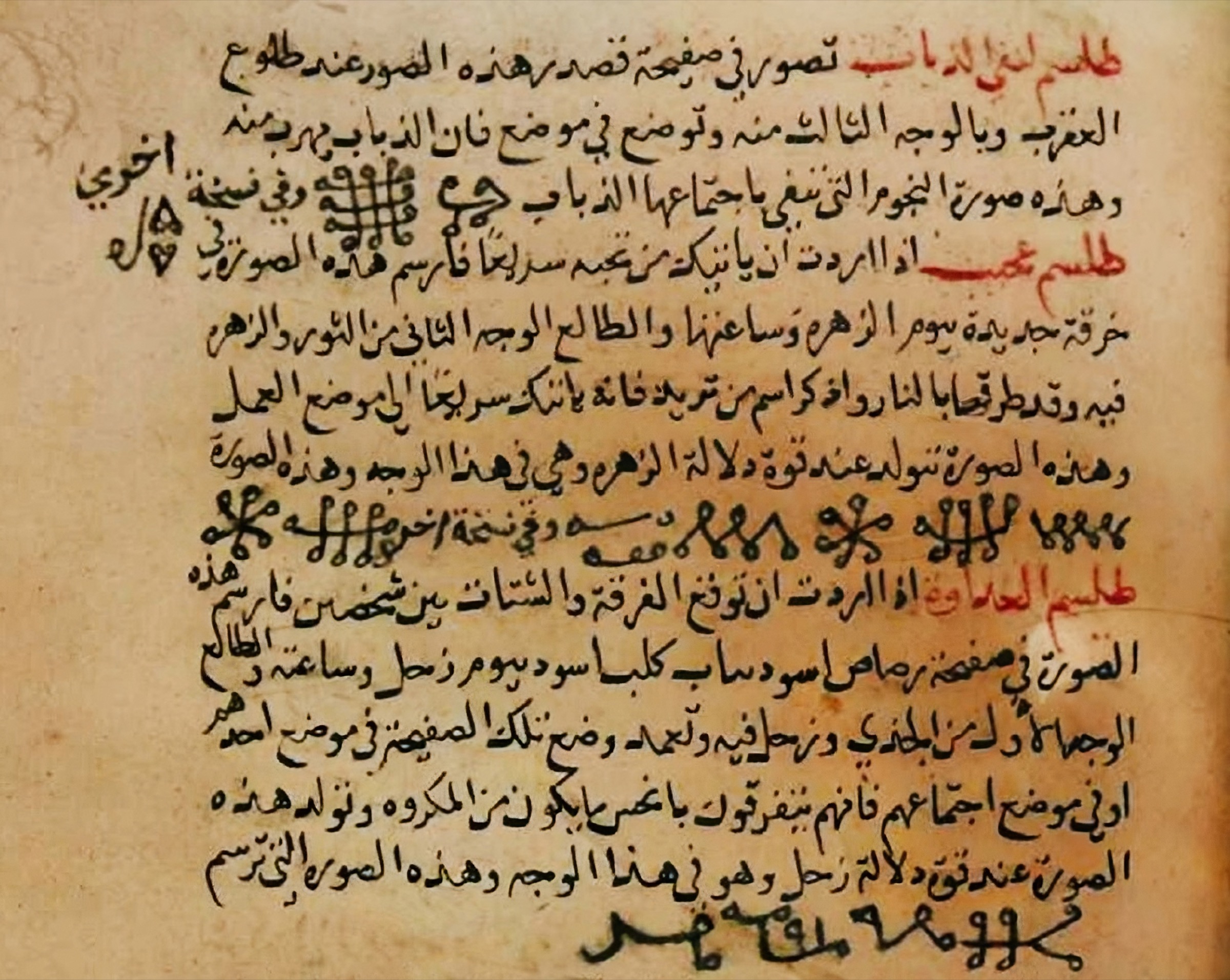
Picture: Manuscript of the attributed work. A page of the eighteenth-century Arabic Ghāyat al-ḥakīm manuscript, Riyadh MS 5751, folio 40r. It illustrates the later transmission of the work influentially attributed to Maslama al-Qurṭubī.
Credit: Unknown author. Source record, Public domain.

The round picture in the lists of the personalities is cropped from it.