




10 min read
Great Experimenter
Michael Faraday
author: High Priest Zevios Metathronos
Making Nature’s Powers Intelligible
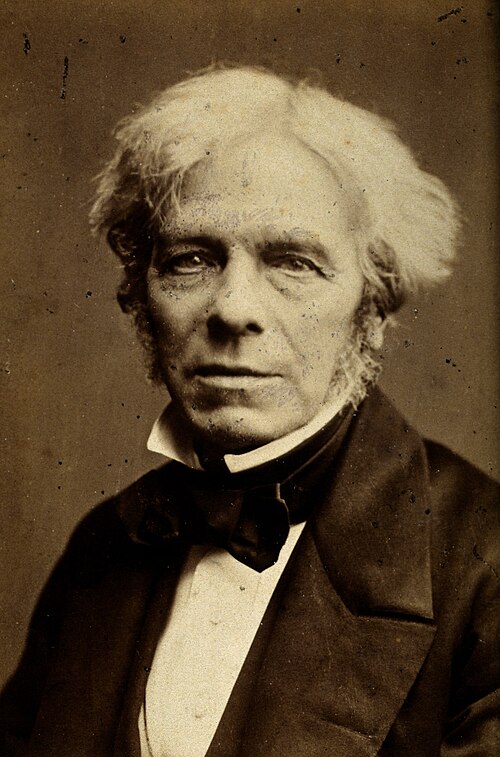
Dates: 1791–1867
Period: Imperial
Michael Faraday was a blacksmith's son from Newington Butts in Southwark. He served 7 years as a bookbinder's apprentice and ended his working life as Director of the Laboratory of the Royal Institution in London.1
His greatest single result came on 29 August 1831. He wound 2 coils of copper wire on an iron ring, sent a current through 1 of them and caught a brief current in the other. That was electromagnetic induction, the conversion of magnetism into electricity, and the Royal Institution counts the ring as the first electric transformer.2
Zevism reads Faraday's life as a lamp carried into darkness. The powers he found had always acted in the world, unseen, and he made them visible on a laboratory bench. His work stands under Prometheus, who gave mortals fire and the arts.
LIFE AND CONTEXT
Faraday was born on 22 September 1791, the son of a blacksmith who belonged to the Sandemanian church. From 1805 to 1812 he was apprenticed to the bookbinder George Riebau. He later wrote that “whilst an apprentice, I loved to read the scientific books which were under my hands.”3
The notes he took at Humphry Davy's lectures won him a post as laboratory assistant at the Royal Institution in March 1813, and in October he left with Davy for a tour of the Continent. MacTutor quotes the verdict of his biographer T. Martin: “These eighteen months abroad had taken the place, in Faraday's life, of the years spent at university by other men.”4
The year 1821 brought a wife and a quarrel. He married Sarah Barnard, whom he'd met at the Sandemanian church. On 3 September he saw a current-carrying wire circle a magnetic pole, and within a month he'd published the result. Davy then accused him of plagiarism, angry that he hadn't credited William Hyde Wollaston, who had studied rotary motion with currents and magnets.5
The quarrel didn't stop his rise. He became Director of the Laboratory in 1825 and Fullerian Professor of Chemistry in 1833, keeping both posts for life. He also taught chemistry at the Royal Military Academy in Woolwich from 1830 to 1851 and advised Trinity House, the lighthouse authority, from 1836 to 1865.1
He declined the presidency of the Royal Society twice, though he accepted a Civil List pension in 1836 and, in 1858, a Grace and Favour house at Hampton Court. He died there on 25 August 1867. His church life as a Sandemanian runs through his published correspondence.6
ATTAINMENTS
- On 3 September 1821 he made a wire carrying a current rotate around a magnet fixed upright in a vessel of mercury. The historian Allison Marsh dates the electric motor from this experiment.7
- He liquefied chlorine in 1823.8
- He isolated benzene, which he called “bicarburet of hydrogen,” while studying why the Portable Gas Works' oil gas was losing its power, and announced it to the Royal Society on 16 June 1825.9
- He discovered electromagnetic induction on 29 August 1831 and read the paper to the Royal Society on 24 November 1831 as the 1st series of his Experimental Researches in Electricity.10
- In his work on electrolysis in the early 1830s he coined words still in use, among them electrode, cathode and ion. For the names of the poles he consulted William Whewell, who wrote on 25 April 1834: “I think anode and cathode much the best.”11
- In 1845 he found the magneto-optical effect, a magnetic field acting on light, and diamagnetism, the repulsion of matter by a magnet. He went on to formulate a theory of the field.1
- He gave 19 series of the Royal Institution's Christmas Lectures for young people, more than anyone before or since, from his first in 1827 to The Chemical History of a Candle in 1860.12
KEY STORIES
The Notes in a Quarto Volume
Faraday told this story himself, in a letter to Dr John Ayrton Paris dated 23 December 1829. As a bookseller's apprentice he'd been “very fond of experiment, and very averse to trade.” A member of the Royal Institution took him to hear some of Humphry Davy's last lectures in Albemarle Street. “I took notes, and afterwards wrote them out more fairly in a quarto volume.”13
His “desire to escape from trade, which I thought vicious and selfish,” pushed him to write to Davy directly and ask for any opening in science. With the letter he sent the notes.
Davy answered on 24 December 1812. He was “far from displeased with the proof you have given me of your confidence, and which displays great zeal, power of memory, and attention.” He was leaving town and couldn't see the young man until the end of January.14
Early in 1813 Davy called him in and told him of the post of assistant in the laboratory, “then just vacant.” Faraday walked into the Royal Institution early in March 1813. By October he was crossing to the Continent with Davy “as his assistant in experiments and in writing.”14
The Ring of 29 August 1831
Faraday had spent years trying to make magnetism give electricity. In the summer of 1831 he had a ring welded from soft round bar iron, “the metal being seven-eighths of an inch in thickness, and the ring six inches in external diameter.” He wound copper wire on opposite sides of it in 2 coils, insulated with cotton. The Royal Institution reckons the winding took about 10 working days.15
He wired coil B to a galvanometer 3 feet away and connected coil A to a battery of 10 pairs of plates. The needle jumped at once, “but though the contact was continued, the effect was not permanent, for the needle soon came to rest in its natural position.” When he broke the battery contact, the needle swung hard again, “in the contrary direction.” With 100 pairs of plates the impulse was enough “to make the needle spin round rapidly four or five times.”16
A steady current did nothing; only a change produced the effect. On 23 September he wrote to his friend Richard Phillips: “I am busy just now again on Electro-Magnetism and think I have got hold of a good thing but can't say; ‘it may be a weed instead of a fish that after all my labour I may at last pull up.’” It was a fish, and he read the paper to the Royal Society on 24 November.17
A Candle for a Juvenile Audience
At Christmas 1860 Faraday, 69 years old, gave his last series of Christmas Lectures. The subject was one he'd already taught in 1848: a candle. William Crookes edited the talks, and they came out as a book in 1861.12
“There is no better, there is no more open door by which you can enter into the study of natural philosophy, than by considering the physical phenomena of a candle,” he told the children. He'd taken the subject before, he admitted, and “were it left to my own will, I should prefer to repeat it almost every year.”18
To show why a wick draws up its fuel, he stood up “a column of salt” and poured into the plate at its foot “a saturated solution of salt which cannot absorb more.” He'd dyed it: “I have coloured the fluid, that you may see the action better.” The children watched it creep “up the salt higher and higher.” A flame they'd all seen at home became their door into chemistry, and for the Temple that's Light handed from a master to the young, the way the chain of knowledge is kept.19
White Cards in the Thames
On 7 July 1855 Faraday wrote to the Editor of The Times. “I traversed this day by steamboat the space between London and Hungerford Bridges between half-past 1 and 2 o'clock.” It was low water. “The whole of the river was an opaque pale brown fluid.”20
He'd measured it on the spot. He “tore up some white cards, into pieces moistened them so as to make them sink easily,” and “dropped some of these pieces into the water at every pier the boat came to.” Before they had sunk an inch below the surface they were indistinguishable, “though the sun shone brightly at the time.” The smell was the smell of the street gullies, and “the whole river was for the time a real sewer.” He warned that a hot season might “give us sad proof of the folly of our carelessness.”21
The hot season came 3 years later. In the summer of 1858 temperatures reached 30 degrees and stayed high for weeks, and the stink reached Parliament. A bill to fund a new sewer became law in 18 days.22
THE ZEVIST READING
Zevism holds that unexplored darkness is ground to be walked into with a light, and that explored darkness becomes Light, which is knowledge. Induction had always been at work in the world, and nobody had seen it. Faraday built a ring, watched a needle jump and fall still, and brought a hidden law into view.
The candle belongs to Prometheus. In Aeschylus the Titan says he stole “the source of fire that has proved a teacher to mortals in every art,” and later that “every art possessed by man comes from Prometheus.”23 Faraday took the commonest form of that fire, a household candle, and turned it into a course of chemistry for children. The Temple reads the lectures as the Promethean gift completed: first the fire, then the art of understanding it.
The Thames letter falls under Ma'at. Egyptian religion named Ma'at “the personification of truth, justice, and the cosmic order” and set her against isfet, disorder.24 A river turned to sewage is Izfet in physical form. Faraday answered it with a measurement anyone could repeat, white card vanishing within an inch of the surface, and a public warning in plain words. Measurement is how Ma'at is restored.
Faraday was a Sandemanian Christian, and that faith belongs to his own record. The Temple's claim concerns the work. A bookbinder's apprentice who rose by his own notes, then gave away what he'd found to anyone who would come to the lecture theatre, lived the path Plato named ὁμοίωσις θεῷ κατὰ τὸ δυνατόν, likeness to the divine “as far as possible.”25
NOTES
1 Royal Institution, “Michael Faraday (1791–1867)”.
2 Royal Institution, “Michael Faraday's ring-coil apparatus”.
3 Royal Institution, “Michael Faraday (1791–1867)”; O'Connor and Robertson, “Michael Faraday,” MacTutor.
4 Paris, The Life of Sir Humphry Davy, vol. 2; O'Connor and Robertson, “Michael Faraday”.
5 O'Connor and Robertson, “Michael Faraday”; Allison Marsh, “200 Years Ago, Faraday Invented the Electric Motor,” IEEE Spectrum, 27 August 2021.
6 Royal Institution, “Michael Faraday (1791–1867)”; Royal Institution, “Michael Faraday's correspondence”.
8 O'Connor and Robertson, “Michael Faraday”.
9 Katy Duncan, “The Tiny Vial That Changed the World: Benzene at 200,” Royal Institution, 16 June 2025.
10 Faraday, Experimental Researches in Electricity, vol. 1, §§1, 27–31.
11 Royal Institution, “Michael Faraday (1791–1867)”; Whewell to Faraday, 25 April 1834, Epsilon.
12 Royal Institution, “History of the Christmas Lectures”.
13 J. A. Paris, The Life of Sir Humphry Davy, vol. 2.
14 Paris, Life of Davy, vol. 2.
15 Faraday, Experimental Researches, §27; Royal Institution, ring-coil apparatus.
16 Faraday, Experimental Researches, §§28, 31.
17 Faraday to Phillips, 23 September 1831, Epsilon.
18 Faraday, The Chemical History of a Candle, Lecture I.
19 Faraday, Chemical History of a Candle, Lecture I.
20 Faraday to the Editor of The Times, 7 July 1855, Epsilon.
21 Faraday to The Times, Epsilon.
22 London Museum, “The Great Stink of 1858”.
23 Aeschylus, Prometheus Bound 109–111, 507, tr. H. W. Smyth.
BIBLIOGRAPHY
Royal Institution, “Michael Faraday (1791–1867)”, biographical summary, posts held and publications.
Royal Institution, “Michael Faraday's ring-coil apparatus”, object record, August 1831.
Royal Institution, “Michael Faraday's correspondence”, descriptions of the published volumes and his Sandemanian church life.
Royal Institution, “History of the Christmas Lectures”; Katy Duncan, “The Tiny Vial That Changed the World: Benzene at 200”, Royal Institution, 16 June 2025.
Michael Faraday, Experimental Researches in Electricity, vol. 1, Project Gutenberg; 1st series, read 24 November 1831, §§1, 27–31.
Michael Faraday, The Chemical History of a Candle, edited by William Crookes, Project Gutenberg; Lecture I.
John Ayrton Paris, The Life of Sir Humphry Davy, vol. 2, Project Gutenberg; Faraday to Paris, 23 December 1829, with Davy's reply of 24 December 1812.
Ɛpsilon: The Michael Faraday Collection: Faraday to Richard Phillips, 23 September 1831; William Whewell to Faraday, 25 April 1834; Faraday to the Editor of The Times, 7 July 1855. Also printed in The Correspondence of Michael Faraday.
J. J. O'Connor and E. F. Robertson, “Michael Faraday”, MacTutor History of Mathematics, University of St Andrews.
Allison Marsh, “200 Years Ago, Faraday Invented the Electric Motor”, IEEE Spectrum, 27 August 2021.
London Museum, “The Great Stink of 1858”.
Aeschylus, Prometheus Bound 109–111, 507, tr. Herbert Weir Smyth, Theoi Classical Texts Library; Encyclopaedia Britannica, “Maat”; Plato, Theaetetus 176a–b, Perseus Digital Library.
CREDIT
Picture: Michael Faraday, photographed by John Watkins; Wellcome Collection V0026346.
John Watkins / Wellcome Collection, V0026346, CC BY4.0 / Wikimedia Commons. Image record, CC BY 4.0.

The round picture in the lists of the personalities is cropped from it.