



9 min read
Consul of Philosophers
Michael Psellos
author: High Priest Zevios Metathronos
Dates: 1018–c. 1078 CE; death date uncertain
Period: Ignorance (1000–1336 CE)
Michael Psellos was a Byzantine courtier, teacher and historian who held the title “Consul of the Philosophers” and taught every branch of philosophy in 11th-century Constantinople. He served a long line of emperors, argued with a rebel general inside the general's own tent, and wrote the Chronographia, a history of the imperial court from 976 told by a man who'd stood in its rooms.1
His greatest attainment was to read the whole Platonic succession, from Plato through Plotinus, Porphyry and Iamblichus to Proclus, and to put it back into teaching. He's also the earliest surviving source for 36 of the Chaldaean Oracles, oracular verses that appear to have reached him through Proclus.2
Psellos was a Christian and said so in his writings. Zevism reads his work as the keeping of a source: the Hellenic chain of Plato's successors, carried through a Christian capital by a man who loved it.
LIFE AND CONTEXT
He was born in Constantinople in 1018 and baptised Constantine. He took the name Michael later, and it's the name that stuck. His teacher was John Mauropous, then a private tutor in the city and afterwards Archbishop of Euchaita.3
He rose through the imperial secretariat. By 1042 he'd been acting “for a long time” as secretary to the emperor Michael V and had just been admitted to the ceremonies of the imperial presence. Under Constantine IX Monomachos, who came to the throne that year, he was in his 25th year and deep in study. He credits his speaking for his advancement: “it was the eloquence of my tongue that, so to speak, proved to be my fore-runner.”4
Constantine IX became his chief patron. In 1045 he was put at the head of the philosophy faculty in the newly founded imperial school, and he taught there with the title of Consul of the Philosophers. His lectures ran from Aristotle's logic to Plato and the Neoplatonists, and he wrote many short treatises on questions raised, at least in part, by his pupils.5
Court favour didn't last. Threatened with a reversal near the end of Constantine IX's reign, he withdrew to a monastery in 1054. Hussey's verdict is blunt: he “soon realized his total lack of vocation” and came back once it was safe. The empress Theodora recalled him in 1055–56 to run her government, and he kept high office down to the reign of his own former pupil, Michael VII Doukas, from 1071 to 1078.6
The date of his death is uncertain, conventionally about 1078. He had written the last part of the Chronographia, probably late in Michael VII's reign, after seeing the emperor's son born in 1075. His pupil John Italos succeeded him as Consul of the Philosophers, and in 1082 the Church put Italos on trial and condemned him for applying philosophical analysis and logic to theology.7
ATTAINMENTS
- He held the chair of philosophy in the imperial school of Constantinople from 1045 as Consul of the Philosophers and taught all its branches.8
- He wrote the Chronographia, which picks up from the historian Leo the Deacon at Basil II's accession in 976 and runs to the abdication of Isaac Komnenos in 1059, with a continuation written after 1075.3
- He commented on and paraphrased parts of Aristotle's Organon, including On Interpretation and the Prior Analytics, and adapted the system of Proclus's Elements of Theology “with some modifications.”9
- He's the earliest surviving source for 36 of the Chaldaean Oracles, verses that appear to have reached him from Proclus.10
- About 500 of his letters survive, along with a large body of short treatises and the compendium De omnifaria doctrina, On All Kinds of Learning.9
- He wrote literary and art criticism: a comparison of the novels of Heliodorus and Achilles Tatius, essays on Euripides and George of Pisidia, and discussions of ancient works of art and of beauty.11
KEY STORIES
The Voyage to the Harbour of Proclus
Psellos tells the story of his education in Book VI of the Chronographia, and by the end it has turned into a sea voyage. “Philosophy, when I first studied it, was moribund as far as its professors were concerned, and I alone revived it, untutored by any masters worthy of mention.” One teacher sent him on to another, and the last sent him to Aristotle and Plato.12
“Starting from these authors I completed a cycle, so to speak, by coming down to Plotinus, Porphyry, and Iamblichus.” Then came the landfall: “continuing my voyage, I put in at the mighty harbour of the admirable Proclus.” From there he climbed to mathematics, which he placed midway between the study of bodies and the ideas themselves. “I devoted time to the study of music and astronomy, as well as to their various subsidiary arts.”13
He didn't keep philosophy and style apart. “Thus, from time to time, when I compose an oration, I introduce some scientific proof, not without some elegance.”14 The claim to have revived philosophy alone belongs to his self-portrait; Hussey records that John Mauropous taught him.3 The reading list itself is exact, and it follows the order in which the Platonic tradition had grown.
The Blinding at the Studite Monastery
In 1042 the emperor Michael V sent the empress Zoe to a convent, and the city rose. “The indignation, in fact, was universal and all were ready to lay down their lives for Zoe.” Psellos, the emperor's secretary, was standing at the palace entrance. “I straightway mounted my horse, and going through the midst of the city I saw with my own eyes the sight which now I can hardly believe.”15
Michael and his uncle, the nobilissimus Constantine, fled by ship to the holy Studite monastery and took refuge at the altar. Psellos went in with the officer sent to fetch them. His anger went out of him at the sight: “I stood there dumbfounded, mute with astonishment,” and then “a flood of tears beyond control poured from my eyes.”16
The men sent by Theodora's party had orders “to burn out the fugitives's eyes, as soon as they saw them outside the sacred building.” The uncle lay down on his back. “There was no change of colour in his face, no crying out, no groaning.” The deposed emperor, watching, was “beating his hands together, smiting his face and bellowing in agony.” Psellos wrote down both men exactly as he saw them.17
The Embassy to Isaac Komnenos
On 20 August 1057 the rebel general Isaac Komnenos beat the army of the aged emperor Michael VI at Petroë, and Michael sent Psellos to treat with him. “I would not voluntarily undertake such a commission,” Psellos protested, and went anyway, with 2 senators. The offer was the rank of Caesar, with Isaac subject to the emperor. His colleagues pushed him forward to speak because, “unlike themselves, I was a philosopher.”18
He faced Isaac on a gilded couch inside a tent ringed with soldiers, and he argued in plain speech modelled on Lysias. “Honour your father in his old age, and you will inherit the throne by legal means.” Then “a cry rose up behind me, a cry which from that moment has never ceased to ring in my ears.” Isaac quieted it: “This man has said nothing at all which gives the appearance of chicanery or wilful deception.”19
Then messengers arrived. The city had risen, and Michael VI had been forced to abdicate; he gave up the throne on 31 August, and Isaac was crowned the next day. Psellos waited in the camp for his executioners, “petrified with fear.” Instead Isaac talked to him plainly about the cares of the empire and asked his opinion on the best way to govern. He'd gone into that camp armed with speech alone, the envoy's weapon that belongs to Hermes, and he came out adviser to the next emperor.20
THE ZEVIST READING
Zevism is the chain of all spirituality from its inception to today, and it holds that one must return to the source. Psellos walked the Hellenic stretch of that chain link by link. He began with Plato and Aristotle, went down through Plotinus, Porphyry and Iamblichus, and anchored at Proclus. Then he did what the Temple honours in every transmitter: he taught the texts, worked them into his own treatises, and became the oldest surviving witness for 36 of the Oracles.21
The Platonists he read set philosophy a single aim, stated in the Theaetetus: to become like the divine as far as possible, ὁμοίωσις θεῷ κατὰ τὸ δυνατόν.22 Psellos's plan of study is the ladder that aim requires. He put mathematics between bodies and ideas and climbed through it toward first principles. Zevism reads that climb as the meditative dimension of the path, the widening of τὸ δυνατόν, what a mind is capable of. The Chaldaean Oracles belong to the 4th dimension, theurgy, where intelligence joins the intelligence of the Gods.
His claim that philosophy was “moribund” when he found it overstates the case, but the act underneath it is real. A library that nobody reads is unexplored darkness, and it isn't evil; it's the place a mind walks into with a lamp. Psellos walked into Proclus and brought back lectures, paraphrases and short treatises that pupils could use. Explored darkness becomes light, and that's the service Zevism recognises here.
He adapted what he found to Christian theology. Zevism reads the texts he kept as the source travelling under another name, and the source keeps its priority over every adaptation. It reached the next age because a Consul of the Philosophers had read it through to the end.
NOTES
1 Ierodiakonou and Bydén, “Byzantine Philosophy,” §1.3; Hussey, introduction to the Chronographia.
2 Chronographia VI.37–38; Wheeler, “Towards a Reception History of the Chaldaean Oracles”.
4 Chronographia V.27; VI.36, VI.45.
5 Britannica, “Michael Psellus”; “Byzantine Philosophy,” §1.3.
6 Hussey, introduction; Britannica.
7 Hussey, introduction; “Byzantine Philosophy,” §1.3.
8 “Byzantine Philosophy,” §1.3; Britannica.
9 “Byzantine Philosophy,” §1.3.
11 Barber and Papaioannou, Michael Psellos on Literature and Art.
15 Chronographia V.25–27; Britannica, “Michael V”.
18 Chronographia VII.15–26; Britannica, “Isaac I Comnenus”.
20 Chronographia VII.35–42; Britannica, “Isaac I Comnenus”.
21 Wheeler.
BIBLIOGRAPHY
Michael Psellos, Chronographia, Book V, Book VI and Book VII, translated by E. R. A. Sewter, Yale University Press, 1953; Fordham Internet History Sourcebooks Project; V.25–49, VI.36–45, VII.15–42.
J. M. Hussey, Introduction to the Chronographia, in Sewter's translation, 1953; Fordham Internet History Sourcebooks Project.
Katerina Ierodiakonou and Börje Bydén, “Byzantine Philosophy,” §1.3, Stanford Encyclopedia of Philosophy, revised 2018.
Encyclopaedia Britannica, “Michael Psellus”, “Michael V” and “Isaac I Comnenus”.
Graham John Wheeler, “Towards a Reception History of the Chaldaean Oracles”, International Journal of the Classical Tradition 28 (2021), pp. 261–284.
Charles Barber and Stratis Papaioannou, editors, Michael Psellos on Literature and Art: A Byzantine Perspective on Aesthetics, University of Notre Dame Press, 2017; contents and general introduction.
Plato, Theaetetus 176a–b, Greek text, Perseus Digital Library.
CREDIT
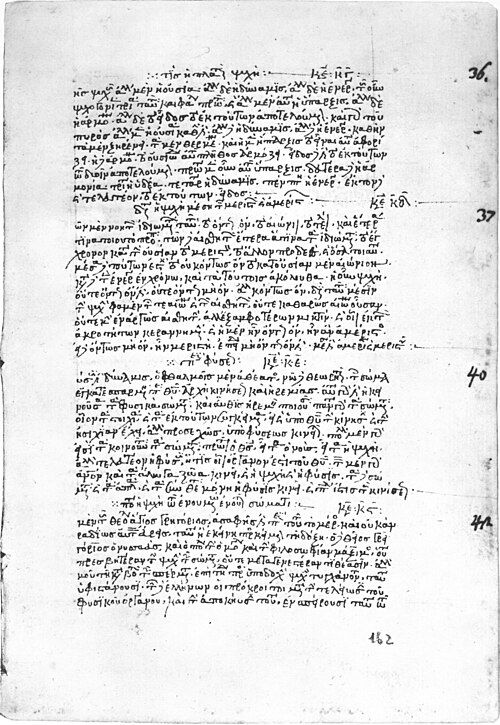
Picture: Michael Psellos’s De omnifaria doctrina in a manuscript dated 1347, Biblioteca Medicea Laurenziana, Plut. 86.15, fol. 162r. Later manuscript witness, not an autograph.
Unknown medieval scribe; text by Michael Psellos; reproduction uploaded by Πυλαιμένης; Wikimedia Commons; Public domain; faithful reproduction of a public-domain artwork. Image record, Public domain; faithful reproduction of a public-domain artwork.

The round picture in the lists of the personalities is cropped from it.