




9 min read
Father of the Novel
Miguel de Cervantes
author: High Priest Zevios Metathronos
Imagination Answerable to Life
Dates: 1547–22 April 1616
Period: Renaissance (1336–1650)
Miguel de Cervantes fought at Lepanto, spent 5 years as a captive in Algiers, went to prison in Seville over a revenue account and then wrote Don Quixote. The 1st part came out in Madrid at the start of 1605, when he was 57, and the 2nd at the end of 1615. By his own estimate, 9 editions of the 1st part and 30,000 copies were in print before he died.1
The book tells of a country gentleman who reads so many romances of chivalry that he rides out as a knight, with his neighbour Sancho Panza as his squire. He takes windmills for giants and attacks them.2
Zevism reads Cervantes under the Muses, whom Hesiod calls “a forgetting of ills and a rest from sorrow.”3 A man who'd been shot, enslaved and jailed answered those ills with a comic book, and his knight is a study in the difference between a good will and a good act.
LIFE AND CONTEXT
The surviving records place his baptism in Alcalá de Henares on 9 October 1547; the familiar birthday of 29 September is a conjecture.4
As a young man he went to Rome as chamberlain to Giulio Acquaviva, later a cardinal, who'd been sent by the Pope to Philip II at the end of 1568. In the summer of 1570 he gave up the post and enlisted as a private soldier in Captain Diego Urbina's company.5
He fought at Lepanto in October 1571 and came out of the battle with a crippled left hand. In September 1575 he sailed from Naples for Spain with his brother Rodrigo, carrying letters from Don John of Austria and the Duke of Sesa. On the 26th a squadron of Algerian galleys overpowered them. His master, Dali Mami, found the letters, concluded that his prize “must be a person of great consequence,” and scornfully refused the first ransom money as too little.6
Freedom came slowly. At last 300 ducats were got together and entrusted to Father Juan Gil, and on 19 September 1580, “after a captivity of five years all but a week,” Cervantes was set free.5
Back in Spain he lived on government work. He was made a collector of revenues for the kingdom of Granada, entrusted the money to a merchant who failed and absconded, and was sent to prison in Seville in September 1597. The balance against him was small, about 26 pounds, and he was released at the end of the year.5
Juan de la Cuesta began printing Don Quixote in late September 1604, and it was full of misprints; the success of the book led the publisher, Robles, to a 2nd edition with many of the mistakes corrected. The Novelas ejemplares followed in the summer of 1613, dedicated to the Conde de Lemos, and Part 2 was printed at the very end of 1615.7
Cervantes died in Madrid on 22 April 1616 and was buried the next day. He was a Catholic, and by his will he was laid in the neighbouring convent of Trinitarian nuns. A few years later the nuns moved to another convent and took their dead with them.8
ATTAINMENTS
- He fought aboard the galley Marquesa at Lepanto on 7 October 1571 and took 3 gunshot wounds, 2 in the chest and 1 in the left hand, which never worked again.5
- In Algiers he planned the escape of 14 fellow captives from a hiding place in a garden by the sea, and when the plot was betrayed he took the whole responsibility on himself.5
- Don Quixote, Part 1, printed by Juan de la Cuesta in Madrid, came out at the start of 1605. By his own estimate, 9 editions and 30,000 copies had appeared before his death.7
- He published the Novelas ejemplares in the summer of 1613, dedicated to the Conde de Lemos. In the prologue he claimed to be “the first who has written novels in the Spanish language,” since all the earlier ones had been translated from foreign authors.9
- Part 2 of Don Quixote appeared at the end of 1615, a decade after the 1st, and answered a rival continuation signed “Alonso Fernandez de Avellaneda” and printed at Tarragona in 1614.7
- In Part 1, chapter 14, he gave the shepherdess Marcela a speech in her own defence, an episode that the Centro Virtual Cervantes reads as structured like a trial, with witnesses, charges and a defence.10
KEY STORIES
The Post at Lepanto
On the morning of 7 October 1571 the Turkish fleet came in sight of the Christian galleys off Lepanto. Cervantes “was lying below ill with fever.” Ormsby tells what came next. “At the news that the enemy was in sight he rose, and, in spite of the remonstrances of his comrades and superiors, insisted on taking his post,” saying he “preferred death in the service of God and the King to health.”5
His galley, the Marquesa, “was in the thick of the fight.” By the end he had taken 3 gunshot wounds, 2 in the breast and 1 in the left hand or arm. He lived, but “he came out with his left hand permanently disabled; he had lost the use of it.”5
He never disowned the wound. In 1613, giving his age as “upwards of sixty-four,” he described himself in the prologue to his Exemplary Novels: “He lost his left hand by a musket-shot in the battle of Lepanto: and ugly as this wound may appear, he regards it as beautiful, having received it on the most memorable and sublime occasion” of any age. In his Viaje del Parnaso he even gave the God Mercury the task of telling him the hand was lost “for the greater glory of the right.”11
The Cave in the Garden
Cervantes didn't wait for a ransom. In a garden outside Algiers, on the shore, he and the gardener, a Spaniard, built a hiding place, and “one by one” he brought “fourteen of his fellow-captives” into it. A vessel procured by his brother Rodrigo was to take them off.5
The ship came, and a passing fishing boat scared its crew away. Then the hiding men “found themselves surrounded by Turkish troops, horse and foot.” The Dorador, as Ormsby names the traitor, “had revealed the whole scheme to the Dey Hassan.”5
Cervantes “declared aloud that the whole plot was of his contriving, and that nobody else had any share in it.” Before the Dey he said the same. He was threatened with impalement and with torture, and nothing moved him from his statement. The gardener was hanged by his master. Hassan sent Cervantes back to prison “more heavily ironed than before” and took him into his own keeping, since a man “of such resource, energy, and daring, was too dangerous a piece of property to be left in private hands.”5
The Sequel from Tarragona
In the autumn of 1614 Cervantes was working slowly through Part 2. He'd reached chapter 59 when someone put into his hand a small volume lately printed at Tarragona. It called itself the 2nd volume of Don Quixote, “by the Licentiate Alonso Fernandez de Avellaneda of Tordesillas.”5
Cervantes had invited trouble. Part 1 ended with the Italian line “forse altro cantera con miglior plettro,” perhaps another will sing with a better plectrum, and he'd given no sign of a sequel for 8 and a half years. Ormsby thought he “had no case, or a very bad one, as far as the mere continuation was concerned.” Avellaneda, however, added a preface “full of such coarse personal abuse as only an ill-conditioned man could pour out.”5
So Cervantes put everything else aside and “set himself to finish off his task.” The last half of chapter 59 and most of the chapters after it show his irritation. The genuine Part 2 was ready for the press in February and printed at the very end of 1615, a few months before he died.5
THE ZEVIST READING
Hesiod says the Muses were born to Zeus and Memory as “a forgetting of ills and a rest from sorrow,” and that when a singer, “the servant of the Muses,” chants of old deeds and the Gods, the grieving listener “forgets his heaviness and remembers not his sorrows at all.”12 Cervantes had the ills: a ruined hand, 5 years in chains, a cell in Seville. He answered them with laughter, and Zevism reads the comedy of Don Quixote as the Muses' gift, given by a man who'd known the ills it eases.
The knight himself carries a doctrine. Zevism names the andrapod, the one who lives among ruins and answers them with complaint, attack and nostalgia. Don Quixote lives in the ruins of the age of chivalry, and he attacks windmills in its name. Cervantes stood among ruins of his own, a maimed veteran with a prison record, and answered as a Creator: he built a new book out of the old romances.
The windmills also teach the Zevist doctrine of the Good. The Good is the conjunction of Ma'at, right order, and Right, the right act from the right will. Don Quixote's will is often generous, and his acts still go wrong because he doesn't see what's in front of him. Sancho's plain eyes supply the order that the knight's will lacks.13
When Sancho is about to govern his island, Don Quixote gives him the counsel of Zeus's justice: refuse gifts, weigh the merits of the case, and don't let a personal grudge decide it.14 Hesiod sets Dike, daughter of Zeus, beside her father.15 Cervantes had lived that justice in the garden at Algiers, when he took the blame for 14 men and kept it under threat of death.
NOTES
1 Ormsby, introduction to Don Quixote; Library of Congress, record of the 1605 edition.
4 Canavaggio, “Resumen cronológico de la vida de Cervantes,” Centro Virtual Cervantes.
5 Ormsby.
6 Ormsby; Canavaggio.
7 Library of Congress; Ormsby.
8 Canavaggio; Ormsby.
9 Ormsby; Cervantes, Exemplary Novels, prologue, tr. Kelly.
10 Cervantes, Don Quixote 1.14; Centro Virtual Cervantes, commentary on 1.14.
11 Cervantes, Exemplary Novels, prologue; Ormsby.
12 Hesiod, Theogony 53–55, 98–103.
13 Don Quixote 1.8.
14 Don Quixote 2.42.
15 Hesiod, Works and Days 256–262.
BIBLIOGRAPHY
Jean Canavaggio, “Resumen cronológico de la vida de Cervantes”, Centro Virtual Cervantes, Instituto Cervantes: baptism of 1547, capture of 1575, ransom of 1580, death on 22 April 1616 and burial the next day.
John Ormsby, translator's introduction to Don Quixote, 1885, Project Gutenberg: Lepanto, capture, the garden escape, ransom, Seville prison, publication, Avellaneda, Part 2, editions and burial.
Miguel de Cervantes, Don Quixote, translated by John Ormsby, Project Gutenberg; Part 1, chapters 8 and 14; Part 2, chapter 42.
Library of Congress, World Digital Library, with the National Library of Spain, The Ingenious Gentleman Don Quixote of La Mancha, Madrid: Juan de la Cuesta, 1605; printing, misprints, Robles's 2nd edition and Part 2 of 1615.
Centro Virtual Cervantes, “Lectura del capítulo XIIII,” Part 1, commentary on Marcela's defence and the episode's structure.
Miguel de Cervantes, The Exemplary Novels, translated by Walter K. Kelly, Project Gutenberg; author's prologue and dedication of 13 July 1613.
Hesiod, Theogony 53–55, 98–103, translated by H. G. Evelyn-White, Theoi Classical Texts Library.
Hesiod, Works and Days 256–262, translated by H. G. Evelyn-White, Theoi Classical Texts Library.
CREDIT
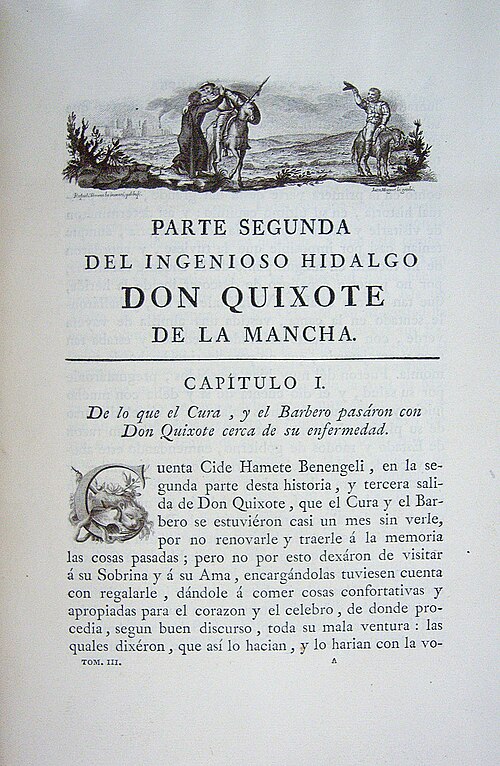
Picture: Page from the 1780 Madrid edition of Don Quixote, printed by Joaquín Ibarra; University of Navarra Library.
Joaquín Ibarra, printer; Miguel de Cervantes, author; Real Academia Española, sponsor / Wikimedia Commons; Public domain. Image record, Public domain.

The round picture in the lists of the personalities is cropped from it.