





9 min read
Master of Kokugaku
Motoori Norinaga
author: High Priest Zevios Metathronos
Exact Words and a Receptive Heart
Dates: 1730–1801 CE
Period: Enlightenment
Motoori Norinaga practised medicine for children in the town of Matsusaka and spent 34 years on the Kojiki-den, a commentary on the Kojiki in 44 volumes. He finished it in 1798, and his disciples had it fully printed by 1822, 21 years after his death.1
He was also a reader of feeling. His lectures on The Tale of Genji placed the heart of literature in “the mind that knows the pathos of things,” mono no aware o shiru kokoro.2
Norinaga served the kami under their own names. Zevism reads his philology as a return to the source under Hermes, God of language, his reading of the Genji under the Muses, and his practice among children under Asclepius.
LIFE AND CONTEXT
Norinaga was born in 1730 in Matsusaka, in Ise Province, to Ozu Sadatoshi and Okatsu, “proprietors of a cotton wholesaling business.” After his father's death he was briefly adopted into the Imaida family in Yamada, but he “had loved reading and composing poetry since childhood and showed no inclination for commerce,” and the adoption was annulled.3
In 1752 his mother sent him to Kyoto to study medicine. He trained under Hori Genkō and Takekawa Kōjun and read the Chinese classics with Hori Keizan of the Ogyū Sorai school.3
Back home he opened a practice for children. From 1758 he lectured on The Tale of Genji. In 1763 he met Kamo no Mabuchi at Matsusaka, became his disciple the next year and studied with him by letter.3
His school, the Suzunoya, “achieved a state of great influence and power,” and he travelled to lecture in other regions. In 1792 the Tokugawa lords of Kii employed him as a special lecturer. He died in the 9th month of 1801, which Britannica gives as 5 November, and he was buried on Mount Yamamuro, outside Matsusaka.4
His scholarship rested on devotion to the kami and on a sharply particular account of Japan's ancient way. Britannica says that, “rejecting Buddhist and Confucian influence on the interpretation of Shintō, he instead traced the genuine spirit of Shintō to ancient Japanese myths.” He asserted the superiority of Japan's sacred books, and his study of the classics “provided the theoretical foundation of the modern Shintō revival.”5
The English translator of the Kojiki later took the measure of the work. Chamberlain wrote that it was “perhaps the most admirable work of which Japanese erudition can boast” and that “the charm of Motowori's style will be found to shed a glamour over the driest parts of the original work.” He didn't spare it either: “The author's judgment only seems to fail him occasionally when confronted with the most difficult or corrupt passages.”6
ATTAINMENTS
- He wrote the Kojiki-den, “Forty-four fascicles in forty-four volumes,” completed in 1798. The first 5 fascicles came out in 1790 and the whole work was in print by 1822.7
- He set out a method. Fascicle 1 gives his general outline, his rules for reading the ancient words, the character of the text, and his essay Naobi no mitama, “the rectifying spirit.”7
- He put mono no aware at the centre of literary theory. The Stanford Encyclopedia of Philosophy credits him with a study of The Tale of Genji “that showed this phenomenon to be its central theme.”8
- His works include Isonokami no sasamegoto, Shibun yōryō, Naobi no mitama, Tamakatsuma, Uhiyamabumi and Genji monogatari tama no ogushi.3
- He made the Suzunoya a school of “great influence and power,” travelled to lecture in various regions and served the Tokugawa of Kii as special lecturer from 1792.3
- His commentary served Chamberlain's English translation of the Kojiki. Chamberlain wrote that most of the useful quotations from dictionaries had been “incorporated by Motowori in his ‘Commentary,’” so he rarely needed to cite them himself.6
KEY STORIES
The Doctor and The Tale of Genji
Norinaga went to Kyoto in 1752 to learn medicine. His teacher in the Chinese classics, Hori Keizan, had a library, and there Norinaga found the writings of the monk and scholar Keichū. He came home to Matsusaka, opened his practice for children and took a leading place in the town's poetry circles.3
In 1758 he began a series of lectures on The Tale of Genji, Lady Murasaki's long court novel, and he read it as a book about feeling. Out of those lectures came his position that “the core of literature” lay in “the mind that knows the pathos of things.”3
Graham Parkes and Adam Loughnane explain how wide he meant it. He argued for mono no aware as “a profound sensitivity to the emotional and affective dimensions of existence in general.” On his reading, “the greatness of Lady Murasaki's achievement consists in her ability to portray characters with a profound sense of mono no aware in her writing, such that the reader is able to empathize with them in this feeling.”8
The Night at the Shinjō-ya
In May 1763 Kamo no Mabuchi, the Edo scholar of the Man'yōshū, stopped at Matsusaka on his way back from the Ise Shrine. Norinaga met him at an inn called the Shinjō-ya. He was 33; Mabuchi was 66.9
Norinaga told him he meant to write a commentary on the Kojiki. Mabuchi said he'd hoped to do it himself, and he gave the younger man a rule for the work: “Eschew Chinese ways of thinking, he advised, and learn the language of the ancient Japanese if you would like to know their spiritual world.” The 2 men “are said to have talked through the night.”10
Mabuchi pointed him to his own work on the Man'yōshū as a foundation and handed him an annotated copy of the Kojiki. The next year Norinaga became his disciple, and instruction on the Man'yōshū went back and forth “through written correspondence.”11
The Memory of Hiyeda no Are
The Kojiki has its own origin story, and Norinaga's commentary had to reckon with it. Its preface, by the court noble Yasumaro, reports the complaint of a Heavenly Sovereign that the chronicles and the old words kept by the great families “deviate from exact truth, and are mostly amplified by empty falsehoods.”12
He found a man to hold the true version. Hiyeda no Are “was twenty-eight years old, and of so intelligent a disposition that he could repeat with his mouth whatever met his eyes, and record in his heart whatever struck his ears.” Are “was commanded to learn by heart the genealogies of the emperors, and likewise the words of former ages.”13
Years later an empress ordered Yasumaro “to select and record the old words learnt by heart by Hiyeda no Are.” Yasumaro faced a problem of script: “To relate everything in an ideographic transcription would entail an inadequate expression of the meaning; to write altogether according to the phonetic method would make the story of events unduly lengthy.” His text couldn't follow either method alone.13
More than 1,000 years later, that script was Norinaga's problem. The 1st fascicle of the Kojiki-den sets out how to read the ancient words behind the characters, and the other 43 carry the commentary through the text.7
The Men Who Printed the Commentary
After the night at the Shinjō-ya, Norinaga “commenced his transcription, textual comparison, and critical commentary on Kojiki.” He worked in stages, and at each stage he'd “circulate it among his most trusted disciples and colleagues.”7
Printing took a team. Yokoi Chiaki, a retainer of the Owari domain, pushed for publication and paid for it. Norinaga's eldest son, Motoori Haruniwa, wrote out the text that was carved into the wooden blocks, and Uematsu Arinobu worked directly on the printing. The first 5 fascicles appeared in 1790. In June 1798, “after thirty-four years of study,” the manuscript was complete.14
Norinaga didn't live to see it all in print. At his death, “up to fascicle 17 had been published.” His disciples kept going, and “twenty-one years after Norinaga had died, the entire commentary had appeared.” The Encyclopedia of Shinto calls the printed work a joint achievement of Norinaga and the Suzunoya.7
THE ZEVIST READING
Zevism holds that spirituality is one chain from its inception to today, and the chain runs through Japan under the names of its kami. Norinaga served those kami. The Temple lets them keep their names and reads his labour as a link in the chain.
His method is the Zevist rule of the source. Knowledge evolves in transmission, but the source holds priority, and one must return to it. Norinaga went back to the words Hiyeda no Are had learned by heart. Zevism honours the transmitters as keepers of the source, and here they have names: Are, Yasumaro, Norinaga, Haruniwa, who wrote out the text for the blocks, and Chiaki, who paid for them.
His medicine belongs in the reading too. The Hippocratic physicians swore “by Apollo the physician, and Asclepius, and Hygieia and Panacea and all the gods.”15 Norinaga didn't swear that oath, but his practice for children served Asclepius's work, and Zevism counts healing as the restoration of Ma'at.
Mono no aware touches the dimension of Meditation. To be moved by the world, a mind has to be open and still enough to receive it. Zevism reads that receptivity as part of the capacity of power, τὸ δυνατόν, and as a step toward likeness to the divine “as far as possible,” ὁμοίωσις θεῷ κατὰ τὸ δυνατόν.16
The Temple keeps his method and not his ranking of traditions. He asserted the superiority of Japan's sacred books; Zevism reads Japan's books and Greece's and China's as links in one chain, each honoured at its source.
NOTES
1 Motoori Norinaga Memorial Museum, “About Norinaga”; Mori Mizue, “Kojikiden,” Encyclopedia of Shinto.
2 Mori Mizue, “Motoori Norinaga,” Encyclopedia of Shinto.
4 Mori, “Motoori Norinaga”; Britannica, “Motoori Norinaga”.
5 Britannica; Mori, “Motoori Norinaga”; Mori, “Kojikiden”.
6 Chamberlain, Introduction 1.
8 Parkes and Loughnane, “Japanese Aesthetics,” §2.
9 Motoori Norinaga Memorial Museum.
10 Memorial Museum.
11 Memorial Museum; Mori, “Motoori Norinaga”.
12 The Kojiki, Preface, tr. Chamberlain.
13 Kojiki, Preface.
14 Mori, “Kojikiden”; Memorial Museum.
15 Hippocratic Oath, tr. Michael North, National Library of Medicine.
BIBLIOGRAPHY
Mori Mizue, “Motoori Norinaga,” Encyclopedia of Shinto, Kokugakuin University; birth, adoption, study in Kyoto, practice, Genji lectures, Mabuchi, the Suzunoya, Kii, works, death and burial.
Mori Mizue, “Kojikiden,” Encyclopedia of Shinto, Kokugakuin University; size, method, composition and the collaborative publication.
Motoori Norinaga Memorial Museum, Matsusaka, “About Norinaga”; the meeting at the Shinjō-ya and the completion of the Kojiki-den in 1798.
Graham Parkes and Adam Loughnane, “Japanese Aesthetics,” Stanford Encyclopedia of Philosophy, Spring 2024 edition, §2, “Mono no aware: the Pathos of Things.”
The Kojiki, translated by Basil Hall Chamberlain, 1919 edition, Internet Sacred Text Archive: Preface of Yasumaro and Introduction, section 1, “The Text and Its Authenticity.”
Hippocratic Oath, translated by Michael North, National Library of Medicine, 2002.
Encyclopaedia Britannica, “Motoori Norinaga”.
Plato, Theaetetus 176a–b, Greek text, Perseus Digital Library.
CREDIT
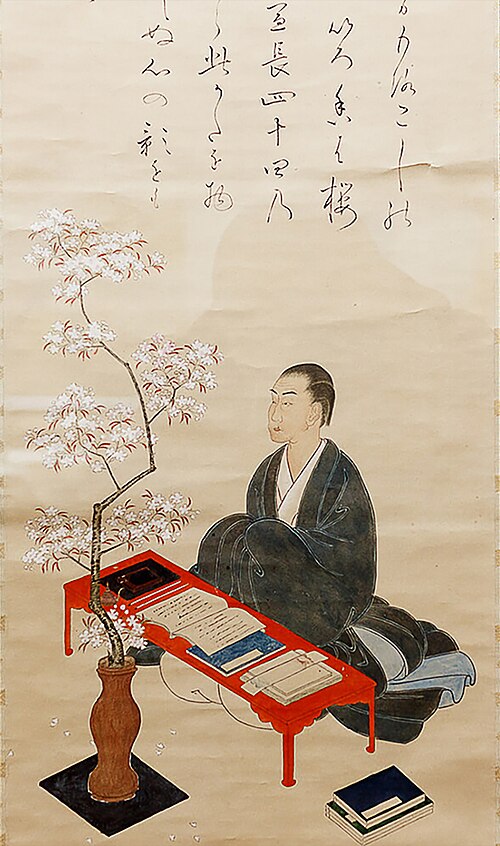
Picture: Motoori Norinaga’s self-portrait, 1773 (detail).
Motoori Norinaga; Public domain (PD-Art, author died 1801); Wikimedia Commons. Image record, Public domain (PD-Art, author died 1801).

The round picture in the lists of the personalities is cropped from it.