




9 min read
Roman Socrates
Musonius Rufus
author: High Priest Zevios Metathronos
The Divine Gift of Reason in Daily Life
Dates: c. 30–before 101/102 CE
Period: Roman period
Gaius Musonius Rufus was a Roman knight from Etruria who taught Stoic philosophy in Rome under Nero and the Flavian emperors. He was exiled twice, trained Epictetus, and left 21 discourses and 32 short sayings, all preserved by others.1
His best-known discourse answers a single question: should women study philosophy? He said yes, because “women as well as men” have received “from the gods the gift of reason,” and he drew the conclusion that daughters and sons need the same education.2
Zevism reads him as a teacher of ὁμοίωσις θεῷ in Roman dress. He taught that “of all creatures on earth man alone resembles God and has the same virtues that He has,” and he put that likeness to work in the classroom, the army camp and the senate.3
LIFE AND CONTEXT
Musonius was born before 30 CE at Volsinii, an Etruscan city, into the equestrian order. He taught in Rome in the reign of Nero, and his pupils later included Epictetus, the philosopher Euphrates of Tyre and the orator Dio of Prusa.4
In 65 CE the conspiracy of Calpurnius Piso against Nero was discovered, and Nero banished Musonius to Gyaros, which the IEP calls an “arid, desolate island” in the Aegean.5 Tacitus gives the reason in 1 line: “To Verginius Flavus and Musonius Rufus expulsion was brought by the lustre of their names; for Verginius fostered the studies of youth by his eloquence, Musonius by the precepts of philosophy.”6
He came back to Rome under Galba in 68 CE.5 The next year was civil war, and Musonius went out among the troops to speak for peace. Once the Flavians held the city, he took the informer Publius Celer to trial before the senate and won.7
Vespasian later drove the philosophers out of Rome. Cassius Dio records that he “expelled from Rome all the philosophers except Musonius,” and deported Demetrius and Hostilianus to islands.8 The exemption didn't last. Vespasian exiled him a 2nd time, and he returned only under Titus. He died before 101/102 CE.5
None of his own writings survive. The IEP notes that the reports of his teaching are in Greek, apart from the Latin testimonia of Aulus Gellius, and that he probably lectured in Greek. Centuries later the emperor Julian said Musonius became famous “because he endured his sufferings with courage and sustained with firmness the cruelty of tyrants.”9
His classroom was hard on the young. Epictetus remembered that “Rufus generally attempted to discourage” his hearers, as a test of which ones had a good natural disposition: “It is not easy to exhort weak young men; for neither is it easy to hold cheese with a hook.”10
ATTAINMENTS
- He left a body of teaching that survives as 21 longer discourses and 32 sayings, “all apparently preserved by others,” which Cora E. Lutz translated into English in 1947.11
- He argued that women should study philosophy, since they share the gift of reason and have “a natural inclination toward virtue and the capacity for acquiring it.”12
- He concluded that daughters and sons need the same schooling: “If then men and women are born with the same virtues, the same type of training and education must, of necessity, befit both men and women.”13
- He laid out a programme of training for body and soul, holding that virtue is “practical application as well” as knowledge. The exercises he named were “cold, heat, thirst, hunger, meager rations, hard beds, avoidance of pleasures, and patience under suffering.”14
- He proposed that a philosopher should live by farming and teach in the fields, where pupils would learn by “seeing him at work.”15
- He set out an ethics of the household and the table. Marriage, he argued, needs “companionship and mutual care of husband and wife,” and the right diet was a cheap lacto-vegetarian one, since food exists to nourish the body, “not to provide pleasure.”16
- He trained a generation of teachers, among them Epictetus, Euphrates of Tyre and Dio of Prusa.17
- He secured the senate's conviction of Publius Celer for false testimony against Barea Soranus, early in the Flavian regime.18
KEY STORIES
The Spade at the Isthmus
Philostratus, in his Life of Apollonius, passes on a report from the philosopher Demetrius, who stayed on at Athens even while Nero was “outraging Greece over the games.” Demetrius said he'd come upon Musonius at the Isthmus of Corinth. The philosopher was “fettered and under orders to dig,” a convict labouring on the cut through the Isthmus.19
Demetrius offered him “such consolations as he could.” Musonius didn't answer at once. He “took his spade and stoutly dug it into the earth,” then looked up and said: “You are distressed, Demetrius, to see me digging through the Isthmus for Greece; but if you saw me playing the harp like Nero, what would you feel then?”
Philostratus says Musonius's sayings were “many and remarkable,” and passes over the rest. Zevism reads the spade as the Creator's answer to ruin. The andrapod meets misfortune with complaint; Musonius met it with work and a joke at the emperor's expense.
The Philosopher Among the Soldiers
In the last days of 69 CE the Flavian armies closed on Rome. The senate chose envoys to go out to the commanders. The soldiers of Petilius Cerialis wounded the praetor Arulenus Rusticus and killed his lictor. The envoys who went to Antonius Primus got “a fairer hearing,” Tacitus says, because the general had more authority.20
“Musonius Rufus had joined these delegates.” He walked among the companies of armed men, “discoursing on the blessings of peace and the dangers of war.” Tacitus reports the result without kindness: “Many were moved to ridicule by his words, more were bored.” Some were ready to jostle him and trample him, and he stopped only when the quieter soldiers warned him and others threatened. Tacitus called it “untimely moralizing.”
The peace he argued for didn't come. The Vestal Virgins brought Antonius a letter from Vitellius asking for a day's delay, and the reply came back that by killing Sabinus and “burning the Capitol” Vitellius had made all communication between the 2 sides impossible.21
The Informer on Trial
With Vitellius dead, the senate turned to old debts. “Then Musonius Rufus attacked Publius Celer, charging him with bringing Barea Soranus to ruin by false testimony.” Tacitus explains why the case burned so hot: “Celer had been his teacher in philosophy, then had given testimony against him, thus betraying and profaning friendship, the nature of which he professed to teach.” The earliest possible day was set for the trial. Men looked forward less to Musonius or Celer than to Priscus, Marcellus “and all the rest,” Tacitus says, “for their minds were now set on vengeance.”22
When the senate took up the case again, “Publius was condemned, and the shades of Soranus were appeased.” One name on the other side stung. Demetrius the Cynic, the same philosopher whom Philostratus places beside Musonius at the Isthmus, spoke in Celer's defence, and Tacitus says the public judged that he'd shown “more selfish interest than honourable purpose” in defending a man “manifestly guilty.”23
The Capitol in a Syllogism
Epictetus studied with Musonius while he still had a master in Rome, and he kept the lessons for life. He remembered a day when Rufus “blamed me for not having discovered the one thing omitted in a certain syllogism.” The pupil answered with a joke: “I suppose that I have burnt the Capitol.” Musonius shot back: “Slave, was the thing omitted here the Capitol?”24 The Capitol had burned in the civil war of 69 CE, and the pupil reached for the gravest crime he could name. The master wouldn't let a small error hide behind a large one.
He also tested his pupil's freedom. “This and this will befall you from your master,” Musonius would say. Epictetus replied that such things happen “in the ordinary course of human affairs.” Then came the teacher's answer: “Why, then, should I ask him for anything when I can obtain it from you?”25
THE ZEVIST READING
Heraclitus opened his book with the Logos: “all things happen according to this Word,” though men don't understand it even after they've heard it.26 The Stoics took Heraclitus as the inspiration for their physics, and Musonius, a Stoic, brought that order down into the household.27 Zevism is the Logos restored, and it counts him among the teachers who kept that thread unbroken.
His argument for women's education starts from a divine gift. If reason came from the Gods to women as it came to men, then a household that leaves half its members untrained wastes what the Gods gave. That's the logic of Lecture III, and Zevism takes it as its own.12
Lecture XVII carries the argument to its summit. God is “unconquered by pleasure or greed,” “high-minded, beneficent, and kindly,” and man, “in the image of Him, when living in accord with nature, should be thought of as being like Him.”28 Plato named that aim ὁμοίωσις θεῷ κατὰ τὸ δυνατόν, likeness to the divine “as far as possible.”29 Musonius gave it a training schedule of cold, hunger and hard beds.
The Celer trial carries the same teaching into public life. False testimony is Izfet in its purest form: a lie placed in the record so that an innocent man is destroyed. Egyptian religion set Ma'at, “truth, justice, and the cosmic order,” against isfet.30 Musonius went before the senate and had the lie struck down, and the true record of Barea Soranus was restored.
NOTES
1 William O. Stephens, “Musonius Rufus,” IEP.
4 Stephens, “Musonius Rufus,” §§1, 7.
5 Stephens, §1.
7 Tacitus, Histories 3.81; Histories 4.40.
11 Stephens, “Musonius Rufus”.
12 Lecture III.
13 Lecture IV.
14 Lecture VI.
15 Lecture XI.
16 Stephens, §§4, 6.
17 Stephens, §7.
18 Tacitus, Histories 4.10, 4.40.
19 Philostratus, Life of Apollonius 5.19.
20 Tacitus, Histories 3.80–81.
26 Daniel W. Graham, “Heraclitus,” SEP, §2.
27 Graham, §7.
28 Lecture XVII.
BIBLIOGRAPHY
William O. Stephens, “Musonius Rufus”, Internet Encyclopedia of Philosophy; §§1–2, 4, 6 and 7: birth, exiles, transmission, diet, marriage, pupils and later reputation.
Musonius Rufus, Lecture III, Lecture IV, Lecture VI, Lecture XI and Lecture XVII, tr. Cora E. Lutz, Yale Classical Studies 10, 1947; transcribed at TheStoicLife.org.
Tacitus, Histories 3.80–81, 4.10 and 4.40, tr. Clifford H. Moore, Loeb Classical Library; LacusCurtius.
Tacitus, Annals 15.71, tr. John Jackson, Loeb Classical Library, vol. 5, 1937; LacusCurtius.
Cassius Dio, Roman History 65.13.2, tr. Earnest Cary, Loeb Classical Library; LacusCurtius.
Philostratus, Life of Apollonius of Tyana 5.19, tr. F. C. Conybeare, Loeb Classical Library, 1912; Livius.org.
Epictetus, Discourses 1.7 and 1.9 and 3.6, tr. George Long; Internet Classics Archive.
Daniel W. Graham, “Heraclitus”, Stanford Encyclopedia of Philosophy, §2 (fragment B1) and §7 (influence on the Stoics).
Encyclopaedia Britannica, “Maat”.
Plato, Theaetetus 176a–b, Greek text, Perseus Digital Library.
CREDIT
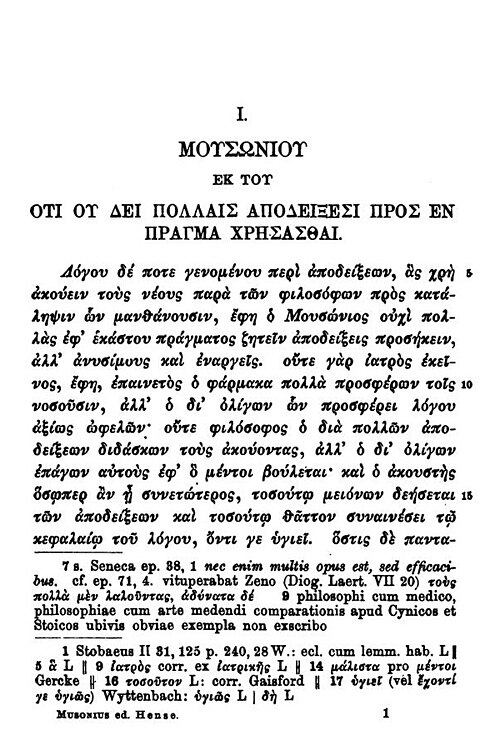
Picture: First page of Musonius Rufus’s surviving teachings in Otto Hense’s 1905 edition; a printed textual witness, not a portrait.
Musonius Rufus; editor Otto Hense; 1905 Teubner edition; Wikimedia Commons; Public domain; faithful reproduction of a public-domain artwork. Image record, Public domain; faithful reproduction of a public-domain artwork.

The round picture in the lists of the personalities is cropped from it.