




10 min read
Last King of Babylon
Nabonidus of Babylon
author: High Priest Zevios Metathronos
Restoring the Sacred Inheritance
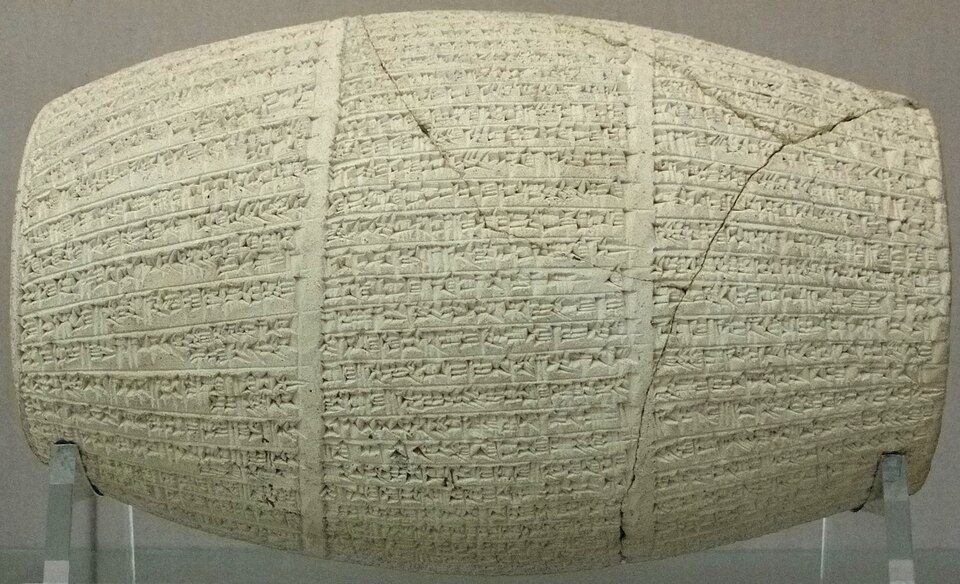
Dates: Reigned 556–539 BCE.
Period: Ancient.
Nabonidus was the last king of the Neo-Babylonian empire. He ruled Babylonia from 556 to 539 BCE, when Cyrus of Persia took the city, and he spent his reign rebuilding the houses of the moon God Sin at Harran and Ur and of the sun God Shamash at Sippar.1
His greatest attainment was a method. Before he laid a brick he dug for the first foundation of the house, and when he found the buried inscriptions of earlier kings he read them, anointed them with oil and set them back beside his own. At Sippar his workmen went down 18 cubits to reach a foundation deposit of Naram-Sin of Akkad.2
Zevism reads that digging as service to Ma'at, the right order that Zeus holds as Sovereign of the Cosmos, and as an act of return to the source. Nabonidus served that order under the names of Sin, Shamash and Marduk.
LIFE AND CONTEXT
Nabonidus came from outside the ruling house. The Encyclopaedia Iranica notes that he “was an Aramean, not a Chaldean,” and that after “a succession of three kings in a few brief years” he “seized power in May, 556.” His father was Nabû-balâssi-iqbi and his mother Adad-guppi.3
Sin came first in his devotion. A basalt stela in the British Museum shows the king beneath 3 emblems: the star of Ishtar, the winged disc of Shamash and the crescent of Sin, which is carved largest. The museum's note says he saw the moon God as supreme, “thus downgrading other gods which caused offence.”4
The offence fell on Babylon's own God. Iranica reports that the king wanted precedence for the cult of Sin, and “these reforms brought Nabonidus into conflict with the priests of Marduk in Babylon.” Around 552 BCE, when Median troops left Harran, he restored the temple of Sin there.5
Then he left his capital. For 10 years he stayed at the oasis of Tayma in northern Arabia and handed the government of Babylonia to his son Belshazzar. The Babylonian chronicle notes it in the same flat words year after year: “The king (was) in Tayma (while) the prince, his officers, (and) his army (were) in Akkad.” It sets the cost beside it. The king didn't come to Babylon, Bel didn't come out, and “The Akitu festival did not take place.”6
The end came in his 17th year. Cyrus fought the army of Akkad at Opis on the Tigris, “Sippar was captured without a battle,” and “Nabonidus fled.” Persian troops entered Babylon without a fight and took him there. Iranica says Cyrus spared his life; Britannica says Cyrus's general Gobryas captured him and sent him into exile.7
The winners wrote their version on clay. The British Museum summarises the Cyrus Cylinder's charge that Nabonidus “had perverted the cults of the Babylonian gods, including Marduk,” and “had imposed labour-service on its free population.”8
ATTAINMENTS
- He rebuilt Ehulhul, the temple of Sin at Harran, on a command he says Marduk and Sin gave him in a dream. For the work he called up his troops “from the country of Gaza on the border of Egypt” to the lands past the Euphrates, and he set beams of cedar from Lebanon above the house.9
- At Sippar he rebuilt Ebabbar, the house of Shamash, on its oldest known foundation. Nebuchadnezzar's rebuilding had sagged after 45 years; Nabonidus dug 18 cubits down to Naram-Sin's deposit and laid his brickwork on it “not a finger's breadth too wide or too narrow.”10
- He excavated, surveyed and inspected the old foundations of Eulmash, the temple of the Goddess Anunitu at Sippar-Anunitu, rebuilt it and raised her upkeep: “The regular offerings and the other offerings I increased over what they were.”11
- At Ur he repaired E-lugal-galga-sisa, the ziggurat of Sin. He first read that Ur-Nammu had built it “but not completed it” and that Shulgi his son had finished it, then restored it on their foundations “as in former times, with bitumen and baked bricks.” The cylinder dates to about 540 BCE.12
- He kept the records of earlier kings. At Harran he returned an inscription of Ashurbanipal of Assyria to its place beside his own, and his cylinders ask every future builder to do the same for him.13
- His foundation texts survived in several copies. BM 91109, a fired clay cylinder 22.86 centimetres high, was excavated by Hormuzd Rassam in the temple of Shamash at Sippar; another copy, dug from the royal palace at Babylon, is in the Pergamon Museum in Berlin.14
- He held Tayma for a decade and, even by his enemies' account, “built there a palace like the palace in Babylon.”15
KEY STORIES
The Dream of Marduk and Sin
“In the beginning of my everlasting reign they sent me a dream,” the Sippar cylinder begins its tale. Marduk, the great lord, and Sin stood together, and Marduk gave the order: “Nabonidus, king of Babylon, carry bricks on your riding horse, rebuild Ehulhul and cause Sin, the great lord, to establish his residence in its midst.”16
The king answered with a soldier's objection. Harran was in Median hands. “That temple which you ordered me to build, the Mede surrounds it and his might is excessive.” Marduk's reply was short: “The Mede whom you mentioned, he, his country and the kings who march at his side will be no more.”17
The text names the instrument. In the 3rd year the Gods “aroused him, Cyrus, the king of Anšan,” who “scattered the vast Median hordes with his small army” and took Astyages captive to his own country. The chronicle tells the same fall from the Median side: “The army rebelled against Astyages and he was taken prisoner.”18
With Harran free, Nabonidus built. He cleared the foundations “on the foundation deposit of Aššurbanipal, king of Assyria, who had found the foundation of Šalmaneser,” so 3 kings stood in one trench. “I mixed its mortar with beer, wine, oil and honey,” he wrote, and he hung “doors of cedar wood, whose scent is pleasing” at its gates.19
The Foundation of Naram-Sin
Ebabbar, the house of Shamash at Sippar, was failing. Nebuchadnezzar had rebuilt it after searching for its old foundation deposit without finding it, and “after forty-five years the walls of that temple had sagged.” Nabonidus went looking for what his predecessor had missed.10
He cleared the debris and set men digging. “I dug to a depth of eighteen cubits into the ground,” he wrote, and there “Šamaš, the great lord, revealed to me the original foundations of Ebabbar,” the deposit of “Naram-Sin, son of Sargon,” “which no king among my predecessors had found in three thousand and two hundred years.”17
The figure is too high. Paul-Alain Beaulieu, who translated the cylinder, notes that Naram-Sin was Sargon's grandson and reigned about 2255–2218 BCE, so the king's estimate is “about twice the real time.” The find itself was real. Nabonidus set his walls on the old line, “not a finger's breadth too wide or too narrow.”20
At Harran he'd already found an inscription “written in the name of Aššurbanipal,” and he'd done what he now asked of others: “I anointed it with oil, performed a sacrifice, placed it with my own inscription, and returned it to its place.” The cylinder closes by turning to a future king, “whoever you are,” and asks him to “find the inscription written in my name and not alter it.” Hormuzd Rassam dug a copy out of the temple of Shamash, and it's now BM 91109.21
A Decade in Tayma
As his 3rd year was about to begin, the Verse Account says, Nabonidus “entrusted the army [?] to his oldest son, his first born,” and “turned to Tayma deep in the west.” The poem is hostile. Livius's introduction reads it as evidence of “strong rumors” in his lifetime “that the king suffered from a mental illness and proposed a religious reform.”15
It tells the march in hard words. “When he arrived there, he killed in battle the prince of Tayma, slaughtered the flocks of those who dwell in the city as well as in the countryside.” Then he stayed, “made the town beautiful” and built a palace to match the one he'd left.22
Back in Babylonia a chronicler kept the count: the king in Tayma, the prince and the army in Akkad, the New Year festival not held. In the 17th year the entry changes. Nabu came from Borsippa for the procession, Bel came out, and the festival was performed again.23
It came too late. Within months Cyrus was at Opis, and after the city fell “the gods of Akkad which Nabonidus had brought to Babylon returned to their places.”24
THE ZEVIST READING
Zevism holds that spirituality is one chain from its inception to today, and Nabonidus is a link in its Mesopotamian length. He served under the names of Sin, Shamash, Anunitu and Marduk, and the Temple lets his Gods keep those names. It reads the order he tended as the order Zeus holds as Sovereign of the Cosmos.
His defining act was a return to the source. A temple set on a guessed line sagged after 45 years; a temple set on the first foundation took its measure from the builders of Akkad. Zevism holds that knowledge changes in transmission while the source keeps priority. Nabonidus applied that rule with spades. He went down until he reached the original, then built upward from it.
Ma'at gives the 2nd measure. Egyptian religion named her “the personification of truth, justice, and the cosmic order” and set her against isfet.25 A sagging wall is Izfet in brick, and so is an old record scraped away to make room for a new name. Nabonidus answered both: courses true to a finger's breadth, and an Assyrian king's inscription anointed and put back. Zevism honours keepers of the source in whatever language they wrote.
The Good in Zevism is the conjunction of Ma'at and Right, the right order and the right act from a right will. Nabonidus's devotion to Sin is plain on his stela and his cylinders, and his buildings are in the record. Yet year after year Babylon's New Year festival went unperformed while he stayed in Arabia, and his own subjects and priests remembered it. The Temple honours the builder and measures the king by both halves.
Plato set the aim of the path as likeness to the divine “as far as possible,” ὁμοίωσις θεῷ κατὰ τὸ δυνατόν.26 His closing appeal shows that he knew a temple outlives its builder only if the next builder keeps faith. He asked to be found and left unaltered, and the cylinder Rassam lifted from the temple of Shamash still reads as he wrote it.
NOTES
1 Britannica, “Nabonidus”; British Museum, stela 90837.
2 Nabonidus Cylinder from Sippar, ii.43b–iii.10.
3 Dandamayev, “Babylonia i,” Encyclopaedia Iranica; Livius, “Nabonidus”.
4 British Museum, stela 90837.
5 Dandamayev, Encyclopaedia Iranica.
6 Nabonidus Chronicle, ABC 7, ii.5–6; Iranica.
7 ABC 7, iii.12–16; Britannica.
8 British Museum, Cyrus Cylinder 90920.
10 Sippar Cylinder, ii.47–iii.10.
11 Sippar Cylinder, iii.22–38.
12 Nabonidus Cylinder from Ur.
13 Sippar Cylinder, ii.43b–46, iii.43–51.
14 British Museum, 91109; Livius, Sippar Cylinder, introduction.
15 Verse Account of Nabonidus.
16 Sippar Cylinder, i.8–ii.25.
17 Sippar Cylinder.
18 Sippar Cylinder; ABC 7, ii.1–2.
20 Sippar Cylinder, with Beaulieu's note.
21 Sippar Cylinder, ii.43b–46, iii.43–51; British Museum, 91109.
22 Verse Account.
24 ABC 7, iii.12–22.
BIBLIOGRAPHY
Nabonidus Cylinder from Sippar, translated by Paul-Alain Beaulieu, Livius; introduction, i.8–ii.46, ii.47–iii.10 with editorial note, iii.22–38 and iii.43–51.
Nabonidus Cylinder from Ur, translated by Paul-Alain Beaulieu, Livius; the ziggurat of Ur-Nammu and Shulgi, the prayer to Sin and the date of about 540 BCE.
Nabonidus Chronicle (ABC 7), translated by A. K. Grayson with later revisions, Livius; ii.1–6 and iii.5–22.
Verse Account of Nabonidus, translated by A. Leo Oppenheim in J. B. Pritchard, Ancient Near Eastern Texts Relating to the Old Testament, 1950, Livius; with the page's introduction.
Livius, “Nabonidus”, biographical data sheet; parentage.
British Museum, foundation cylinder of Nabonidus, 91109, museum number 1882,0714.1025; description, findspot, dimensions and excavator.
British Museum, stela of Nabonidus, 90837, museum number 1825,0503.99; description and curator's comment.
British Museum, the Cyrus Cylinder, 90920, museum number 1880,0617.1941; curator's summary of the text.
Muhammad A. Dandamayev, “Babylonia i. History of Babylonia in the Median and Achaemenid Periods”, Encyclopaedia Iranica.
Encyclopaedia Britannica, “Nabonidus”.
Encyclopaedia Britannica, “Maat”.
Plato, Theaetetus 176a–b, Greek text, Perseus Digital Library.
CREDIT
Picture: Clay foundation cylinder of Nabonidus, British Museum 91109. The inscribed artifact illustrates his temple-restoration record; it is not a portrait. Photograph by Fæ; CC BY-SA 3.0.

Photograph by Fæ, via Wikimedia Commons; CC BY-SA 3.0. Image record, CC BY-SA 3.0.
The round picture in the lists of the personalities is cropped from it.