



9 min read
Reformer of the Heavens
Nicolaus Copernicus
author: High Priest Zevios Metathronos
Dates: 1473–1543
Period: Renaissance (1336–1650 CE)
Nicolaus Copernicus was a canon of the cathedral chapter of Warmia, on the Baltic coast, who set the Sun at rest near the centre of the universe and put the Earth in motion around it. He published the full argument in De revolutionibus orbium coelestium, printed at Nuremberg in 1543, the year of his death.1
The book gave the Earth a daily rotation and a yearly circuit between Venus and Mars, with the Moon travelling beside it. The backward loops of the planets then became, in his words, “not movements of the planets, but a motion of the earth.”2
Copernicus called the cosmos “this most beautiful temple” and judged it “highly unlikely” that anyone without knowledge of the heavens could “become and be called godlike.” Zevism reads his work as service to the order of the cosmos that Zeus holds as its Sovereign, and as a step on the path Plato named ὁμοίωσις θεῷ, likeness to the divine.
LIFE AND CONTEXT
He was born at Toruń on 19 February 1473, the youngest of 4 children of a merchant who had moved there from Cracow and of Barbara Watzenrode. His father died in 1483, and his maternal uncle Lucas Watzenrode, bishop of Warmia from 1489, took charge of his education and his career in the church.3
He enrolled at Cracow in 1491, and his brother Andreas's name stands beside his on the matriculation records of 1491–92.4 At Bologna from 1496 he lived with the astronomy professor Domenico Maria Novara and made his first observations. He then studied medicine at Padua, on leave granted on 27 July 1501, and in the spring of 1503 took a doctorate in canon law at Ferrara.5
His uncle had arranged his election in 1495 as a canon of the cathedral chapter at Frombork, “an administrative position just below that of bishop.”3 He was a Catholic cleric, and church office, medicine and astronomy ran together through his working life. He was his uncle's physician and kept an observatory in the rooms he lived in, in one of the towers of Frombork's fortifications.4
He adopted the heliocentric theory sometime between 1508 and 1514.3 He wasn't the first to move the Earth, and he didn't pretend to be. His system still turned on uniform circular motions and epicycles, and it didn't settle every question of observational accuracy.6 He died of a cerebral haemorrhage on 24 May 1543.4
ATTAINMENTS
- He published De revolutionibus in 1543, a full mathematical system of 6 planetary spheres around the Sun: Saturn in 30 years, Jupiter in 12, Mars in 2, the Earth with the Moon in 1, Venus in 9 months and Mercury in 80 days.7
- He explained the stations and retrogradations of the planets as effects of the Earth's own motion.8
- In the Commentariolus of about 1514 he set out his assumptions, among them that the universe is much larger than had been thought and that the distance from the Earth to the Sun is a small fraction of its size.3
- He took a doctorate in canon law at Ferrara in 1503 after studying at Cracow, Bologna and Padua, where he read medicine.4
- As administrator of the districts of Allenstein and Mehlsack from 1516, he organised the defence of Allenstein castle in the war that began late in 1519, and the castle held.4
- He wrote on coinage against the debasement of the currency and presented a plan of reform to the Diet of Graudenz in 1522.5
KEY STORIES
The Little Handwritten Book
Around 1514, MacTutor records, Copernicus “distributed a little book, not printed but hand written, to a few of his friends.” It came to be called the Commentariolus, the Little Commentary, and it was never printed in his lifetime.9
In a few pages it set out the whole programme as a list of assumptions. The Earth is the centre only of gravity and of the Moon's orbit. All the spheres encircle the Sun, which lies close to the centre of the universe. The universe is much larger than had been assumed, so the distance from the Earth to the Sun is a small fraction of its size. The daily motion of the heavens and the Sun's yearly path, and the backward loops of the planets, come from the Earth's own motion.3
The proofs would take him another 29 years, and he wouldn't see them in print until the year he died.4
The Canon Who Held Allenstein
In 1516 the chapter gave Copernicus the task of administering its districts of Allenstein and Mehlsack. He was 43, a canon with a doctorate in church law and a manuscript on the planets that he showed only to friends.4
War with the Teutonic Knights broke out late in 1519. Rabin names Copernicus “a leader for West Prussia” in that war, which lasted from 1520 to 1525. At Allenstein he had to organise the defence of the castle against the attacking forces. MacTutor records the result in 3 words: “The castle resisted.”5
After the war came a plan of recovery, and Copernicus's share of it was money. He drafted an essay that “deplored the debasement of the currency and made recommendations for reform,” and took his plan to the Diet of Graudenz in 1522. The leaders of both Prussia and Poland consulted his manuscripts as they tried to steady their coinage.5
The Visitor from Wittenberg
In May 1539 a young mathematician from the University of Wittenberg arrived at Frombork. Georg Joachim Rheticus was 25, and Johann Schöner of Nuremberg seems to have persuaded him to make the journey.10
He stayed about 2 years. He studied with the old astronomer and “convinced him to publish a full-size book on his new system.” To test the waters he printed his own Narratio prima, the First Account, in 1540, 3 years before De revolutionibus itself; Ashworth counts it “one of the great rarities of the history of astronomy.”11
Rheticus then carried the manuscript to the printer Petreius in Nuremberg. When he left, Andreas Osiander, a Lutheran minister with an interest in astronomy, saw the book through the press and added an unsigned preface, “To the Reader Concerning the Hypotheses of this Work.” It told readers: “Since he [the astronomer] cannot in any way attain to the true causes, he will adopt whatever suppositions enable the motions to be computed correctly.” Copernicus's friend Tiedemann Giese and Rheticus both protested, and Rheticus struck the preface out in his own copy.3
Buried Among His Papers
The dedication to Pope Paul III tells why the book came so late. Copernicus feared “the scorn which I had reason to fear on account of the novelty and unconventionality of my opinion,” and the fear “almost induced me to abandon completely the work.” He'd thought of the Pythagoreans, who passed on philosophy's secrets “not in writing but by word of mouth.”12
Friends wouldn't let the matter rest. “Foremost among them was the cardinal of Capua, Nicholas Schönberg,” and next Tiedemann Giese, bishop of Chełmno, who “loves me dearly.” So the book appeared “after being buried among my papers and lying concealed not merely until the ninth year but by now the fourth period of nine years.”13
He had an answer ready for learned mockery: “Lactantius, otherwise an illustrious writer but hardly an astronomer, speaks quite childishly about the earth's shape, when he mocks those who declared that the earth has the form of a globe.” Then came the line that closed the argument: “Astronomy is written for astronomers.”13
The printed book reached him at the end. “On 24 May 1543 Copernicus held a copy of the finished work on his deathbed,” Rabin writes.3
THE ZEVIST READING
Copernicus wrote the cosmos as a sanctuary. “At rest, however, in the middle of everything is the sun. For in this most beautiful temple, who would place this lamp in another or better position than that from which it can light up the whole thing at the same time?” He cited “[Hermes] the Thrice Greatest,” who “labels it a visible god.”7
He closed the image with kingship: “as though seated on a royal throne, the sun governs the family of planets revolving around it.”7 Zevism reads that throne as the order of the cosmos held by Zeus as Sovereign, and the book as a true record of that order.
His own introduction sets astronomy on the path of elevation. “It is highly unlikely,” he wrote, “that anyone lacking the requisite knowledge of the sun, moon, and other heavenly bodies can become and be called godlike.”14 Plato gave that aim its classic form, ὁμοίωσις θεῷ κατὰ τὸ δυνατόν, likeness to God as far as possible.15 Zevism reads the aim as the literal elevation of human nature, and Copernicus placed the study of the heavens on that road.
The Temple teaches that one must return to the source. Copernicus did so in his own account. He “found in Cicero that Hicetas supposed the earth to move,” then in Plutarch that Philolaus, Heraclides and Ecphantus had held the same, and wrote: “having obtained the opportunity from these sources, I too began to consider the mobility of the earth.”13 He was a Catholic canon who took his starting point from ancient authors, and Zevism reads him as a link in the chain of all spirituality.
The Temple honours transmitters as keepers of the source, and this book needed them. Rheticus pressed it into print, and in 1576 Thomas Digges put Book I into English in A Perfit Description, “to a large extent, a paraphrased translation.”16 It took, as Ashworth puts it, “a hundred years for the Copernican system to be generally accepted.”17
NOTES
1 Rabin, “Nicolaus Copernicus,” Stanford Encyclopedia of Philosophy; MacTutor, “Nicolaus Copernicus”; Ashworth, “Nicolaus Copernicus”.
2 Copernicus, On the Revolutions, Book I.9–11, tr. Rosen.
3 Rabin, SEP.
4 MacTutor.
5 Rabin, SEP; MacTutor.
7 On the Revolutions, Book I.10.
8 On the Revolutions, Book I.9–11.
9 MacTutor; Rabin, SEP.
10 MacTutor; Ashworth, “Georg Joachim Rheticus”.
12 On the Revolutions, dedication.
13 Dedication.
14 On the Revolutions, Book I, introduction.
16 Dartmouth, “Thomas Digges”.
17 Ashworth, “Nicolaus Copernicus”.
BIBLIOGRAPHY
Nicolaus Copernicus, On the Revolutions, translated by Edward Rosen, Dartmouth electronic excerpt; original published 1543; dedication to Paul III, Book I introduction and chapters 9–11; Osiander's foreword is separately identified.
Sheila Rabin, “Nicolaus Copernicus”, Stanford Encyclopedia of Philosophy, 2004, revised 2023; §§1 and 2.1–2.5, for chronology, the Commentariolus, coinage, Rheticus, Osiander and the deathbed copy.
J. J. O'Connor and E. F. Robertson, “Nicolaus Copernicus”, MacTutor History of Mathematics, University of St Andrews; education, cathedral office, Allenstein, the Diet of Graudenz, Rheticus's stay and dates.
William B. Ashworth Jr., “Georg Joachim Rheticus”, Scientist of the Day, Linda Hall Library, 16 February 2015.
William B. Ashworth Jr., “Nicolaus Copernicus”, Scientist of the Day, Linda Hall Library, 19 February 2015.
Mathematics Across the Curriculum, Dartmouth College, “Thomas Digges”, on A Perfit Description of the Caelestiall Orbes, 1576.
Plato, Theaetetus 176a–b, Greek text, Perseus Digital Library.
CREDIT
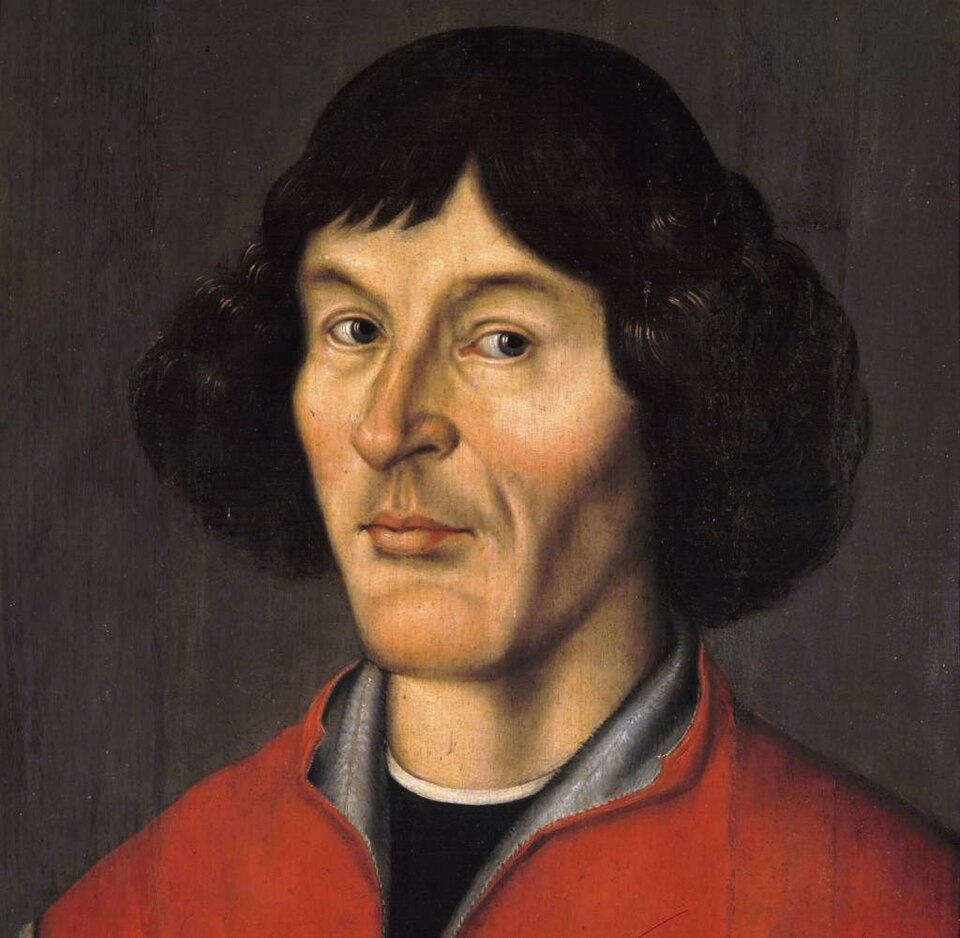
Image: The Toruń portrait of Copernicus, unknown artist, c. 1580. A later sixteenth-century portrait, public domain; not represented as a surviving painting made during his lifetime.

Unknown artist, c.1580; Wikimedia Commons; Public domain; faithful reproduction of a public-domain artwork. Image record, Public domain; faithful reproduction of a public-domain artwork.
The round picture in the lists of the personalities is cropped from it.