





10 min read
Iron Chancellor
Otto von Bismarck
author: High Priest Zevios Metathronos
Security as a Public Obligation
Dates: 1815–1898
Period: Imperial (1804–1900)
Otto von Bismarck led the Prussian government from 1862 and founded the German Empire, which he governed as its first chancellor from 1871 to 1890. He made it in 3 wars fought between 1864 and 1871, and he left office only when a new emperor forced him out.1
This collection receives him for a different work. Under his government the Reichstag passed health insurance for workers in 1883, accident insurance in 1884 and old-age and invalidity insurance in 1889, the world's first state old-age insurance program.2
Zevism reads that legislation under Zeus, the sovereign who guards law, and under Ma'at, the order that keeps a household from ruin when a worker's strength fails. The same government passed the Anti-Socialist Law, and the same man sharpened a telegram to bring France into war, and the Temple's reading keeps both facts in view.
LIFE AND CONTEXT
Bismarck was born on 1 April 1815 at Schönhausen in the Altmark, the 4th of 6 children of the landowner Ferdinand von Bismarck and Wilhelmine Luise Mencken. He enrolled at Göttingen in 1832 to study law and political science and moved to the University of Berlin in September 1833. On 28 July 1847 he married Johanna von Puttkamer at Reinfeld in Pomerania.3
He learned power as a diplomat. Prussia named him its envoy to the federal diet at Frankfurt on 15 July 1851, sent him to the Russian court at St Petersburg in 1859 and to Paris in March 1862. On 23 September 1862 King Wilhelm I made him provisional minister-president, and on 8 October the appointment became permanent, with the foreign ministry added.3
The wars came quickly. Prussia fought Denmark in 1864 and beat Austria and Saxony at Königgrätz in Bohemia on 3 July 1866. France declared war on 19 July 1870. On 18 January 1871 the German Empire was proclaimed in the Hall of Mirrors at Versailles, and on 21 March Bismarck became its first chancellor and was raised to the rank of prince.4
At home he used the law against 2 opponents. In his struggle with the Catholic Church he declared on 14 May 1872, “Nach Canossa gehen wir nicht,” a vow that the state wouldn't go to Canossa, recalling the penance of Emperor Henry IV. On 18 October 1878 the Reichstag passed the law “wider die gemeingefährlichen Bestrebungen der Sozialdemokratie,” against the publicly dangerous aims of Social Democracy. That February he'd offered to settle the Balkan crisis as an “ehrlicher Makler,” an honest broker, and in June the powers met at the Congress of Berlin.3
The end came with a new emperor. When Wilhelm II took the throne in 1888, the balance at the top of the Reich, fixed since the 1870s, began to shift. Bismarck was dismissed as chancellor and Prussian minister-president on 20 March 1890, and he died at Friedrichsruh near Hamburg on 30 July 1898, aged 83.5
ATTAINMENTS
- He founded the German Empire after wars with Denmark in 1864, Austria in 1866 and France in 1870–1871, and he became chancellor of the new Empire on 21 March 1871. He held that office until 1890 and led the Prussian ministry over the same years, with a break in 1873.6
- On 19 February 1878 he told the Reichstag he was ready to mediate the Eastern crisis as an “ehrlicher Makler.” In June 1878 the Congress of Berlin met in his capital to settle the Balkan crisis.3
- The health insurance law of 15 June 1883 covered industrial workers, though not salaried employees. Workers paid 2/3 of the contributions and employers paid 1/3.7
- Accident insurance came into force on 6 July 1884, a year after the health law. Only the employers paid into it.7
- The Reichstag passed old-age and invalidity insurance on 24 May 1889, under the shock of a great miners' strike in the Ruhr. The old-age pension began at 70; the state paid 50 marks a year toward every pension, and the insured and their employers split the rest in equal halves.7
- The United States Social Security Administration counts the 1889 scheme as the world's first old-age social insurance program. Germany lowered its pension age from 70 to 65 only in 1916, 18 years after Bismarck's death.8
KEY STORIES
Iron and Blood
On 30 September 1862, a week after the king had called him to office, Bismarck faced the budget commission of the Prussian parliament. Crown and deputies were locked in a constitutional fight over the money for the army.9
He began with geography. “Prussia's borders according to the Vienna Treaties are not favorable for a healthy, vital state,” he told them. The southern states could keep their liberal politics: “Germany is not looking to Prussia's liberalism, but to its power; Bavaria, Württemberg, Baden may indulge liberalism, and yet no one will assign them Prussia's role.” Prussia had to “coalesce and concentrate its power for the opportune moment, which has already been missed several times.”10
Then came the sentence that gave the speech its name. “It is not by speeches and majority resolutions that the great questions of the time are decided,” he said; that had been “the big mistake of 1848 and 1849.” They'd be decided “by iron and blood.” Within 9 years Prussia had fought 3 wars, and the king who appointed him was an emperor.11
The Dinner of 13 July 1870
Bismarck told this story himself in his memoirs. On 13 July 1870 he'd invited Roon and Moltke, the chief of the general staff, to dine with him alone. A telegram came from the king at Ems, drawn up and signed by Abeken “at his Majesty's command.” Bismarck read it out, and his guests' “dejection was so great that they turned away from food and drink.”12
He asked Moltke how ready the army was. Moltke answered that “if there was to be war he expected no advantage to us by deferring its outbreak.” Then Bismarck cut the text. “I reduced the telegram by striking out words, but without adding or altering,” he wrote, and he read the new version aloud. Moltke said, “Now it has a different ring; it sounded before like a parley; now it is like a flourish.”13
Bismarck explained that the text would be known in Paris before midnight and “will have the effect of a red rag upon the Gallic bull.” Moltke smote his breast: “If I may but live to lead our armies in such a war, then the devil may come directly afterwards and fetch away the ‘old carcass’.” Roon said, “Our God of old lives still and will not let us perish in disgrace.” The shortened dispatch went to the press, and France declared war on 19 July.14
The Emperor's Message of 17 November 1881
Wilhelm I was due to open the new Reichstag in person, but he fell ill. “Due to indisposition, His Majesty the Emperor finds Himself, contrary to expectation, unable to open the session,” the record reads, and Bismarck read the imperial message to the deputies in his place.15
The message set out a programme. “Curing social defects,” it said, would have to be pursued “through the repression of Social Democratic excesses” and also “through the consistent and positive promotion of workers' welfare.” A new bill would “give consistent organization to the commercial health insurance system” beside the accident bill already drafted. Those who had “become unfit for gainful employment through age or disability also have a legitimate claim to a greater degree of state welfare.” It admitted the cost: the goal couldn't be reached “without the investment of substantial funds.”16
The editors of the translation sum up the policy in one line: “To supplement the stick of legal repression and political intimidation, the chancellor offered German workers the carrot of social welfare legislation.” The DHM gives the reasoning: workers would feel more bound to the state if it guaranteed them some security. The emperor hoped to leave the fatherland “new and lasting guarantees of internal peace” and to have given “the needy greater security.” The laws of 1883, 1884 and 1889 followed. In Zevist terms the message joined a work of Ma'at to its opposite in a single text.17
The Letter of Resignation and the Birthday
On 18 March 1890 Bismarck sent Wilhelm II his request to resign. The DHM describes the letter as so skilfully worded that the whole responsibility for the break fell on the emperor. On 20 March he was out of both his offices.3
He didn't go quietly. From retirement he kept up his criticism of the new chancellor's policy and of the parliament, and on 23 March 1895 the Reichstag majority voted down an address of congratulation for his 80th birthday.3
The country answered for itself. For the birthday, on 1 April 1895, more than 450 towns made him an honorary citizen, and the post office at Friedrichsruh delivered 9,875 telegrams and 450,000 letters. His memoirs, Gedanken und Erinnerungen, came out in 2 volumes in November 1898, a few months after his death, and the first 100,000 copies sold out almost at once.3
THE ZEVIST READING
Hesiod sets “virgin Justice, the daughter of Zeus” beside her father, where she “tells him of men's wicked heart.”18 Zeus holds sovereignty so that law holds among men, and a law that keeps the sick, the injured and the old from destitution is a work of Dike. Zevism reads Bismarck's insurance statutes under that sovereignty.
Egyptian religion named Ma'at “the personification of truth, justice, and the cosmic order” and set her against isfet.19 Sickness, an injury at the machine and old age without income are forms of Izfet in a working household: the order of its life collapses when the earner's strength fails. A fund paid in advance, with fixed shares and a pension age written into the statute, restores Ma'at before the collapse arrives. It turns concern for the weak into a mechanism that clerks can run for decades.
The Temple defines the Good as Ma'at joined to Right, the right act from a right will. Bismarck's record falls short of it. The message of 1881 offered care with one hand and repression with the other, and the Ems telegram was cut to provoke a war. The Temple judges the insurance laws as a work of Ma'at and the man who made them as a mixed case.
The laws outlived his calculation. Later governments kept the scheme and lowered its pension age from 70 to 65 in 1916. In Zevist terms a statute that keeps working after its author's motives are forgotten has joined the order Zeus guards.
NOTES
1 Encyclopaedia Britannica, “Otto von Bismarck”; Deutsches Historisches Museum, “Otto von Bismarck”.
2 Deutsches Historisches Museum, “Sozialgesetze”; Social Security Administration, “Otto von Bismarck”.
4 DHM, “Otto von Bismarck”; German History in Documents and Images, “Politics I: Forging an Empire”.
5 DHM, “Otto von Bismarck”; Britannica.
6 DHM; Britannica.
8 Social Security Administration.
9 German History in Documents and Images, “Blood and Iron” speech.
10 Bismarck, speech of 30 September 1862, tr. Jeremiah Riemer.
12 Bismarck, recollection of the Ems Dispatch, ed. Theodore S. Hamerow.
13 Hamerow, The Age of Bismarck.
15 “Kaiser Wilhelm I's Royal Proclamation on Social Policy,” tr. Erwin Fink.
17 GHDI; DHM, “Sozialgesetze”.
18 Hesiod, Works and Days 256–262.
BIBLIOGRAPHY
Deutsches Historisches Museum, “Otto von Bismarck 1815–1898”, LeMO chronological biography; entries for 1815, 1832–1833, 1847, 1851, 1859, 1862, 1864, 1866, 1870, 1871, 1872, 1878, 1888, 1890, 1895 and 1898.
Katharina Draheim, Deutsches Historisches Museum, “Sozialgesetze”, LeMO, 14 September 2014; the laws of 1883, 1884 and 1889 and their political purpose.
Otto von Bismarck, “Blood and Iron” speech to the budget commission, 30 September 1862, from Die gesammelten Werke, vol. 10, pp. 139–140, translated by Jeremiah Riemer, German History in Documents and Images.
Otto von Bismarck, “Bismarck Remembers the Evening the Ems Dispatch was Edited (July 13, 1870)”, from Gedanken und Erinnerungen, in Theodore S. Hamerow, ed., The Age of Bismarck: Documents and Interpretations, Harper & Row, 1973, pp. 93–95; German History in Documents and Images.
“Kaiser Wilhelm I's Royal Proclamation on Social Policy,” 17 November 1881, Stenographische Berichte über die Verhandlungen des Reichstags, 5th legislative period, 1st session, Berlin, 1882, pp. 1–3; translated by Erwin Fink, German History in Documents and Images.
German History in Documents and Images, “Politics I: Forging an Empire”, section listing, including Anton von Werner's The Proclamation of the German Empire on January 18, 1871, in the Hall of Mirrors at Versailles.
United States Social Security Administration, “Otto von Bismarck”, historical account of the 1889 insurance program and its original pension age.
Encyclopaedia Britannica, “Otto von Bismarck”, summary of offices held.
Hesiod, Works and Days 256–262, translated by H. G. Evelyn-White, Theoi Classical Texts Library.
Encyclopaedia Britannica, “Maat”.
CREDIT
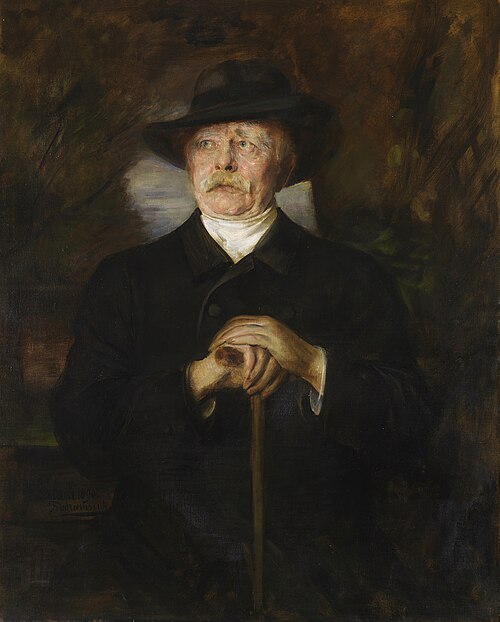
Illustration: Franz von Lenbach, Otto von Bismarck, 1890, oil on canvas. Public-domain artwork and faithful reproduction. Image record and attribution.
.jpg)
Franz von Lenbach (1836–1904) / Wikimedia Commons; Public domain. Image record, Public domain.
The round picture in the lists of the personalities is cropped from it.