



9 min read
Philosopher of Being
Parmenides of Elea
author: High Priest Zevios Metathronos
The Discipline of Truth
Dates: Born about 515 BCE by a conventional reconstruction; active in the early 5th century BCE; death date uncertain
Period: Classical, 500–334 BCE, by the period of his philosophical work
Parmenides of Elea wrote a single poem, and in it he asked what can truly be said of what is. Its argument holds that what is “is uncreated and indestructible,” and it pictures what is “like the mass of a rounded sphere, equally poised from the centre.”1
He also looked at the sky. He saw that the moon shines by light reflected from the sun, and he's credited with recognising the morning star and the evening star as 1 planet, Venus.2
Zevism reads his work under Dike, the Justice who keeps the keys of his poem's gates and who sits, in Hesiod, beside her father Zeus. A portrait inscription from Elea ties him to Apollo the Healer. His poem is a journey out of Night into light, and the Temple reads it by its doctrine of Light and Darkness.
LIFE AND CONTEXT
Elea was a Greek colony on the Tyrrhenian coast of southern Italy. Strabo tells how the Phocaeans, after Cyrus' general Harpagus captured Phocaea, “embarked with their entire families on their light boats,” were beaten off from Cyrnus and Massalia, and then “founded Elea.”3 The city was about 30 years old when Parmenides was born.4
His birth date comes from Plato. The dialogue Parmenides makes him about 65 at a visit to Athens when Socrates was “quite young then,” normally taken as about 20. Socrates was a little past 70 at his execution in 399 BCE, so Parmenides was born about 515 BCE. Palmer calls the visit “fictionalized.”4
The ancient tradition sets him among the thinkers of Magna Graecia, beside Xenophanes and the Pythagoreans, “whom he may well have encountered.” Strabo calls Elea “the native city of Parmenides and Zeno, the Pythagorean philosophers.”5
Aristotle placed him in a line of thinkers who held that all is one. Xenophanes was “the first of these partisans of the One (for Parmenides is said to have been his pupil).” Parmenides, Aristotle judged, “seems in places to speak with more insight.” He was “forced to follow the observed facts,” so for the world of the senses “he now posits two causes and two principles, calling them hot and cold, i.e. fire and earth.”6
He wrote a single poem. It “originally extended to perhaps eight hundred verses,” and about 160 survive, in fragments that run from 1 word to the 62 verses of fragment 8. Much of it survives because Simplicius, in the 6th century CE, had “a good copy of the work” and quoted it at length in his commentaries on Aristotle.4
The poem has 2 halves. The Goddess first teaches the way of truth, then “the opinions of mortals in which is no true belief at all.”7 In the 2nd half she promises “the substance of the sky, and all the signs in the sky,” the works of the sun and “the wandering deeds of the round faced moon.”8 Scholars still disagree on how the 2 halves fit together.9
His death date isn't known. His likeness was still honoured in his city 5 centuries later, when a portrait head of the 1st century CE was set up at Elea with his name on it.4
ATTAINMENTS
- He wrote a philosophical poem of perhaps 800 verses, of which about 160 survive; fragment 8 alone runs to 62 verses.10
- He set out the 2 ways of inquiry. The first is “that It is, and that it is impossible for it not to be,” and it is “the way of belief, for truth is its companion.”11
- He argued that what is can't come to be or pass away. Justice “doth not loose her fetters,” and “hard necessity keeps it in the bonds of the limit that holds it fast.”12
- He explained moonlight. Fragment 14 calls the moon “Shining by night with borrowed light, wandering round the earth,” and fragment 15 has her “Always looking to the beams of the sun.”13
- He gave the world of appearances 2 principles, which Aristotle calls “hot and cold, i.e. fire and earth.”14
- He's credited with identifying the morning star and the evening star as the planet Venus, a report preserved by Aëtius.15
- He gave laws to Elea. Plato's successor Speusippus is said to have reported that Parmenides “established the laws for the citizens of his native Elea.”4
- He taught Zeno, “his younger associate,” who travelled with him to Athens and read out his own book there.16
KEY STORIES
The Road to the Gates of Night and Day
The poem opens in motion. “The car that bears me carried me as far as ever my heart desired,” the speaker begins, on “the renowned way of the goddess, which alone leads the man who knows through all things.” “The wise steeds” drew the car, “and maidens showed the way.”17
The axle glowed in its socket and sang like a pipe. The maidens were daughters of the Sun, “hasting to convey me into the light,” and they “threw back their veils from off their faces and left the abode of Night.” They came to “the gates of the ways of Night and Day,” with a lintel above and a threshold of stone below, and “Avenging Justice keeps the keys that fit them.”7
The maidens “cunningly persuade” Justice to draw the bolts. The doors swung open on bronze posts, the chariot passed straight through, and “the goddess greeted me kindly, and took my right hand in hers.” Her first words set the terms: “It is no ill chance, but right and justice that has sent thee forth to travel on this way.”7 The poem never names her. Palmer suggests she's Night herself, since the youth goes to “the halls of Night” and she welcomes him to “our home.”18
The Visit to Athens
Plato sets a scene at the Great Panathenaea in Athens. Parmenides arrived with Zeno. He was “about 65 years old, very white with age, but well favoured,” and Zeno, near 40, was “tall and fair to look upon.” They lodged with Pythodorus “in the Ceramicus, outside the wall,” and Socrates, “then a very young man,” came to hear them.19
Zeno read his book aloud and had nearly finished when Parmenides walked in. Socrates went straight at the argument: “What is your meaning, Zeno? Do you maintain that if being is many, it must be both like and unlike, and that this is impossible?”20
The old man then questioned the young one about his ideas. Were there ideas, he asked, even of “hair, mud, dirt, or anything else which is vile and paltry”? Socrates admitted he was afraid he might “fall into a bottomless pit of nonsense, and perish.” Parmenides answered him: “that is because you are still young; the time will come, if I am not mistaken, when philosophy will have a firmer grasp of you, and then you will not despise even the meanest things.”21
The Lawgiver of Elea
Elea was a small city with strong neighbours. Strabo reports that it “was well governed,” and that this good government let its people hold their own against the Leucani and the Poseidoniatae and even come home victorious, “although they were inferior to them both in extent of territory and in population.” He gave some of the credit to “the influence of these men,” Parmenides and Zeno.3
The Academy remembered him the same way. Speusippus, Plato's successor, is said to have reported in his On Philosophers that Parmenides gave Elea its laws.4
In the 1960s excavators at Castellamare della Bruca, ancient Elea, found a portrait head of the 1st century CE. Its inscription reads: “Parmeneides, son of Pyres, Ouliadês, Natural Philosopher.” The title Ouliadês ties him to a cult of Apollo Oulios, Apollo the Healer.4
THE ZEVIST READING
Justice holds the keys in the poem, and the Goddess says “right and justice” sent the traveller. Hesiod names the same power: “virgin Justice, the daughter of Zeus,” who “sits beside her father” and “tells him of men's wicked heart.”22 In fragment 8, Justice holds what is in fetters so that it can't come to be or pass away. Zevism reads that as Dike at the root of being as well as of law, and Parmenides served her twice, in his argument and in the laws of Elea.
The poem moves out of the house of Night into the light, and yet the Goddess who teaches the truth may be Night herself. Zevism holds that unexplored darkness isn't evil. It's what one walks into carrying light, and explored darkness becomes knowledge. Parmenides did it in the sky as well: he looked at the moon “shining by night with borrowed light” and saw where the light came from.
The inscription from Elea calls him Ouliadês, and ties him to Apollo the Healer. Zevism doesn't need more than that to read him in Apollo's domain of measure and healing. His argument cures thought of a sickness, the habit of speaking of what is not as though it were something.
Plato, who gave him the leading part in a dialogue, set the aim that Zevism takes for its own: ὁμοίωσις θεῷ κατὰ τὸ δυνατόν, becoming like the divine “as far as possible.”23 Parmenides' traveller is taken by the hand and taught by a God. The Temple reads the proem as the pattern of that ascent: the mind goes through the gate that Justice guards, and the God receives it.
NOTES
4 Palmer, §1.
6 Aristotle, Metaphysics 1.5, tr. Ross.
7 Fragment B1.
8 Fragment B10.
11 Fragment B2.
12 Fragment B8.
13 Fragments B14, B15; Palmer, §2.4.
14 Aristotle, Metaphysics 1.5.
15 Palmer, §2.4.
16 Palmer, §1; Plato, Parmenides, opening narrative.
18 Palmer, §2.1.
19 Plato, Parmenides, opening narrative, tr. Jowett.
21 Plato, Parmenides, Parmenides to Socrates.
22 Hesiod, Works and Days 256–262.
BIBLIOGRAPHY
Parmenides, fragments B1, B2, B8, B10, B14 and B15, John Burnet translation from Early Greek Philosophy (1908), presented with the Diels fragment numbering by Lexundria.
John Palmer, “Parmenides”, Stanford Encyclopedia of Philosophy, substantive revision 4 March 2025; §§1–3, including 2.1 and 2.4.
Plato, Parmenides, translated by Benjamin Jowett, Internet Classics Archive, MIT; the opening narrative and Parmenides' questioning of Socrates.
Aristotle, Metaphysics, book 1, translated by W. D. Ross, Internet Classics Archive, MIT; chapter 5 (Part 5 on the page).
Strabo, Geography 6.1.1, translated by H. L. Jones, Loeb Classical Library, 1924, LacusCurtius.
Hesiod, Works and Days 256–262, translated by H. G. Evelyn-White, Theoi Classical Texts Library.
Plato, Theaetetus 176a–b, Greek text, Perseus Digital Library.
CREDIT
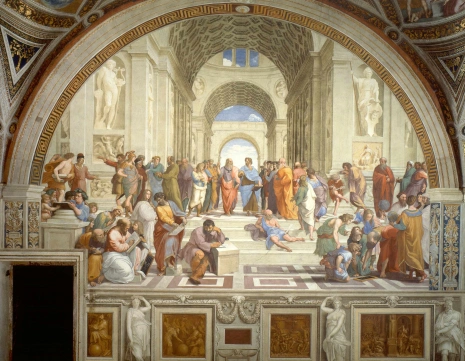
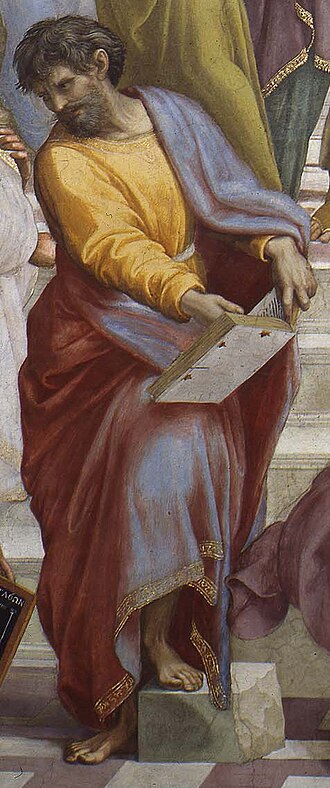
Image: A figure traditionally identified as Parmenides in Raphael’s School of Athens. This is a Renaissance interpretation, and the figure’s identification is not certain. Public domain. Image record.

Raphael, School of Athens detail; Wikimedia Commons, public domain. Image record, Public domain.
The round picture in the lists of the personalities is cropped from it.