



9 min read
Great Romantic Poet
Percy Bysshe Shelley
author: High Priest Zevios Metathronos
The Light and Sympathy of Poetry
Dates: 1792–1822 CE
Period: Imperial Era, 1804–1900
Hymns of Apollo and Pan: 1820, published 1824
Percy Bysshe Shelley was an English poet who drowned at 29 and left behind Prometheus Unbound, Adonais, Hellas, “Ozymandias” and A Defence of Poetry. He gave the Greek Gods their own voices in English. In 1820 he wrote the songs of Apollo and Pan for Mary Shelley's drama Midas, and in the same year he turned the Homeric Hymn to Hermes into ottava rima.1
His largest claim is in prose. The Defence argues that goodness grows from imagination: “A man, to be greatly good, must imagine intensely and comprehensively; he must put himself in the place of another and of many others.”2
Shelley was an avowed atheist, and Oxford expelled him in 1811 over a pamphlet called The Necessity of Atheism. Zevism reads his work as service to Apollo, God of poetry and light, and as a return to the Hellenic source he named himself: “We are all Greeks.”
LIFE AND CONTEXT
Shelley was born on 4 August 1792 at Field Place, near Horsham in Sussex, the son of Timothy and Elizabeth Shelley.3 He entered Eton at 12 in 1804, and the boys there called him “Mad Shelley” and “Shelley the atheist.”4
He came up to University College, Oxford, in 1810. An anonymous pamphlet, The Necessity of Atheism, “had been studiously sent to most of the dignitaries of the University & to others.” On 25 March 1811 the Master and Fellows called Shelley in. He “was asked if he could or would deny the obnoxious production as his. No direct reply was given.” His friend Thomas Jefferson Hogg declared that he was “equally implicated” and asked for his share of the penalty. The college expelled both “for contumacy in refusing to answer certain questions put to them.”5
That August he married Harriet Westbrook in Edinburgh. On 27 July 1814 he eloped with Mary Godwin, and they married on 30 December 1816.6
In March 1818 the Shelleys moved to Italy with their children and Claire Clairmont. He didn't expect Prometheus Unbound (1820) “to sell more than 20 copies.” The stirrings of Greek independence moved him to write Hellas (1822), which he dedicated to Prince Mavrocordato.6
On 8 July 1822 he was lost at sea off Livorno, sailing in his boat the Don Juan with Edward Williams. Their bodies washed ashore on 18 July. His ashes lie near Keats in the Protestant Cemetery at Rome.7
ATTAINMENTS
- He published “Ozymandias” in The Examiner, no. 524, on 11 January 1818, under the pen name “Glirastes.”8
- He translated Plato's Symposium at Bagni di Lucca between 7 and 17 July 1818, working on it daily. Mary later published it as The Banquet.9
- In 1820 he “translated and freely expanded into playful ottava rima the Hymn to Mercury,” the Homeric hymn to Hermes.10
- He wrote the “Hymn of Apollo” and the “Hymn of Pan” for the singing contest in Mary Shelley's Midas (1820). Mary printed both in Posthumous Poems in 1824.11
- He mourned Keats in Adonais, an elegy of 55 Spenserian stanzas.6
- He answered Peacock's essay “The Four Ages of Poetry” (1820) with A Defence of Poetry, which ends: “Poets are the unacknowledged legislators of the world.”12
- He opened the preface to Hellas with a claim for the whole of Europe: “We are all Greeks. Our laws, our literature, our religion, our arts have their root in Greece.”6
KEY STORIES
The Sonnet Contest at Marlow
Diodorus Siculus had described the tomb of a king he called Osymandyas at Thebes, with a colossal seated statue and an inscription: “King of Kings am I, Osymandyas. If anyone would know how great I am and where I lie, let him surpass one of my works.”13
In 1816 Henry Salt and his agent Giovanni Belzoni took the head of a colossal statue of Ramesses II from the Ramesseum. Cut from a single block of granite and granodiorite, it still weighs about 7¼ tons. It reached London in 1818, and its discovery and journey were widely reported. Shelley probably never saw it. The British Museum records that the news set Shelley and his friend Horace Smith to a friendly rivalry: each wrote and published a poem on the subject.14
Shelley wrote his sonnet at Marlow, and it came out first, in The Examiner of 11 January 1818. Smith's followed on 1 February. Shelley's traveller finds 2 legs of stone in the desert and a broken face, and on the pedestal these words: “My name is Ozymandias, King of Kings, / Look on my Works ye Mighty, and despair!” The poem answers in 3 lines: “Nothing beside remains. Round the decay / Of that colossal Wreck, boundless and bare / The lone and level sands stretch far away.”15
Apollo and Pan Before Tmolus
In 1820 Mary Shelley wrote 2 short verse dramas on Greek myths, Proserpine and Midas, and Percy wrote songs for both.16 Midas stages the old contest. Tmolus sits as judge on a bare hill, and Apollo and Pan sing in turn.
Pan's song begins with a crowd of listeners: “From the forests and highlands / We come, we come.” It rises to “the dancing stars” and “the daedal Earth,” then turns to Pan's own loss: “I pursu'd a maiden and clasp'd a reed. / Gods and men, we are all deluded thus!”17
Apollo's song ends with a claim on everything bright: “I am the eye with which the Universe / Beholds itself & knows it is divine. / All harmony of instrument or verse, / All prophecy, all medecine is mine.” Tmolus gives the verdict at once: “Phœbus, the palm is thine.” Midas dissents: “Your sprightly song in melody outweighs / His drowsy tune.” Apollo's reply is short. “Have asses' ears!”18
10 Days with the Symposium
The Shelleys spent the summer of 1818 at Bagni di Lucca, in the hills of Tuscany. The work began, as Amanda Blake Davis tells it, in “the despair of producing any thing original,” and Shelley turned to Plato. He began translating the Symposium on 7 July and worked at it every day until he finished on 17 July. Mary copied it out between 19 July and 6 August.9
On 10 July he wrote to the Gisbornes that he meant “to give Mary some idea of the manners & feelings of the Athenians.” He began an essay on the Greeks to go with it, arguing that love for them was “a profound and complicated sentiment.”19 The speeches of Aristophanes, Agathon and Diotima reached English readers in Shelley's words, and Mary judged that the version “for the first time introduces the Athenian to the English reader.”
The Pyre on the Shore at Via Reggio
Italian quarantine laws required that bodies washed ashore be burned, and Edward Trelawny took charge, with Byron and Leigh Hunt present.6 Having burned Williams the day before, Trelawny's party rowed “down the little river near Via Reggio to the sea” with the same boats and gear. Trelawny set down the view: “The sea, with the islands of Gorgona, Capraji, and Elba, was before us.”20
“We threw frankincense and salt into the furnace, and poured a flask of wine and oil over the body.” Trelawny noted that “more wine was poured over Shelley's dead body than he had consumed during his life.” Then he gave the reason for 1 omission: “The Greek oration was omitted, for we had lost our Hellenic bard.”20
Byron couldn't watch to the end; he “withdrew to the beach and swam off to the ‘Bolivar.’” When the fire died, “the heart remained entire.” Trelawny pulled it out: “In snatching this relic from the fiery furnace, my hand was severely burnt.” He collected the ashes in a box and took them on board.20
THE ZEVIST READING
Shelley didn't worship the Gods, and the Temple doesn't claim him. It reads his work by what it served. The line he gave Apollo, “I am the eye with which the Universe / Beholds itself & knows it is divine,” states the Zevist doctrine of Light in a poet's words. Darkness that no one has entered isn't evil; it's unexplored, and the light carried into it becomes knowledge. Apollo is that carrying light, and Shelley gave him an English voice equal to the claim.
The 2nd strand is the return to the source. Shelley went back to the Greek himself: the Symposium at Bagni di Lucca, the Homeric Hymn to Hermes recast in ottava rima, the myths of Proserpine and Midas worked into song. Zevism holds that knowledge evolves in transmission but the source keeps priority. “We are all Greeks,” Shelley wrote, and the preface to Hellas goes on to root law, letters, religion and art in Greece. The Temple reads that sentence as a statement of the chain.
The Defence supplies the 3rd strand, the ethical dimension of the path, Φρόνησις and Justice. Shelley called love “a going out of our nature, and an identification of ourselves with the beautiful which exists in thought, action, or person, not our own.”2 A judge who can't imagine the person before him can't do justice to that person, and Zevism counts the training of imagination as part of the training of right judgment.
Pan's song adds a note that Apollo's lacks. A God who pursues and loses, and says so to the listeners, gives grief a form another person can share: “Gods and men, we are all deluded thus!” Zevism doesn't ask the poet to choose between the 2 singers. Apollo's measure and Pan's lament belong to the same order.
Trelawny's phrase fits the case. The friends who burned Shelley's body called him “our Hellenic bard,” and the Temple gives him that title on the evidence of the work.
NOTES
1 Britannica, “Percy Bysshe Shelley”; Scully, “The Homeric Hymns and George Chapman's Translation”.
2 Shelley, A Defence of Poetry.
3 Britannica.
4 Poetry Foundation, “Percy Bysshe Shelley”.
5 University College, Oxford, “Tales from the Archives: Shelley and Univ”.
7 Britannica; Poetry Foundation.
8 Representative Poetry Online, “Ozymandias”.
9 Davis, “Shelley translates Plato's Symposium”.
10 Scully, “The Homeric Hymns”.
11 RPO, “Hymn of Pan”; Koszul, Proserpine and Midas, introduction.
12 Poetry Foundation; A Defence of Poetry.
13 Diodorus Siculus 1.47.4, tr. Oldfather.
14 British Museum, “Ramesses II statue”.
16 Koszul, Proserpine and Midas, introduction, section 1.
17 RPO, “Hymn of Pan,” lines 1–2, 25–36.
18 Mary Shelley, Midas, ed. Koszul.
19 Davis.
20 Trelawny, Recollections, ch. 12.
BIBLIOGRAPHY
Donald H. Reiman, “Percy Bysshe Shelley”, Encyclopaedia Britannica; birth at Field Place, death off Livorno.
Poetry Foundation, “Percy Bysshe Shelley”, biography: Eton, marriages, Italy, Prometheus Unbound, Adonais, Hellas and its preface, the Defence, death and burial.
University College, Oxford, “Tales from the Archives: Shelley and Univ”, 17 June 2022; college register of 25 March 1811.
Percy Bysshe Shelley, A Defence of Poetry, Poetry Foundation text.
Percy Bysshe Shelley, “Ozymandias”, The Examiner, no. 524, 11 January 1818; Representative Poetry Online, University of Toronto, text and notes.
Percy Bysshe Shelley, “Hymn of Pan”, Posthumous Poems, edited by Mary Shelley, 1824; Representative Poetry Online, University of Toronto, complete text and notes.
Mary Shelley, Proserpine and Midas, edited by A. Koszul, 1922; introduction §I and the text of Midas.
Diodorus Siculus, Library of History 1.47.4, translated by C. H. Oldfather, Loeb Classical Library, 1933; LacusCurtius.
British Museum, “Ramesses II statue: everything you need to know”, the “Younger Memnon”.
Amanda Blake Davis, “On This Day in 1818: 17 July, Percy Bysshe Shelley translates Plato's Symposium”, British Association for Romantic Studies, 17 July 2018.
Stephen Scully, “The Homeric Hymns and George Chapman's Translation”, Princeton University Press, introductory chapter.
Edward John Trelawny, Recollections of the Last Days of Shelley and Byron, ch. 12, 1858; Lord Byron and his Times.
CREDIT
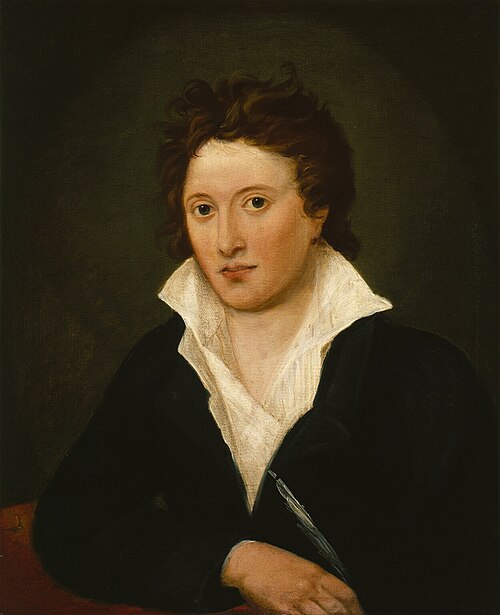
Image: Portrait of Shelley after Amelia Curran’s 1819 likeness, National Portrait Gallery, NPG 1234. Commons records the reproduction as public domain.

After Amelia Curran / Wikimedia Commons; Public domain (Commons PD-Art). Image record, Public domain (Commons PD-Art).
The round picture in the lists of the personalities is cropped from it.